
Last Updated 2 months ago by Kenya Engineer
The most important part of an artificial-intelligence service is often the part its users never see.
Behind the chatbot, coding assistant or automated business system sits a large computing infrastructure: processors, high-bandwidth memory, networks, storage, cooling equipment and power systems. The competition to control that infrastructure is now drawing Microsoft deeper into semiconductor design.
Reuters reported on 10 August 2026, citing The Information and unnamed sources, that Microsoft could unveil a Maia 300 artificial-intelligence accelerator as early as September. The report said the company was discussing substantial future manufacturing capacity with Taiwan Semiconductor Manufacturing Company. Microsoft has not publicly confirmed Maia 300’s launch date or technical specifications. (Reuters, 10 August 2026)
That distinction matters. Maia 300 is, for now, a reported product plan rather than an announced processor. The significance of the story lies in the direction it points.
Microsoft, Google and Amazon are designing more of the silicon used inside their cloud platforms. Custom chips can be optimised around their own software and workloads, giving cloud operators greater control over performance, power consumption, supply and cost. They also reduce—but do not eliminate—dependence on Nvidia’s widely used AI processors.
What Maia 200 already tells us
Microsoft formally introduced Maia 200 in January 2026 as an accelerator designed primarily for inference—the stage at which a trained AI model processes a request and generates an answer.
The chip is manufactured using TSMC’s three-nanometre process and contains more than 140 billion transistors. Microsoft says it has 216GB of HBM3e high-bandwidth memory, memory bandwidth of seven terabytes a second and 272MB of on-chip SRAM. It delivers more than ten petaFLOPS at four-bit precision within a stated 750-watt system-on-chip power envelope. (Microsoft, 26 January 2026)
Those are manufacturer specifications and performance claims. Independent workload comparisons will remain important because headline computing figures do not fully describe model accuracy, utilisation, software maturity or total operating cost.
The architecture nonetheless shows where AI infrastructure is going. Lower-precision computation can accelerate inference while reducing memory and energy requirements. Large amounts of fast memory keep model data close to the processor. Clusters connect thousands of accelerators through high-speed networks.
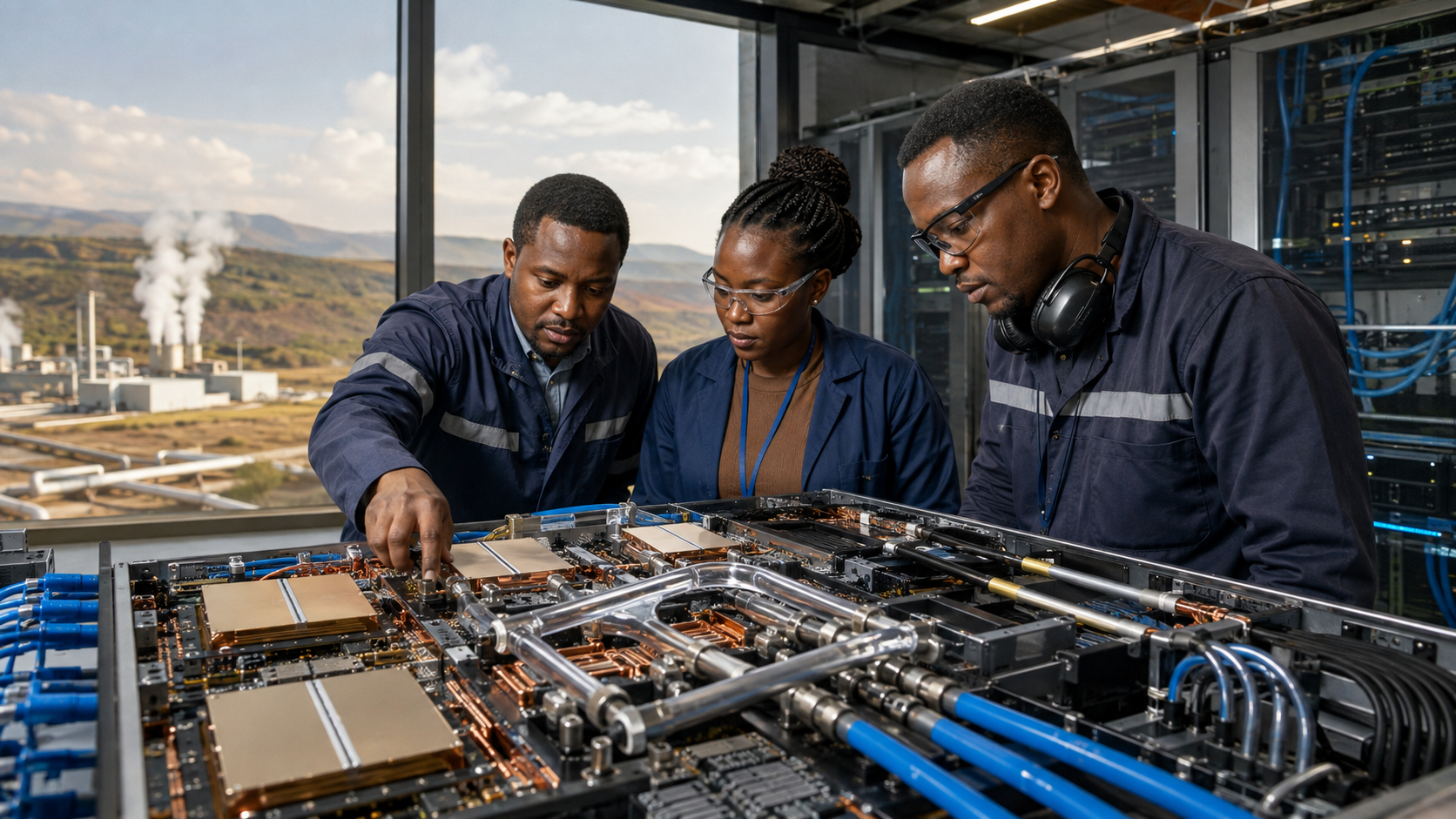
The processor cannot be evaluated separately from the facility around it. Microsoft’s Maia 200 deployment uses a second-generation closed-loop liquid-cooling system. At dense rack scale, conventional air cooling becomes increasingly difficult and power distribution must handle large, rapidly changing loads.
Kenya Engineer has previously examined this shift through new modular and liquid-cooling systems designed for racks exceeding 50kW and, in some configurations, 100kW. (Kenya Engineer, 15 January 2026)
Kenya’s connection is infrastructure, not chip manufacturing
Kenya is unlikely to manufacture processors at the leading three-nanometre node in the foreseeable future. That does not make the semiconductor contest remote.
Microsoft and G42 announced a proposed $1 billion digital-infrastructure initiative for Kenya in May 2024. The plan included a data-centre campus at Olkaria powered by geothermal energy and an East Africa Azure cloud region, subject to definitive agreements and implementation milestones. (Microsoft and G42 announcement)
Kenya Engineer subsequently reported that KenGen was preparing to host the campus in its Olkaria Green Energy Park. The 2024 announcements set ambitious schedules, but an announcement or letter of intent should not be treated as proof of current construction or operational status without a fresh project update. (Kenya Engineer, 10 July 2024)
If an Azure region is ultimately developed in Kenya, custom accelerators such as Maia could influence the price and availability of AI computing accessible to local firms. The chips would not necessarily be deployed in Kenya immediately; Microsoft began Maia 200 deployment in United States data-centre regions. Cloud architecture allows Kenyan customers to consume computing capacity located elsewhere.
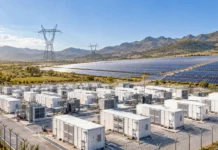
The more durable Kenyan opportunity lies in building the surrounding capability: renewable power, high-voltage connections, fibre routes, cooling engineering, water stewardship, cybersecurity, cloud operations and software capable of using specialised hardware efficiently.
Cheap computation is not the same as local capability
Custom silicon may lower Microsoft’s cost of generating AI responses. Whether those savings reach Kenyan users will depend on cloud pricing, competition, exchange rates, connectivity and the availability of local infrastructure.
There is also a strategic concern. When processors, cloud platforms and foundational models are controlled by a small number of foreign companies, local organisations can become dependent on technical and commercial decisions made elsewhere.
Kenya therefore needs a layered AI strategy. Access to global cloud infrastructure is important, but so are portable software, open standards, strong local data governance and the ability to move workloads between providers. Universities should teach accelerator programming, distributed systems, thermal engineering and data-centre power alongside model development.
Reliable renewable electricity could give Kenya an advantage as AI computing becomes more energy-intensive. Geothermal generation is especially attractive because it can provide low-carbon power throughout the day. That advantage will only count if transmission capacity, power quality and project execution keep pace with investor interest.
Maia 300 may arrive in September, later, or in a different form from that currently reported. Its unconfirmed specifications are less important to Kenya than the industrial shift it represents.
The cloud is becoming a vertically integrated engineering system extending from semiconductor design to software and electricity supply. Kenya’s place in that system will depend on whether it remains primarily a purchaser of AI services—or develops the infrastructure and people needed to shape how those services are built and operated.

-
Product on sale
 AWEBook Volume 2Original price was: KShs 3,500.00.KShs 3,000.00Current price is: KShs 3,000.00.