
Last Updated 2 months ago by Kenya Engineer
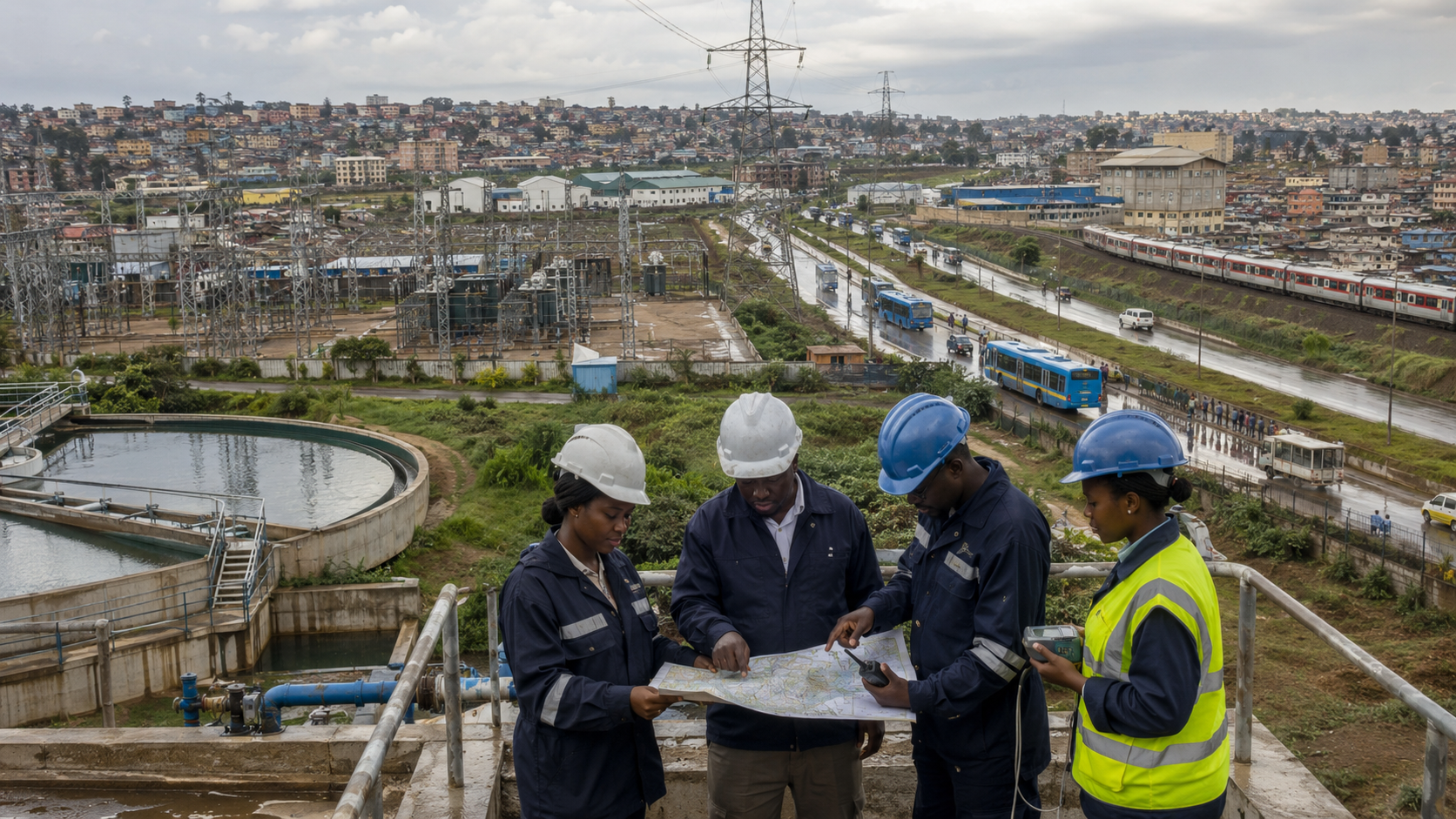
Africa’s sustainable-development challenge is often discussed as a shortage of finance. It is also a problem of engineering delivery.
The 2026 Africa Sustainable Development Report examines five closely connected goals: water and sanitation; affordable and clean energy; industry, innovation and infrastructure; sustainable cities; and partnerships. It was prepared jointly by the African Union Commission, UNECA, the African Development Bank and UNDP. (UNDP, 15 July 2026)
The selection is revealing. A city cannot be sustainable when its water utility is failing. A manufacturer cannot become competitive without dependable electricity and transport. Water utilities need power to pump and treat water. Expanding all these systems requires institutions, finance, technical skills and reliable data.
They are not five separate policy conversations. They are one infrastructure system.
The numbers describe a service crisis
At the Africa Regional Forum on Sustainable Development, UNDP reported that progress is slow on 12 Sustainable Development Goals and moving backwards on five.
Approximately 600 million Africans—about 43 per cent of the continent’s population—still lack access to electricity. Of the 28 countries worldwide in which more than a quarter of the population lacked basic drinking-water access between 2015 and 2024, 24 are in sub-Saharan Africa.
The estimated annual financing gap for achieving Africa’s SDGs now ranges from $670 billion to $848 billion. (UNDP, April 2026)
These are continental figures, and conditions vary widely between countries. Even so, they expose the scale of the implementation problem. At current rates, building more individual projects without improving the institutions that operate them will leave much of the gap intact.
Electricity access, for example, is not fully described by counting connections. A household or business may be connected but experience poor voltage, frequent interruptions or tariffs it cannot afford. Water coverage does not reveal whether water is safe or flows every day.
Engineering performance begins where the access statistic ends.
Kenya’s water challenge illustrates the gap
Kenya has expanded major water and electricity infrastructure, but service deficits remain.
A World Bank assessment published in October 2024 estimated that about 20 million Kenyans lacked basic drinking water, 34 million lacked basic sanitation and 33 million lacked basic hygiene services. It placed the water-sector financing gap at approximately $3.5 billion. (World Bank)
Money is clearly needed. It will produce limited results, however, if utilities continue losing treated water through leaking pipes, illegal connections or inaccurate metering.
Kenya’s Water Services Regulatory Board provides a useful model for measuring the problem. Its Impact reports assess water providers using indicators that include coverage, water quality, hours of supply, non-revenue water, metering, revenue collection, operating-cost coverage and staff productivity. The latest edition, Impact 18, covers the 2024/25 period. (WASREB Impact reports)
This is the kind of evidence that should guide investment decisions. A new treatment plant may increase production, but replacing leaking mains or improving pressure management may sometimes deliver water to more consumers at lower cost.
Infrastructure needs operating institutions
Africa’s infrastructure debate tends to privilege visible construction. New dams, power stations, roads and industrial parks photograph well. Asset management, preventive maintenance, leakage detection, substation protection and laboratory quality control rarely attract the same public attention.
They determine whether the assets continue functioning.
Projects should therefore be assessed across their full life cycle: planning, design, procurement, construction, commissioning, operation, maintenance and eventual rehabilitation. Governments that budget for construction without securing operating revenue are postponing failure rather than preventing it.
The report’s emphasis on partnerships must also go beyond raising money. Effective partnerships should build the capacity of local utilities, regulators, universities, engineering firms and manufacturers. Infrastructure financed externally but dependent indefinitely on foreign maintenance expertise leaves a country vulnerable.
Kenya Engineer’s coverage of Africa Engineering Week 2025 reached a related conclusion: African countries need locally grounded engineering capability to turn innovation and infrastructure into sustainable development. (Kenya Engineer)
Cities are where the systems meet
Rapid urbanisation makes coordination more urgent. Housing developments affect demand for water, sanitation, power and transport simultaneously. When those networks are planned separately, cities inherit congestion, overloaded sewers, unplanned boreholes and costly retrofits.
County spatial plans should therefore be connected to investment plans for utilities and transport agencies. Development approvals should consider available infrastructure capacity, not only the layout of an individual property.
Digital systems can help utilities monitor pressure, consumption, outages and asset condition, but technology cannot correct unclear responsibility or weak maintenance culture. Data are useful when institutions act on them.
From targets to engineering outcomes
The 2030 deadline is close enough that institutional language about “accelerating progress” is no longer sufficient. Governments need to identify which interventions can materially improve service within the remaining period while protecting longer-term investment.
For Kenya, that means reporting not only kilometres of pipe or megawatts installed, but also hours of water supply, non-revenue water, electricity reliability, industrial energy costs, infrastructure condition and the proportion of urban wastewater safely treated.
The 2026 report does not offer a simple engineering solution to Africa’s development shortfall. Its value lies in showing that water, energy, industry and cities are failing or advancing as connected systems.
The continent’s next phase of development will depend on financing. It will depend just as heavily on design quality, operational discipline, maintenance and accountable institutions. Those less glamorous measures are where sustainable development either becomes a daily service—or remains a distant target.
-
Product on sale
 AWEBook Volume 2Original price was: KShs 3,500.00.KShs 3,000.00Current price is: KShs 3,000.00.