Last Updated 1 month ago by Kenya Engineer
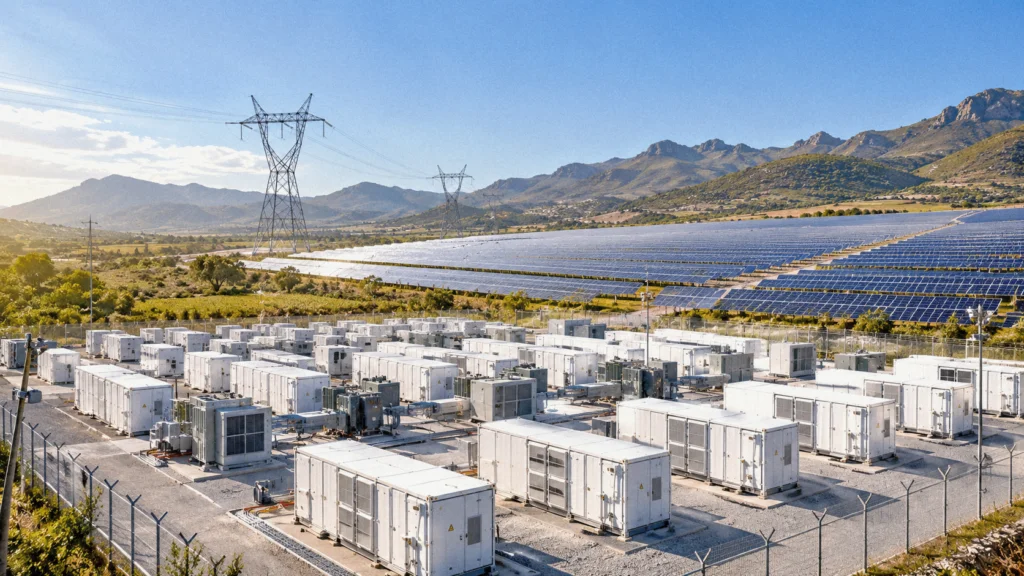
South Africa is putting battery storage and gas-to-power at the centre of its next major electricity procurement programme, prioritising 9,600MW of new capacity as it seeks to reduce renewable-energy curtailment and make the power system more flexible.
Electricity and Energy Minister Kgosientsho Ramokgopa announced on October 7 that the first Section 34 determination under the country’s Integrated Resource Plan 2025 will prioritise 4,600MW of battery energy storage systems (BESS) and 5,000MW of gas-to-power.
The decision is notable for what it does not include.
The first procurement determination contains no new wind or solar capacity. The government says a subsequent determination will address those technologies, including hybrid renewable projects combined with energy storage and longer-term pumped storage.
The immediate priority is to make better use of electricity already available to the grid while adding flexible capacity that can respond when demand rises or renewable generation falls.
For an electricity system increasingly reliant on variable renewable generation, the change reflects a shift in focus from adding megawatts of generation to managing when those megawatts are available.
The problem is no longer only generation
South Africa’s electricity system has been undergoing a major change. Large amounts of solar and wind generation have been added to the grid, while the country continues to deal with the reliability problems associated with its ageing coal fleet.
The result is an increasingly complex operating environment.
At certain times, renewable generators can produce more electricity than the grid can absorb. When this happens, some available generation has to be reduced or switched off. This is known as curtailment.
South Africa’s Department of Electricity and Energy says increasing curtailment is adding pressure to system costs because electricity that could otherwise serve consumers is left unused while infrastructure and contractual costs remain.
The problem is particularly relevant in areas with strong solar and wind resources but limited transmission capacity.
Building more renewable generation does not automatically solve the problem if the grid cannot move the electricity to where it is needed or if there is insufficient demand at the time the electricity is generated.
That is where the new storage programme comes in.
Why 4,600MW of batteries?
Battery storage changes the timing of electricity. A battery can charge when electricity is abundant and discharge when the system needs additional power.
In South Africa’s case, the government wants batteries to absorb electricity that might otherwise be curtailed and release it during evening peaks or other periods when demand is higher.
The Department of Electricity and Energy says the batteries will also provide rapid balancing and grid-support services.
This is different from simply adding another power station.
A conventional generator primarily adds generation capacity. A battery can provide several grid services depending on its design, location and control system.
It can absorb excess electricity, discharge during periods of high demand and respond rapidly to changes in system conditions.
The location of the batteries will also be important.
The government says storage must be positioned where it can access surplus electricity and discharge it without reproducing the network constraint that caused the original curtailment. Procurement will consequently be aligned with the charging and discharge requirements of the system operator.
In other words, 4,600MW of batteries placed in the wrong locations would not solve the underlying grid problem.
South Africa is not starting from zero
The new programme is a substantial expansion of an existing battery-storage market.
By June 2025, all five projects in South Africa’s first battery-storage bid window, with a combined capacity of 513MW, had reached commercial close and entered construction. The projects attracted approximately R15.4 billion in investment, according to the Department of Electricity and Energy.
The country’s Integrated Resource Plan 2025 had already identified storage as an important component of the future electricity system.
The plan includes additional storage capacity to support the grid and unlock generation from renewable-resource areas where transmission constraints have become increasingly important.
The new 4,600MW allocation is consequently not a move from a fossil-fuel system directly to batteries.
It is an expansion of a technology that is already entering the South African grid.
Why add 5,000MW of gas?
Batteries cannot perform every function required by a national electricity system.
Their ability to supply electricity is limited by the amount of energy stored in the battery and by the duration for which the system needs that electricity.
Gas-to-power provides another form of flexibility.
The proposed 5,000MW gas allocation is intended to provide dispatchable electricity when renewable generation falls or electricity demand increases.
Gas generators can be operated when needed and reduced when renewable generation is sufficient.
The government’s procurement approach will consequently consider start-up times, ramping capability and minimum operating levels alongside fuel availability and delivered gas prices.
That makes the proposed gas capacity different from the role traditionally associated with large baseload plants.
The value of these plants will depend heavily on how flexibly they can operate.
The engineering problem is timing
The most interesting aspect of South Africa’s decision is that it is fundamentally about timing.
Consider a simplified electricity system. At midday, solar generation may be high while demand is moderate. Without sufficient storage or transmission capacity, some solar electricity may have to be curtailed.
Several hours later, solar production falls while household and commercial demand rises.
A battery can charge during the period of excess supply and discharge later.
If the demand continues into a longer period when renewable generation is insufficient, flexible gas generation can provide additional electricity.
The combination is intended to make variable renewable generation more useful without requiring the system to maintain an equivalent amount of conventional generation running continuously.
This is increasingly becoming one of the central engineering challenges of renewable-heavy electricity systems.
The question is no longer only: How many megawatts can we generate? It is also: How quickly can those megawatts be delivered, where are they needed and for how long?
Transmission remains critical
Storage cannot remove every constraint on the electricity network.
If a renewable plant is producing electricity in an area where the transmission network is already congested, a battery can absorb some of that surplus. But the system will still need adequate transmission capacity to move electricity from generation areas to major centres of demand.
The South African government has consequently linked the storage and gas procurement programme to transmission expansion, industrial electricity demand and regional electricity trading.
This is an important point for countries across Africa. Generation, storage and transmission cannot be planned independently.
A large solar plant without transmission capacity may produce electricity that cannot reach consumers. A large battery in an unconstrained location may have limited value. A gas plant without adequate fuel infrastructure may not be available when the grid needs it.
Infrastructure planning increasingly has to consider these systems as an integrated network.
What happens to wind and solar?
The absence of new wind and solar from the first determination could easily be interpreted as a reversal of South Africa’s renewable-energy strategy.
The government’s position is different.
The Department of Electricity and Energy says a subsequent determination will address wind and solar, including hybrid projects coupled with storage, as well as longer-term pumped-storage development.
The sequencing is the important part.
South Africa is attempting to address the immediate flexibility and curtailment problem before adding another large wave of variable generation.
The strategy recognises that renewable generation has limited value if the electricity system cannot accommodate or deliver it.
That does not make batteries a substitute for wind and solar. It makes storage part of the infrastructure required to integrate them at scale.
The role of gas is more complicated
Gas-to-power introduces a different set of engineering and financial questions. A 5,000MW gas programme requires more than generating units.
It requires a fuel supply chain.
That includes gas availability, pipelines or other transportation infrastructure, storage where required, import facilities if domestic supply is insufficient, and reliable connections to the electricity transmission network.
The government has specifically said that fuel availability, delivered gas prices, port and pipeline infrastructure, grid connections and commissioning schedules will need to be assessed together.
The economics will also depend on how often the plants operate.
A gas plant designed primarily to provide flexibility may operate fewer hours than a conventional baseload generator, but it still needs to recover its capital and fixed operating costs.
The procurement structure will consequently need to reflect the actual role the plants are expected to perform.
A new market for engineers
The programme could create significant opportunities across South Africa’s engineering and construction sectors.
Battery projects require electrical and power-system engineering, civil works, control systems, protection equipment, thermal management, fire-safety systems and sophisticated energy-management software.
Gas-to-power projects bring requirements for mechanical and electrical engineering, turbines, generators, fuel systems, pipelines, water systems, emissions controls and grid connections.
Transmission projects will have to develop alongside both.
There is also a growing role for engineers who can work across the boundaries between generation, storage and network operations.
The old model of designing an individual power plant in isolation is becoming less useful as electricity systems become more interconnected.
Storage also creates a new manufacturing opportunity
South Africa’s government says the procurement programme will include measurable commitments around local manufacturing, engineering, construction, skills development and broader ownership of energy infrastructure.
That could become significant if the battery programme develops into a sustained procurement market rather than a single round of projects.
Battery storage requires equipment ranging from cells and modules to power-conversion systems, transformers, switchgear, protection systems and control platforms.
Even where battery cells are imported, a significant portion of project engineering, construction, integration, operations and maintenance can take place locally.
The same applies to gas infrastructure. The scale of the proposed programme could consequently create a market for South African engineering companies well beyond the power plants themselves.
What Kenya can learn
South Africa’s experience is relevant to Kenya even though the two electricity systems are very different. Kenya already has a relatively diverse generation mix, with geothermal providing firm generation alongside hydro, wind and solar.
The country is also expanding variable renewable generation and faces its own transmission constraints and changing demand patterns. The South African decision highlights an issue that will increasingly confront power systems across Africa.
Adding renewable generation is only one part of an energy transition.
Countries also need transmission, storage, flexible generation, accurate forecasting, modern control systems and electricity markets capable of responding to changing supply conditions.
Kenya’s electricity planners will have to consider the same question as renewable capacity expands: How much electricity can the grid actually use at the time it is produced?
From megawatts to system flexibility
South Africa’s 9,600MW procurement programme is not simply a decision to build more power stations. It represents a recognition that the architecture of the electricity system is changing.
The 4,600MW of battery storage is intended to shift electricity through time and provide rapid grid support.
The 5,000MW of gas is intended to provide dispatchable power when renewable generation is unavailable or demand rises.
Transmission expansion is needed to connect these resources to consumers.
And additional wind and solar capacity will eventually require the system to become even better at managing variability.
The result is a power system in which the value of an asset increasingly depends on what it can do for the whole grid, rather than simply how many megawatts appear on its nameplate.
For South Africa, the next phase of the energy transition is becoming less about choosing between technologies and more about engineering a system in which different technologies can work together.
That may be the more important lesson from the country’s decision to put 4,600MW of batteries and 5,000MW of gas at the front of its next electricity procurement programme.
-
Product on sale
 AWEBook Volume 2Original price was: KShs 3,500.00.KShs 3,000.00Current price is: KShs 3,000.00.