Last Updated 1 hour ago by Kenya Engineer
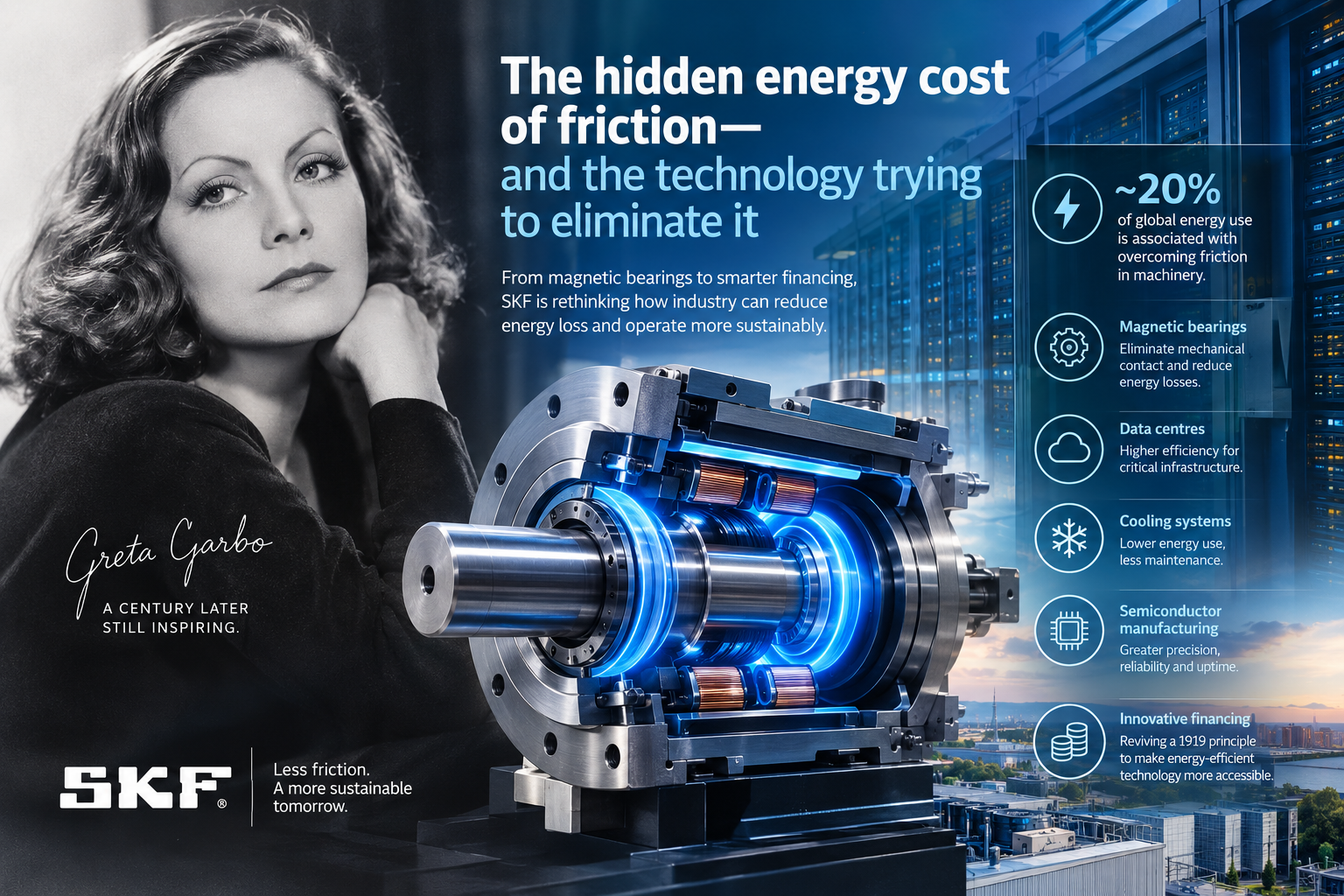
More than a century after Greta Garbo appeared in one of SKF’s early promotional films, the Swedish engineering company has brought the Hollywood icon back using artificial intelligence. This time, however, Garbo is not being used simply to sell bearings. She is being used to draw attention to a very modern engineering challenge: how to reduce the enormous amount of energy consumed by friction in industrial machinery.
SKF says around 20 per cent of global energy use is associated with overcoming friction in machinery and industrial processes. While the precise figure depends on how friction-related energy consumption is defined and measured, the underlying engineering problem is unquestionable. Whenever two surfaces move against one another, energy is dissipated, components wear and heat is generated.
The industrial response has traditionally been better bearings, improved lubrication, better materials and more sophisticated maintenance. SKF is now pushing that principle further with magnetic bearings that allow rotating shafts to operate without physical contact with the bearing.
When the bearing does not touch the shaft
Conventional bearings support a rotating shaft while allowing it to turn. Even highly engineered rolling-element and fluid-film bearings involve mechanical or fluid interaction that produces some degree of resistance, heat and wear.
Magnetic bearings take a fundamentally different approach.
Instead of supporting the rotating shaft through physical contact, electromagnetic forces suspend it within a magnetic field. Sensors continuously monitor the position of the shaft, while a control system adjusts the magnetic forces to keep it precisely centred as it rotates.
The result is a rotating assembly in which the shaft and bearing do not have to make physical contact.
That distinction is important because eliminating mechanical contact can remove several of the problems associated with conventional bearing arrangements. There is no bearing surface rubbing against the shaft, substantially less wear and, in suitable applications, reduced dependence on lubrication.
The technology is particularly interesting for machinery operating at high speed or continuously, where even relatively small sources of energy loss can accumulate into significant operating costs over thousands of hours.
SKF says its magnetic-bearing technology is being used in applications including data centres, cooling systems and semiconductor manufacturing.
These are precisely the kinds of environments in which equipment availability and energy efficiency matter. A cooling system operating around the clock, for example, can consume substantial amounts of electricity over its operating life. Even a modest reduction in losses can therefore become significant when multiplied across continuous operation.
The data-centre connection
The significance of magnetic bearings extends beyond the bearing itself.
Data centres are becoming increasingly important consumers of electricity as cloud computing, artificial intelligence and other digital services expand. Much of the attention surrounding their energy consumption focuses on servers, processors and the electricity used to power computing equipment.
But the supporting infrastructure is equally important.
Servers generate heat, and that heat must be removed continuously. Cooling systems rely on compressors, pumps, fans and other rotating machinery. Any reduction in the energy required by those machines can contribute to reducing the overall energy intensity of a data centre.
This is where technologies such as magnetic bearings become part of a much broader engineering question.
The challenge is no longer simply how to make an individual component more efficient. It is how to reduce the energy required to operate entire industrial systems.
The same principle applies to manufacturing, refrigeration, large-scale cooling, compressors and other industrial applications where rotating equipment represents a significant part of the energy load.
Friction is only part of the equation
The phrase “frictionless” makes for a compelling campaign, but the engineering reality is more nuanced.
A magnetic bearing can eliminate physical contact between the bearing and the rotating shaft, and therefore remove the associated mechanical bearing friction. It does not mean that the entire machine experiences no energy losses.
The magnetic system itself requires energy and sophisticated control electronics. Rotating equipment can also experience aerodynamic losses, electromagnetic losses and resistance elsewhere in the system.
The engineering question is therefore not whether magnetic bearings make a machine literally lossless. It is whether the total energy and operating benefits of the technology outweigh the energy consumed by the magnetic system and its additional control infrastructure.
For the right applications, the potential benefits extend beyond energy.
Reduced physical contact can mean less wear and fewer components subject to mechanical degradation. Lower wear can reduce maintenance requirements and potentially improve equipment availability. The absence of conventional lubrication at the bearing interface can also be valuable in applications where contamination or maintenance access is a concern.
SKF is combining the magnetic-bearing technology with AI-driven condition monitoring, allowing operating data to be used to monitor equipment condition and support asset-management decisions.
That combination is significant.
The future of industrial efficiency is increasingly moving beyond individual mechanical components towards systems that combine mechanical engineering, sensors, controls, software and data.
The problem of the upfront cost
There is, however, another barrier to energy efficiency that has little to do with engineering. It is capital.
A more efficient industrial technology can reduce electricity consumption and maintenance costs over its operating life, but the customer still has to pay for the technology at the beginning.
That creates a familiar problem. A factory may be able to demonstrate that an efficiency upgrade will eventually pay for itself, yet still postpone the investment because the initial capital expenditure competes with other demands on the business.
SKF says it is addressing this problem by reviving a financing principle associated with the company from 1919.
The concept is straightforward: rather than treating the investment purely as an upfront cost, the economic value of the energy savings generated by the technology can be incorporated into the way the investment is financed.
It is an interesting reminder that industrial energy efficiency is not purely a technological problem.
Sometimes the technology already exists. What prevents its adoption is the economics of replacing equipment that is still functioning, even if that equipment is less efficient.
From better bearings to different bearings
SKF has spent more than a century developing technologies designed to reduce friction. Its latest campaign deliberately connects that history with the transition now taking place in industrial technology.
The company was founded in 1907, when the industrial world was rapidly expanding and reliable bearings were becoming essential to machinery, transport and manufacturing.
More than a century later, the engineering objective remains recognisable, but the tools have changed.
Sensors can now continuously monitor machinery. Control systems can adjust electromagnetic forces in real time. Artificial intelligence can analyse operating data. And financing models can potentially allow customers to adopt technologies whose financial benefits emerge over years rather than at the point of purchase.
The magnetic bearing is therefore more than an alternative to a conventional bearing.
It illustrates how modern industrial engineering increasingly brings together mechanical systems, electronics, software, data and finance to solve problems that once appeared to belong entirely to the mechanical engineer.
Greta Garbo’s return may be the attention-grabbing part of SKF’s latest campaign. The engineering story is what happens underneath it: an attempt to remove physical contact from rotating machinery, reduce the energy lost in the process and make energy efficiency economically easier to adopt.
The century-old problem remains friction. The technology being brought to bear on it is changing.

-
Product on sale
 AWEBook Volume 2Original price was: KShs 3,500.00.KShs 3,000.00Current price is: KShs 3,000.00.