
Last Updated 2 months ago by Kenya Engineer
The National Council for Nomadic Education in Kenya is advancing plans for hydrogeological and water, sanitation and hygiene infrastructure under the Integrated Mechanisms for Poverty Reduction and Sustainable Education project.
An expression of interest published by the African Development Bank on 11 August seeks consultancy services for design, compliance and construction supervision across 12 arid and semi-arid counties.
The assignment reportedly requires sustained multi-county deployment over approximately 18 months. Applications close on 31 August 2026.
IMPRESED is primarily an education and skills-development project. It aims to increase access to inclusive education for out-of-school children, expand skills and employment pathways for young people and support more resilient livelihoods in ASAL areas.
Water infrastructure is central to those objectives. A school cannot retain learners reliably if it lacks safe drinking water, usable toilets and facilities for handwashing. Water insecurity also affects food preparation, menstrual hygiene, staff retention and the amount of time children—especially girls—spend collecting water.
Yet providing water in an ASAL environment is not simply a matter of drilling deeper.
A borehole is a hypothesis until it is tested
Groundwater development begins with hydrogeological investigation. Desk studies, geological mapping, satellite information, geophysical surveys and knowledge of existing boreholes can help identify promising locations.
None of these methods guarantees a productive source.
A drilled borehole must be tested to determine its sustainable yield, drawdown and recovery characteristics. Water-quality analysis is equally essential because groundwater may contain fluoride, salinity, iron, manganese or microbiological contamination at levels unsuitable for the intended use.
The temptation in emergency or politically visible projects is to judge success by the number of boreholes drilled. That can reward activity rather than water security.
A more meaningful indicator is the number of schemes consistently producing safe water at a sustainable rate several years after commissioning.
Pump selection starts with the aquifer
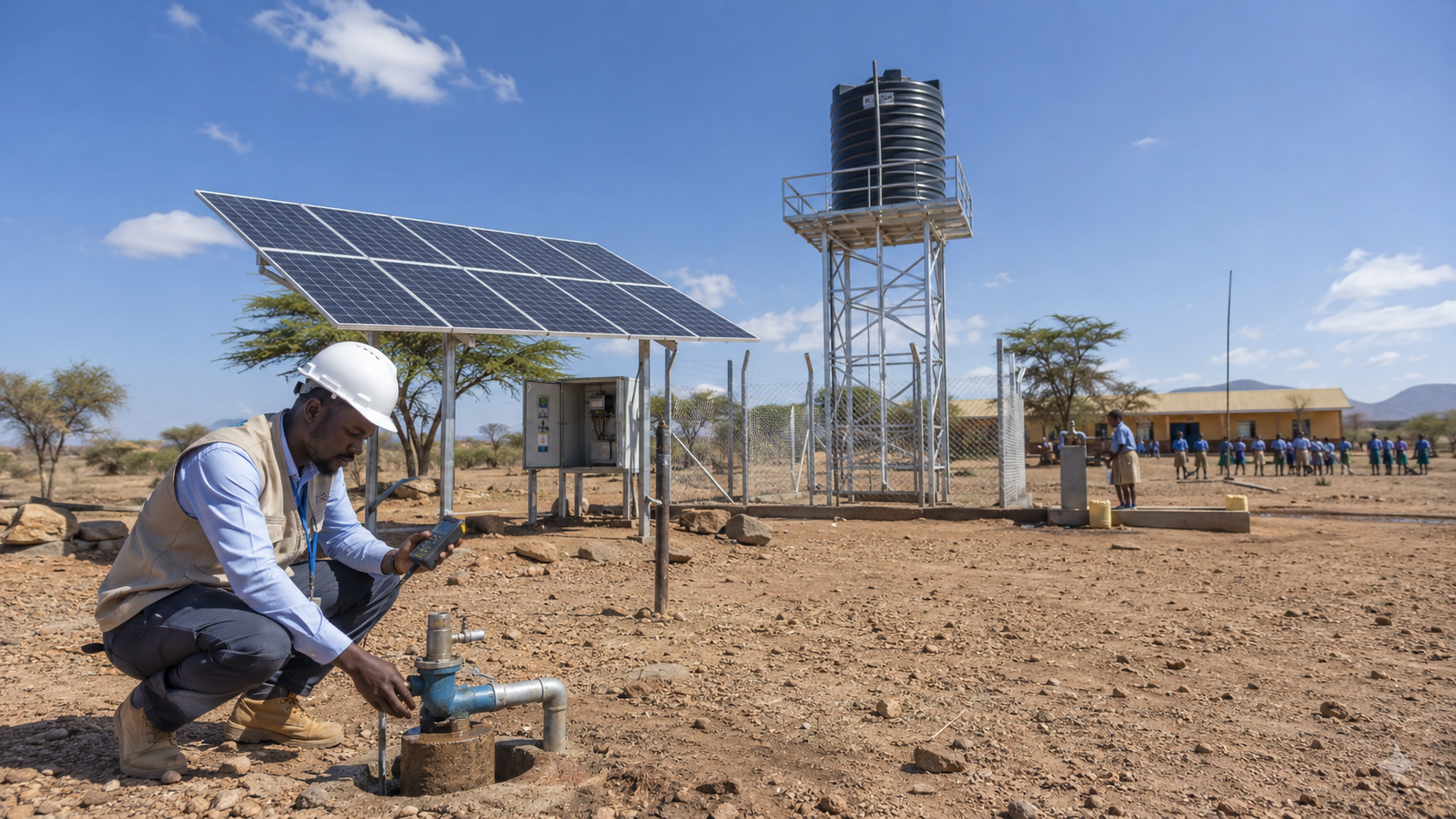
Solar pumping is an attractive option for dispersed institutions because it reduces fuel costs and can operate where grid electricity is unavailable. However, describing a project as “solar-powered” says little about whether it has been engineered correctly.
Pump selection should be based on the borehole’s tested yield, static and dynamic water levels, total dynamic head, daily water requirement, pipe losses and available solar resource.
An oversized pump may draw down the aquifer too aggressively, increase sand ingress or cause the borehole to run dry during operation. An undersized system may fail to meet daily demand or require longer pumping periods than the solar array can support.
Storage is therefore vital. Properly sized elevated tanks allow the system to pump during productive daylight hours while water is used throughout the day. They also provide a limited buffer during cloudy weather or maintenance.
Designers should resist sizing systems around optimistic peak sunlight. Seasonal variation, dust accumulation, high panel temperatures and ageing all affect actual output.
Water quality cannot be treated as a commissioning formality
Water may be physically available but chemically unsuitable.
Parts of Kenya’s Rift Valley and ASAL regions experience naturally high fluoride concentrations. Saline groundwater is another recurring challenge. Treatment technologies can address some contaminants, but they introduce new energy, maintenance and consumables requirements.
A reverse-osmosis unit, for instance, will not remain useful if filters and membranes cannot be procured or if no plan exists for disposing of concentrated reject water.
Each source should therefore be assessed according to its intended use. Drinking water requires a different level of assurance from water reserved for cleaning, livestock or irrigation.
Where treatment is necessary, lifecycle costs must be built into the management model from the beginning. A technically effective treatment system that stops operating when the first consumable expires is not a sustainable solution.
Infrastructure must be designed for its operating environment
Remote ASAL installations face heat, dust, livestock interference, vandalism and long distances to spare parts and technical support.
Solar panels need secure mounting and accessible cleaning arrangements. Electrical enclosures require appropriate protection against dust, water and overheating. Cables, pipes and rising mains need protection from physical damage.
Water troughs, tap stands and drainage areas should be designed so that livestock access does not contaminate domestic collection points. Overflow should be managed to avoid erosion, stagnant water and mosquito breeding.
Sanitation facilities must reflect local soil conditions, groundwater vulnerability, water availability and the needs of children and persons with disabilities. Replicating one toilet design across widely different sites would be a false economy.
Remote monitoring could help—but it cannot replace ownership
Simple monitoring devices can record tank levels, pump operation, electrical faults and daily production. Unusual changes can provide early warning of declining output or equipment failure.
But monitoring only matters when a defined person receives the alert and has the resources to respond.
A school administrator cannot be expected to diagnose a pump controller or remove a submersible pump. County water officers may be located several hours away. Contractors may have no continuing obligation after the defects-liability period.
Every scheme therefore needs an explicit ownership and maintenance structure. This should identify:
- The institution legally responsible for the asset
- Who conducts routine inspection and cleaning
- Who pays for repairs and replacement components
- The response time expected from technical providers
- Where manuals, test results and as-built drawings are retained
- How the school reports a failure
- What interim supply is available during prolonged breakdowns
Community participation is valuable, but it should not become a way of transferring specialist maintenance obligations to people without training or funding.
Supervision must protect what drawings cannot
The consultancy’s construction-supervision role will be as important as its designs.
Borehole depth, casing quality, gravel packing, sanitary sealing, pump installation and yield testing are difficult to verify after completion. Poor work can remain hidden until contamination, sand pumping or mechanical failure occurs.
Supervisors must be present for critical stages and maintain verifiable borehole records. Payment should be linked to documented tests, water-quality compliance and completion of as-built information.
The project should also establish post-completion performance tracking. A scheme that works during handover but fails after one dry season should feed lessons back into future designs.
IMPRESED correctly recognises that education infrastructure cannot be separated from water, health, livelihoods and climate resilience.
Its water component will succeed if it moves beyond the ceremonial borehole: from drilling to aquifer management, from installing solar pumps to designing complete hydraulic systems, and from handing over equipment to establishing a funded maintenance chain.
In Kenya’s ASAL counties, infrastructure is tested most severely after the commissioning photographs have been taken. That is the period for which the project must now design.

-
Product on sale
 AWEBook Volume 2Original price was: KShs 3,500.00.KShs 3,000.00Current price is: KShs 3,000.00.