
Last Updated 2 hours ago by Kenya Engineer
African Export-Import Bank (Afreximbank) has extended a €40 million revolving working-capital facility to Cameroonian metallurgical and industrial group Prometal SA, providing financing to support the company’s continued expansion and the processing of semi-processed steel into finished industrial products.
The agreement was signed on 28 September 2026 at Afreximbank’s headquarters in Cairo by Denys Denya, Senior Executive Vice President of Afreximbank, and Hayssam El Jammal, Chief Executive Officer of Prometal SA.
The facility is intended to provide the financing and guarantees required to meet Prometal’s working-capital needs as it expands production. Rather than being presented as financing for the construction of a single new plant, the facility is structured as revolving working capital, allowing the company to support its ongoing industrial operations and production cycle.
The financing will support the transformation of semi-processed steel into a range of finished products, including construction materials and agricultural equipment. Afreximbank said the facility will also strengthen Prometal’s ability to respond to growing demand from Cameroon’s construction, infrastructure, industrial and agricultural sectors.
The development highlights an important aspect of industrialisation that extends beyond the construction of factories: ensuring that manufacturers have sufficient working capital to continuously procure inputs, operate production lines and convert intermediate materials into higher-value products.
Building a domestic steel value chain
Prometal has been expanding its manufacturing footprint in Cameroon for more than a decade, with steel production forming the core of the group’s industrial activities.
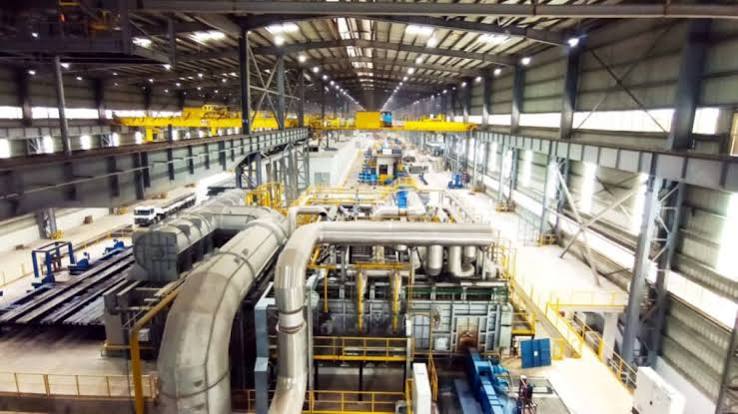
Prometal Acier currently operates seven industrial plants with an aggregate annual production capacity of approximately 360,000 tonnes of finished steel products. The company says it has developed six steel-related production lines and more than 300 products, while employing approximately 2,000 people and working with hundreds of suppliers and service providers.
One of the most significant additions to the group’s industrial base was Prometal 4 in Douala, which was inaugurated in January 2024 alongside Prometal 5 following a combined investment of about CFA57 billion.
Prometal 4, representing approximately CFA45 billion of that investment, was developed as a heavy steel-processing plant with annual capacity of 360,000 tonnes of finished products. Its product range includes reinforcing bars, beams, angles, wire rods and other metal products.
The plant also introduced local production of wire rod, an intermediate steel product used in the manufacture of items such as nails, screws and smooth bars. This is significant because it moves production further up the value chain, allowing downstream manufacturers to source an important intermediate input domestically rather than importing it.
Prometal 5, developed at an estimated cost of CFA12 billion, added production of domestic gas cylinders and metal structures. It has an annual capacity of about 600,000 gas cylinders and 5,000 tonnes of metal structures.
Together, the two facilities represented a major expansion of Cameroon’s capacity to process metallurgical inputs into manufactured products.
From import substitution to regional markets
Prometal’s strategy is increasingly centred on both vertical integration and expansion into new markets.
El Jammal said the group’s approach combines expansion across the value chain, from processing raw materials to manufacturing finished goods, with horizontal expansion into new markets.
The objective, he said, is to manufacture in Africa products that are still largely imported, strengthening domestic production capacity while retaining a greater share of value within African economies.
That approach is particularly relevant to steel because the sector sits at the base of several other industries. Steel products feed into construction, infrastructure, manufacturing, agriculture, energy and transport, meaning that increasing local production can have effects beyond the steel plant itself.
For Cameroon, the development also creates the possibility of supplying markets beyond the domestic economy. Prometal’s expanded product range includes materials that can serve construction and industrial applications across the wider Central African market.
The company’s earlier investments were explicitly associated with reducing imports. At the inauguration of Prometal 4 and 5, the company said the new facilities would strengthen local processing and reduce reliance on imported products, while government officials highlighted their potential contribution to industrialisation and employment.
Afreximbank’s industrialisation strategy
For Afreximbank, the Prometal transaction fits into a broader effort to support African companies involved in manufacturing and intra-African trade.
George Elombi, President and Chairman of the Board of Directors of Afreximbank, said financing companies such as Prometal was part of the bank’s effort to accelerate industrialisation and enable Africa to capture more value from its resources.
The bank said supporting African industrial champions can strengthen domestic manufacturing capacity and contribute to the development of domestic and regional value chains.
The €40 million facility therefore comes at a different stage of Prometal’s development from the large capital investments used to establish its production infrastructure. While the earlier investments expanded physical manufacturing capacity, the new financing is aimed at providing liquidity to support the operation and expansion of that industrial base.
This distinction is important for manufacturers operating in capital-intensive industries. A factory can have substantial installed capacity but still require significant working capital to purchase inputs, maintain production and meet orders.
Steel at the centre of industrial development
The Prometal investment also illustrates why steel remains strategically important to African industrialisation.
The group is not only producing conventional construction steel. Its expansion has moved into intermediate products such as wire rod and downstream products including gas cylinders and fabricated metal structures.
The company’s broader group also includes NOVIA Industries, established in 2018 as its agribusiness arm. NOVIA has reported production capacity of about 500 tonnes of edible oil per day and 160 tonnes of soap per day, giving the wider group interests extending beyond metallurgy into food and consumer manufacturing.
For Cameroon, the longer-term significance of the Prometal expansion will therefore depend not only on the volume of steel produced, but on how effectively that capacity connects with downstream manufacturers, construction companies, infrastructure projects and agricultural equipment producers.
The Afreximbank facility provides additional financial capacity for that process. At €40 million, equivalent to roughly CFA26.2 billion at recent exchange rates, the revolving facility gives Prometal additional room to finance the continuing cycle of purchasing inputs and producing finished goods as it expands its industrial operations.
The transaction ultimately reflects a broader shift in African industrial policy: from exporting or importing largely finished products towards building interconnected domestic and regional manufacturing chains capable of turning intermediate materials into higher-value goods within the continent.
-
Product on sale
 AWEBook Volume 2Original price was: KShs 3,500.00.KShs 3,000.00Current price is: KShs 3,000.00.