
Last Updated 3 hours ago by Kenya Engineer
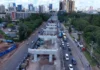
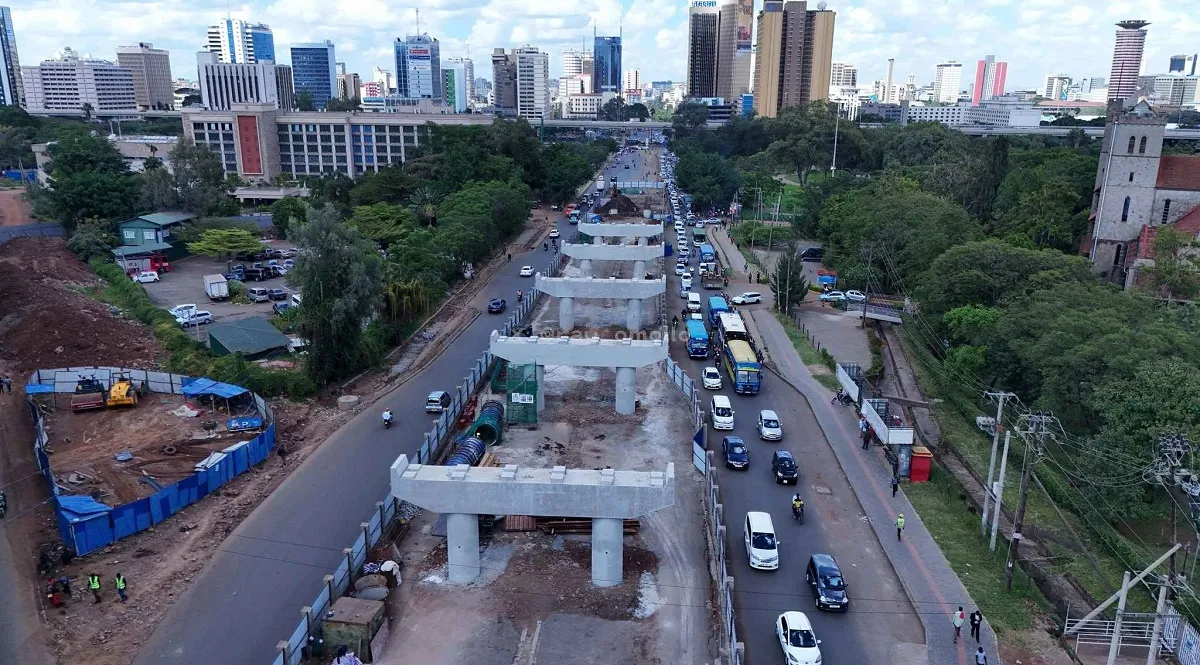
Nairobi’s Kenyatta Avenue–Upper Hill viaduct is taking shape above one of the capital’s most congested road corridors, but the project has already had a much longer journey than originally intended.
The approximately one-kilometre elevated dual carriageway is designed to carry through traffic above the junctions and surface-level movements around the Valley Road, Kenyatta Avenue, Ngong Road and Nyerere Road corridor. The objective is not simply to add another road lane, but to remove some of the conflicts that occur when several major traffic streams converge at grade.
That engineering logic explains much of the project’s design. It also explains why the works involve substantial foundations, reinforced-concrete piers, pier caps and steel structural elements rather than the comparatively straightforward widening of an existing road.
The project is part of a wider KURA contract covering the construction of the Valley Road/Ngong Road/Nyerere Road interchange, the Upper Hill–Haile Selassie overpass and associated road networks. The contract was awarded to China Road & Bridge Corporation (CRBC) at KSh2.9875 billion, according to Kenya Urban Roads Authority records. KURA identifies the overall project length as about six kilometres.
The viaduct itself is the most visible component of that wider scheme. Current descriptions put the elevated section at approximately one kilometre, running between the Integrity Centre/Valley Road side and the Kenyatta Avenue–Serena area, providing a grade-separated connection towards the CBD. The completed facility is also planned to incorporate pedestrian walkways and cycling facilities.
Why build a viaduct here?
The problem the project is attempting to solve is fundamentally one of traffic conflict.
Valley Road, Kenyatta Avenue, Ngong Road and Nyerere Road form an important set of radial and cross-city connections around the southern edge of Nairobi’s CBD. Traffic approaching from Upper Hill, Kilimani, Ngong Road and other southern corridors converges with traffic entering, leaving or circulating through the city centre.
At an ordinary signalised intersection, all of those movements have to be accommodated on the same road surface. Through traffic has to stop or slow down to allow turning movements, pedestrians to cross and other traffic streams to pass.
A viaduct changes that arrangement by physically separating movements.
KURA has explained the principle in straightforward terms: traffic using the elevated route will be able to pass above the junction rather than interacting directly with traffic using the roads below. The authority expects this to reduce traffic conflicts and improve movement through the corridor.
That is an important distinction. The project is not intended to eliminate congestion throughout Nairobi, nor does an elevated road automatically solve congestion elsewhere. Its more specific function is to increase capacity and continuity along a strategically important movement while taking some through traffic out of the junction-level traffic system.
This is the same basic principle used by grade-separated interchanges elsewhere in Nairobi: keep traffic that does not need to stop at a junction moving, while retaining surface-level access for local movements.
A KSh2.99 billion contract
The formal contract value is KSh2,987,506,754.66, although government and media communications generally round this to KSh3 billion. KURA’s project records identify China Road & Bridge Corporation as the contractor.
The contract was signed on 17 September 2020 and commenced on the same day. The original contract period was 36 months, giving an initial completion date of 17 September 2023.
An Auditor-General report subsequently recorded that the contractor had requested an extension, moving the completion date to 17 March 2024. At the time of the audit, the project was already experiencing delays associated with funding and the relocation of utilities, including water and sewer infrastructure as well as electricity cables.
The project’s physical scope was considerably larger than the viaduct now attracting most public attention. The original contract covers approximately seven kilometres of dual carriageway, intermittent service and slip roads and two overpasses. The Auditor-General’s report also noted that underground water and sewer pipes, electricity infrastructure and funding constraints were affecting implementation.
The wider project therefore needs to be understood when considering both its cost and its duration. The KSh2.99 billion is not simply the price of one kilometre of elevated roadway.
Why did a three-year project take so long?
Funding became one of the defining issues.
The project was launched in September 2020, but it did not proceed continuously. According to KURA, the works stalled because of payment problems involving contractors. Construction resumed in July 2025 after the government secured financing to restart stalled road projects.
The project’s financing history illustrates the problem.
The national government’s 2020/21 development estimates included the Nairobi Viaduct Project under the Haile Selassie–Enterprise Road heading. The project had a net allocation of only KSh5 million for that financial year after appropriations in aid, although much larger projections were subsequently included. The following year’s estimates provided KSh50 million, with KSh20 million projected for 2022/23 and KSh100 million for 2023/24. The same budget documents show no foreign financing allocation for the project.
Those allocations were modest compared with the KSh2.99 billion contract value and point to the wider challenge confronting Kenya’s road programme: awarding contracts does not by itself guarantee the predictable cash flow required to keep contractors mobilised.
By 2023, the Auditor-General was reporting both funding constraints and unpaid certified works. At that point, approximately KSh774.7 million had been certified, while KSh323.4 million had been paid.
The eventual restart was therefore part of a much larger road-sector financing intervention.
The KSh175 billion financing intervention
In 2025, the government turned to securitisation of a portion of the Road Maintenance Levy Fund to address the backlog of unpaid road works.
Under the arrangement, KSh7 out of the KSh25 per litre Road Maintenance Levy was securitised, allowing the Kenya Roads Board to raise approximately KSh175 billion upfront against future levy revenues. Parliamentary documentation says the proceeds were intended to settle outstanding obligations of road agencies and enable stalled road projects to resume.
The mechanism was designed around future road-maintenance levy revenues rather than waiting for annual Exchequer allocations. The government said the arrangement would help clear verified contractor arrears and revive more than 580 stalled road projects around the country.
The Kenyatta Avenue viaduct was among the projects that returned to active construction as the road sector began receiving payments under the wider intervention. KURA confirmed that work on the viaduct resumed in July 2025.
It is important, however, not to describe the KSh175 billion as the financing cost of the viaduct. It is a sector-wide financing mechanism. The viaduct’s contractual value remains approximately KSh2.99 billion, while the securitisation provided a broader mechanism for settling road-sector obligations and restarting stalled projects.
The contractor and implementing agency
The project is being implemented by the Kenya Urban Roads Authority, the national agency responsible for urban roads under its statutory mandate. KURA manages, develops, rehabilitates and maintains urban roads across the country and currently oversees a network of approximately 4,625 kilometres.
China Road & Bridge Corporation is the contracted construction firm. KURA’s own structures and ongoing-project databases list CRBC against the Valley Road/Ngong Road/Nyerere Road interchange and Upper Hill overpasses contract and give the contract sum as KSh2.9875 billion.
The project therefore involves three distinct roles that are sometimes blurred in public discussion: the government provides the public financing framework, KURA is the implementing road authority and employer, and CRBC is the contracted construction company.
Why the construction is technically demanding
The most visible parts of the project are the large concrete columns and steel elements rising above Kenyatta Avenue. But these are also among the reasons the project has proved more complex than a conventional road upgrade.
An elevated road in an already developed urban corridor has to be constructed around existing roads, buildings, underground utilities, drainage infrastructure, power lines, pedestrians and live traffic.
The Auditor-General previously identified water and sewer lines and electricity infrastructure as constraints. More recent explanations from KURA have focused on the complexity of installing the columns and steel components, describing the work as requiring precision engineering and phased execution.
The construction sequence therefore cannot simply follow the linear process used on a new road in an undeveloped corridor. Foundations have to be constructed without compromising existing infrastructure, columns have to be positioned accurately, pier caps installed, and the elevated structure assembled while traffic continues to operate around the work zone.
That is one reason why the project’s physical progress should not necessarily be judged by the apparent amount of concrete visible from the road. Structural works can involve substantial engineering and preparation before the road deck itself becomes apparent.
Recent construction updates have shown the project moving into the superstructure phase, including installation of precast girders and construction of the elevated deck.
When will the viaduct be completed?
The original contractual completion date was September 2023. It was subsequently revised to March 2024 and later moved again as funding and implementation problems persisted. By 2025, the revised completion date being reported was 17 December 2026.
In June 2026, President William Ruto said the viaduct would be completed before December 2026. At the time, the government reported the project at about 60 per cent complete.
But the latest publicly reported position is different.
On 22 September 2026, the Kenya Roads Board said the project was 50 per cent complete and gave an expected completion date of 30 May 2027.
KURA’s online urban-roads status database currently lists the wider Valley Road/Ngong Road/Nyerere Road interchange and Upper Hill overpasses project at 44 per cent, while the Kenya Roads Board’s September update puts the project at 50 per cent.
What will change when it opens?
The most immediate expected benefit is improved continuity for traffic moving between Upper Hill and the CBD.
The elevated carriageway should allow through traffic to bypass some of the movements occurring at the junctions below. That should reduce the number of occasions on which vehicles travelling through the corridor have to interact with turning traffic.
The project’s benefits are expected to come from several related changes: better connectivity between the CBD and Upper Hill, fewer traffic conflicts at key junctions, improved traffic flow and more predictable movement along the corridor.
KURA and the Kenya Roads Board have also identified improved mobility and connectivity as expected outcomes. The planned pedestrian walkways and cycle lanes introduce a non-motorised transport component into what is otherwise a major vehicle-oriented intervention.
What can be said with confidence is that the viaduct is designed to remove a particular class of traffic conflict: through movements that currently have to negotiate busy surface-level junctions.
Whether that translates into a significant reduction in total Nairobi congestion will depend on how traffic redistributes once the facility opens.
A solution to one junction, not to Nairobi’s entire congestion problem
The viaduct also raises a broader question about how Nairobi should invest in urban mobility.
Grade-separated roads can increase capacity at specific bottlenecks, but they do not eliminate the underlying growth in travel demand. If additional capacity attracts additional traffic, congestion can eventually move further along the network.
Useful indicators will include traffic volumes on the elevated route, queue lengths at the surrounding surface intersections, travel times between Upper Hill and the CBD, pedestrian and cyclist movements, crash patterns and the extent to which congestion is displaced to neighbouring roads.
The project will also have to work as part of a wider network. The surrounding roads, junctions, public transport routes and pedestrian infrastructure will determine whether the viaduct functions as an integrated urban transport facility or simply moves the bottleneck to another location.
This is particularly important in an area where office development, commercial activity and residential growth continue to increase demand for movement between Upper Hill, Kilimani, the CBD and the southern suburbs.
From stalled contract to strategic urban link
The Kenyatta Avenue viaduct is more than a KSh3 billion construction project. It is an example of the difficulty of delivering complex urban infrastructure when engineering, existing utilities, traffic management and public financing all have to be resolved simultaneously.
The original contract was signed in September 2020 with a three-year delivery period. Six years later, the project is still under construction, with the latest public target now extending to May 2027. The delay has been shaped by payment and funding problems, utility relocation and the technical complexity of the elevated structure.
Yet the underlying transport rationale remains clear.
Nairobi’s road network is increasingly constrained not just by a lack of pavement, but by the number of competing movements forced through the same intersections. Grade separation is one engineering response to that problem. The Kenyatta Avenue viaduct represents a significant test of whether that approach can deliver measurable improvements in one of the capital’s most important urban corridors.
The real assessment will begin when the structure opens.
If the latest schedule holds, motorists should be using the completed facility by 30 May 2027. At that point, the more important question will no longer be how much concrete was poured or how long construction took, but whether the KSh2.99 billion investment has actually made movement between Upper Hill and Nairobi’s CBD faster, safer and more predictable.
-
Product on sale
 AWEBook Volume 2Original price was: KShs 3,500.00.KShs 3,000.00Current price is: KShs 3,000.00.