
Last Updated 3 hours ago by Kenya Engineer
When Kenya’s Standard Gauge Railway reached Mombasa in 2017, its terminus was built at Miritini, roughly 15 kilometres from Mombasa Island. The arrangement worked for long-distance rail operations, but it left passengers with a road journey between the SGR terminus and the city centre.
The Makupa Causeway railway bridge was conceived as part of the solution.
The bridge forms the centrepiece of a new metre-gauge railway connection linking the Mombasa SGR terminus at Miritini with the existing Mombasa railway network and the historic central railway station. Together with rehabilitation of the existing MGR line and new passenger stations, the project creates a direct rail connection between the SGR and Mombasa Island.
The bridge itself has now been constructed, but the wider railway project has experienced a more complicated implementation history involving land acquisition, rehabilitation works and station construction. The latest government records therefore need to be read carefully when describing its completion status.
Why the bridge was necessary
The decision to locate the Mombasa SGR terminus at Miritini separated the new railway from the historic railway infrastructure on Mombasa Island. For passengers arriving on the Madaraka Express, the final part of the journey into the city consequently had to be completed by road.
The new MGR link changes that arrangement.
Kenya Railways designed the project to provide a rail connection from the SGR terminus to the existing MGR system, allowing passengers to transfer from the SGR to a commuter train serving Mombasa Island and intermediate areas.
The project is best understood as a railway interchange and last-mile connectivity project. The bridge is the piece that makes the connection possible across the Makupa Causeway.
A new 2.8km railway connection
Kenya Railways’ project documents describe the new connection as approximately 2.8km of metre-gauge railway linking the Mombasa SGR terminus to the Miritini MGR station and the existing railway network.
The wider project includes the new Miritini passenger station, the Makupa Causeway railway bridge, a locomotive turntable and connections into the existing MGR system. Kenya Railways also undertook rehabilitation of the wider Mombasa Island–Miritini metre-gauge corridor and improvements to passenger stations.
The engineering challenge was to have the new link interface with an existing railway system while also providing a connection to a completely different railway corridor — the SGR.
That required track geometry, platform arrangements, signalling and operational interfaces to be considered as part of one passenger journey rather than as separate infrastructure projects.
The bridge over Makupa Causeway
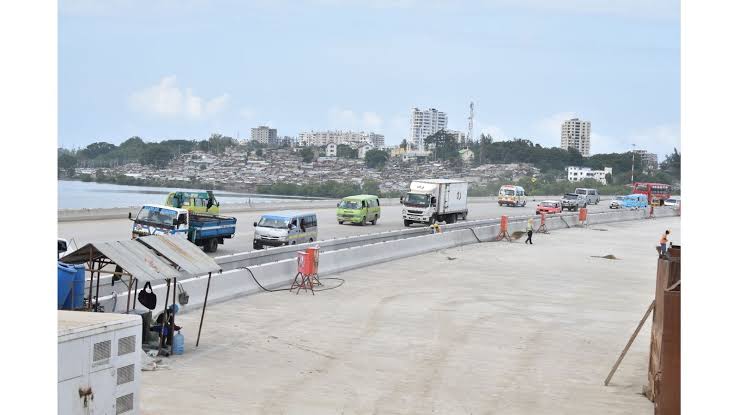
The bridge crosses the Makupa Causeway, the narrow land and water corridor separating Mombasa Island from the mainland.
There have been different figures published for the bridge’s length. Earlier Kenya Railways and government descriptions gave a figure of 480 metres, while a later Kenya Railways project update describes the newly constructed bridge as 283 metres long.
But what is more important from an engineering perspective is the fact that the railway had to cross a constrained coastal environment while maintaining connectivity with the surrounding transport infrastructure.
Kenya Railways says the completed bridge incorporates safety features and drainage works, with modern track construction using ballast and precast sleepers.
Why a bridge rather than another causeway
The railway crossing had to accommodate the physical and environmental characteristics of the Makupa area while maintaining the function of the existing road and marine environment.
The solution separates the railway structure from the road infrastructure.
This also has a longer-term advantage. A dedicated railway bridge provides a defined rail corridor without requiring the railway to compete with road traffic on the causeway. That becomes increasingly important when the line is used not only for passengers but also for freight movements into Mombasa.
Kenya Railways has stated that the link is designed to accommodate both passenger and freight movement.
The bridge is only one part of the railway system
The new crossing cannot generate the intended transport benefits on its own.
At the Miritini end, passengers arriving on the SGR need a convenient interchange between the standard-gauge railway and the metre-gauge commuter system. The project thus includes a pedestrian bridge connecting the SGR and MGR platforms and a new Miritini MGR passenger station.
At the other end, the metre-gauge railway connects into Mombasa’s historic railway infrastructure, including the central station.
The wider project also includes stations at Changamwe East, Changamwe West and Shimanzi, together with rehabilitation of the existing Mombasa Island–Miritini MGR line.
The engineering interface between SGR and MGR
One of the less obvious engineering aspects of the project is the interface between two railway systems.
Kenya’s SGR operates on standard gauge, while the Mombasa commuter connection uses the existing metre-gauge railway. The two systems cannot share the same track. Instead, passengers transfer between them at Miritini through dedicated platforms and pedestrian infrastructure.
This arrangement allows the new commuter railway to serve as the final connection between the SGR and Mombasa Island without requiring conversion of the existing Mombasa railway to standard gauge.
It is a pragmatic example of using existing railway infrastructure as part of a new transport system rather than replacing the entire network.
The project began in 2022
The Mombasa commuter rail project commenced in September 2022 at an estimated cost of about KSh4.2 billion for the core link project. The original implementation period was expected to be much shorter, but land acquisition issues subsequently affected progress.
Government later allocated approximately KSh1.1 billion for compensation of affected landowners along part of the route.
The land issue illustrates an important characteristic of railway construction in established urban areas. Unlike a greenfield railway passing through largely undeveloped land, an urban railway has to negotiate existing buildings, roads, utilities, property boundaries and communities.
The engineering solution can therefore be ready while the project remains constrained by land acquisition.
The bridge itself reached completion before the wider project
The National Treasury’s 2025/26 Energy, Infrastructure and ICT Sector Report records that the Makupa Causeway railway bridge was 100% complete, while land compensation remained outstanding. The same report says construction of the Miritini MGR passenger station and locomotive turntable had also been completed, with the outstanding balance relating to pending certificates and land compensation.
However, a September 2026 report citing government implementation data stated that the Mombasa SGR–Miritini MGR and Makupa Causeway project was 91% complete as at 30 June 2026.
The more likely explanation is that different reporting periods and definitions of project completion are being used. The 91% figure relates to the broader project implementation status, while the Treasury’s earlier report explicitly identifies the bridge itself as complete and the remaining issues as certificates and land compensation.
The wider MGR rehabilitation matters
The new link is only useful if trains can continue beyond it. That is why Kenya Railways has been rehabilitating the existing Mombasa Island–Miritini MGR corridor.
The rehabilitation includes track works and improvements to stations along the route. Treasury reporting indicates that this component has progressed more slowly than the new link infrastructure.
Building a new bridge can create a physical connection, but a railway’s usable capacity depends on the condition of the complete route, including track, signalling, stations, drainage, crossings, rolling stock and operating systems.
The project therefore has two engineering dimensions: constructing the new connection and restoring the existing railway infrastructure that will carry trains beyond it.
The transport logic is straightforward
The SGR terminus at Miritini is located outside Mombasa’s central urban area.
A passenger arriving from Nairobi needs a reliable final connection to the city. If that connection depends entirely on road transport, the time savings achieved by travelling by SGR can be partly lost in the final leg.
The commuter railway addresses that gap.
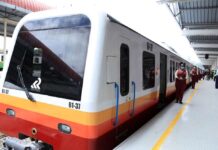
Kenya Railways says the service is designed to provide a first- and last-mile connection for Madaraka Express passengers as well as a transport option for residents along the corridor. The current service information describes a journey between Mombasa Island and the SGR terminus of about 35 minutes.
The railway also provides a park-and-ride and drop-and-ride model, allowing passengers to transfer between road and rail at selected points.
A railway project with a wider urban role
The Makupa connection is significant because it changes the relationship between the SGR and Mombasa’s existing urban transport network. The SGR was designed primarily as an intercity railway. The MGR link gives it a metropolitan interface.
A passenger railway becomes considerably more useful when its terminal is integrated into the urban transport system rather than functioning as an isolated endpoint. The Mombasa project thus represents an early example of Kenya trying to integrate its new high-speed intercity railway with an older metropolitan railway network.
The country is using the existing MGR corridor as the urban distribution system while retaining the SGR as the long-distance trunk railway.
What the project cost
The project has been reported under several related cost figures.
Kenya Railways and government communications have commonly referred to the core Mombasa commuter rail project as a KSh4.2 billion development. Earlier government reporting also referred to an overall investment of more than KSh6 billion when supporting infrastructure and associated facilities were included.
The bridge’s place in Mombasa’s transport system
Makupa is one of several major infrastructure interventions changing Mombasa’s transport geography.
The road crossing has already been transformed by the new Makupa Causeway road bridge, while the railway crossing adds another dedicated transport connection across the same constrained corridor.
The two structures serve different transport systems. The road bridge carries road traffic and opened in 2022. The railway bridge provides the rail connection needed to bring the SGR passenger service closer to Mombasa Island.
Together, they illustrate a broader shift from treating the causeway as a road connection towards treating it as a multi-modal transport corridor.
The real project is the connection
The most important engineering feature of Makupa is not the bridge viewed in isolation. It is the connection that the bridge enables.
At one end is the SGR terminus, designed for high-capacity intercity rail. At the other is Mombasa Island’s historic metre-gauge railway infrastructure. Between them are a new MGR link, the Makupa bridge, interchange facilities, stations and rehabilitated railway.
The engineering task is to make those components function as one transport chain. That is why completion of the bridge alone did not immediately mean that the entire commuter rail system was ready for normal service.
The track must be connected, stations completed, rolling stock available, safety systems tested and the entire route commissioned.
From a terminal to a network
The Makupa Causeway railway bridge ultimately addresses a problem that emerged when Kenya’s modern railway network was built in stages.
The SGR created a new high-capacity railway into Mombasa but terminated away from the island. The MGR network, meanwhile, already extended into the historic urban centre but required rehabilitation.
The new connection brings the two systems together without requiring either to be completely rebuilt. That makes the Makupa bridge more than another coastal infrastructure project.
It is a piece of railway integration infrastructure.
The physical bridge is now in place. The larger task is ensuring that the bridge, new MGR link, rehabilitated railway, stations and SGR interchange operate as a dependable system.
For Mombasa, the significance will ultimately be measured not by the length of the bridge but by what it allows the railway network to do: carry passengers arriving on the SGR directly towards the island, provide an alternative to road transport and reconnect the city’s modern intercity railway with its historic urban rail corridor.
-
Product on sale
 AWEBook Volume 2Original price was: KShs 3,500.00.KShs 3,000.00Current price is: KShs 3,000.00.