
Last Updated 2 hours ago by Kenya Engineer
Egypt’s high-speed electric rail programme is often described simply as a 2,000-kilometre high-speed railway. That description misses the scale of what is being built.
The project is a new national railway system combining high-speed passenger services, regional trains and electric freight locomotives across three major corridors. The network currently under construction totals about 2,000 kilometres, linking 60 cities and connecting the Red Sea, Mediterranean coast, Cairo, Upper Egypt and major industrial and tourism centres.
A wider four-line network is planned to reach approximately 2,250 kilometres.
The system is being delivered by Siemens Mobility together with Egyptian contractors Orascom Construction and The Arab Contractors under contracts with Egypt’s National Authority for Tunnels.
The railway is being designed for high-speed passenger operations of up to 230 km/h, while regional trains will operate at up to 160 km/h and electric freight locomotives at up to 120 km/h.
That combination is what makes the project particularly interesting from an engineering perspective. Egypt isn’t just building a passenger railway. It is building an electrified transport network intended to move people and freight on the same national infrastructure.
Three corridors, one network
The first line runs approximately 660 kilometres from Ain Sokhna on the Red Sea through the New Administrative Capital and the new urban developments around Cairo to El Alamein and Marsa Matrouh on the Mediterranean coast.
The second line extends about 1,100 kilometres from the Cairo area southwards through Upper Egypt to Abu Simbel near the Sudanese border.
The third line links Luxor with Hurghada on the Red Sea.
Together, the first three lines form the 2,000-kilometre system currently under implementation. The geography explains much of the project’s strategic purpose.
Egypt’s existing railway system is heavily concentrated around the Nile Valley and Delta, while large parts of the country’s recent urban, industrial and agricultural development are occurring farther west and east.
The new railway is being built partly to change that geography. It links new cities and industrial areas to established population centres while connecting ports to inland markets and production areas.
High speed is only part of the design
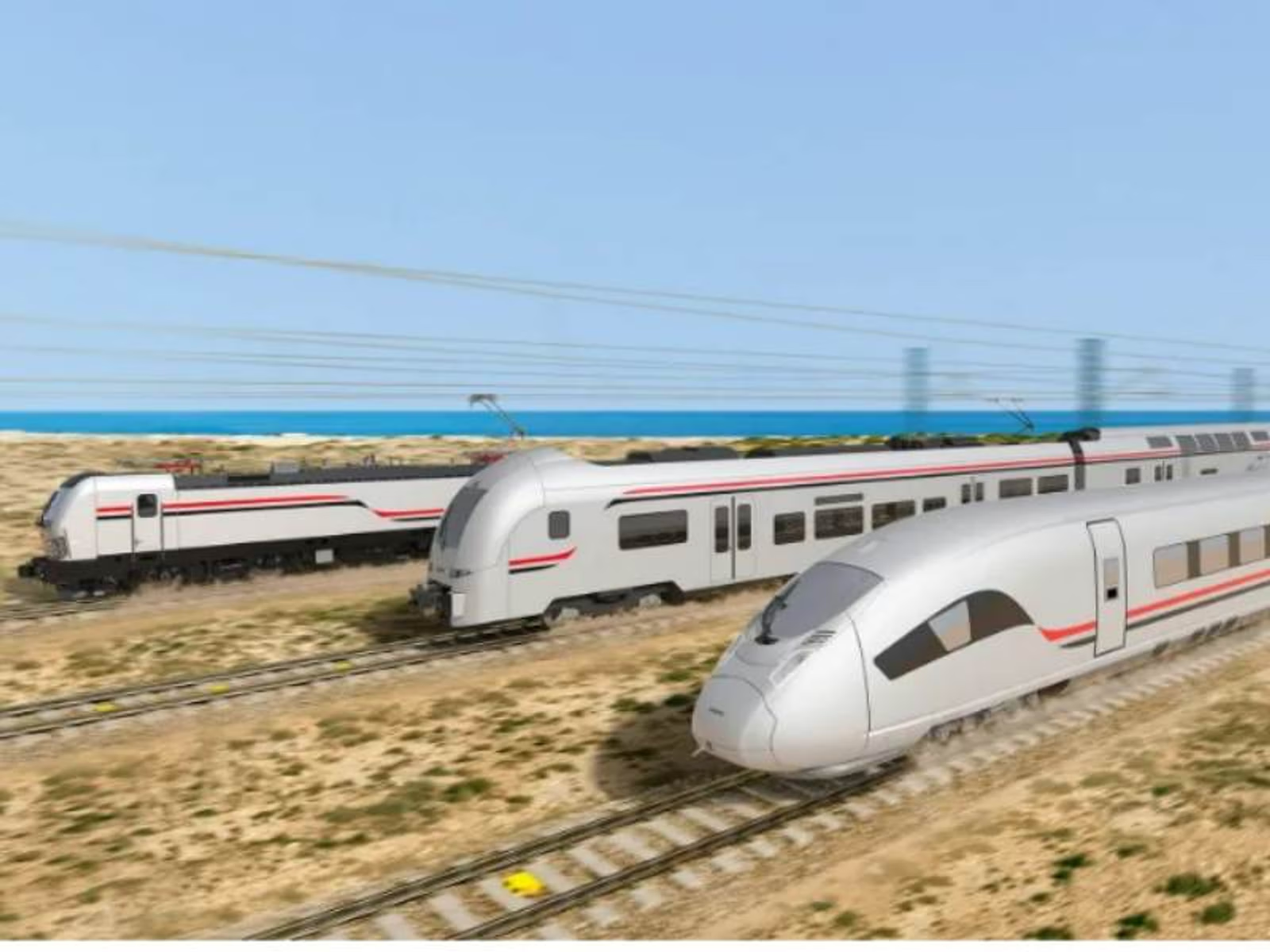
The passenger trains are being designed to operate at speeds of up to 230 km/h. Siemens is supplying 41 eight-car Velaro high-speed trains, but the fleet also includes 94 four-car Desiro High Capacity regional train sets and 41 Vectron freight locomotives.
That fleet composition tells us something important about the railway. The infrastructure must accommodate very different operating patterns.
A high-speed passenger train requires long stretches of track where high speed can be maintained safely. Regional services need frequent station access. Freight trains have different acceleration, braking and axle-load characteristics.
The signalling, electrification, track geometry, stations and control system therefore have to accommodate a mixed railway rather than a single dedicated high-speed passenger operation.
Building a new railway beside old infrastructure
One of the project’s most interesting engineering challenges appears in Cairo.
At Giza, the new high-speed railway crosses the existing diesel railway system on a dedicated elevated alignment. The new interchange station is designed so that high-speed trains operate above the existing railway, while platforms and passenger facilities allow direct interchange between the two systems.
The arrangement avoids forcing passengers to leave the station to transfer between the old and new networks. It is an example of the sort of engineering problem that becomes unavoidable when a new high-capacity railway is inserted into an already congested metropolitan environment.
Other parts of the system involve equally substantial structures.
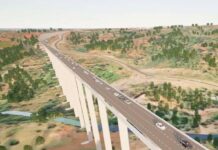
Recent Egyptian government reporting identifies the SUMED Bridge, a 700-metre structure, the Nile bridge complex with a combined length of approximately nine kilometres and a 500-metre bridge associated with Giza station. A 2.5-kilometre approach structure is also being built near Giza.
These are not ancillary works. They are essential to keeping the railway separated from existing roads, waterways and other transport corridors while maintaining the required operating speeds.
Laying the railway itself
Once the civil works establish the formation and bridges, the project moves into the railway systems that determine how the trains actually operate. Current works include ballast placement, rail installation, catenary poles and overhead electrical systems, together with electromechanical works and railway systems.
The overhead catenary supplies electricity to the trains, while signalling and train-control systems manage movements across the network. The railway also requires substations, telecommunications, control systems and maintenance facilities distributed across the corridors.
The result is closer to a national electrical and digital infrastructure project than a conventional railway construction exercise.
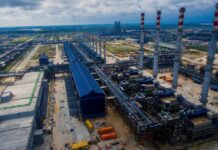
A 578-acre railway workshop
The first line’s main workshop occupies approximately 578 acres.
It is designed to support the operation and heavy maintenance of the trains and locomotives across the network. The facility will also provide storage capacity for approximately 50 trainsets and locomotives.
This is another important element of the project’s design.
High-speed railway infrastructure cannot be sustained by building track and purchasing trains. Maintenance becomes a core part of the system from the first day of operation.
At 230 km/h, track geometry, overhead electrical equipment, signalling and rolling stock all require tight maintenance tolerances. The railway needs a maintenance ecosystem capable of monitoring and correcting defects before they become operational or safety problems.
Stations as transport interchanges
Egypt is also designing the network around interchange.
The central station at the New Administrative Capital connects with the Light Rail Transit system. Hadayek October provides interchange between the first and second high-speed lines. Giza connects the new railway with the existing Cairo–Aswan diesel railway.
Other stations are being positioned to connect the railway with airports, metro systems, the Alexandria transport system and planned bus rapid transit services. This approach is important because a high-speed railway cannot create its full value if passengers cannot reach it efficiently.
That makes station design a major part of the engineering problem, particularly in a country where many new urban developments are being created away from existing city centres.
Freight is central to the project
Perhaps the most significant difference between Egypt’s system and many high-speed railways elsewhere is the inclusion of freight. The network includes 41 electric freight locomotives, and the corridors are intended to connect ports with industrial, agricultural and mining areas.
On the first line, for example, the railway creates a land transport connection between Ain Sokhna on the Red Sea and the Mediterranean coast. This has implications far beyond passenger travel.
A freight railway can move containers and bulk goods between ports and inland production areas without relying entirely on highways. It can also improve the competitiveness of industrial zones by providing predictable long-distance transport.
The railway thus forms part of a broader logistics strategy linking maritime gateways with production and consumption centres.
Financing and delivery
The Siemens-led contract signed in 2022 covered the three-line, approximately 2,000-kilometre system.
Siemens Mobility’s share of the contract was valued at €8.1 billion, including the earlier contract for the first line. The wider turnkey scope includes the rolling stock, rail infrastructure technology, eight depots and yards and 15 years of maintenance.
Egyptian companies are responsible for substantial civil and construction work, while Siemens supplies the high-speed trains, regional rolling stock, freight locomotives and major railway technology.
That division allows the project to combine international railway technology with Egypt’s large domestic construction industry.
The railway as a development corridor
The ultimate engineering value of Egypt’s new railway is to create new connections between cities, ports, industrial zones, agricultural developments and tourist destinations.
The second line illustrates this particularly well. Running about 1,100 kilometres southwards, it extends modern electric rail infrastructure deep into Upper Egypt and toward Abu Simbel.
The railway will reach areas that have historically depended heavily on roads and the older diesel railway system.
Egypt is effectively using rail infrastructure to redraw its development map.
When complete, it will bring together electrification, high-speed passenger services, regional trains, freight, digital train control, interchanges, maintenance facilities and port connections over thousands of kilometres.

-
Product on sale
 AWEBook Volume 2Original price was: KShs 3,500.00.KShs 3,000.00Current price is: KShs 3,000.00.