





Last Updated 2 hours ago by Kenya Engineer
For decades, motorists travelling along the Makutano–Embu–Meru (A9) highway have approached the Nithi River crossing with unusual caution.
The existing Nithi Bridge is not particularly long. Its three-span composite steel-concrete superstructure has an overall length of about 50 metres. What makes the crossing dangerous is everything around it: the bridge sits on a sharp horizontal curve, the approaches form part of an S-curve and sections of the road leading from the Nithi valley have gradients ranging from 10 to 24 per cent.
The combination of steep gradients, tight curves, limited sight distance and heavy traffic has made the section one of Kenya’s best-known road blackspots. Now, rather than attempting to manage the danger with signs, speed restrictions and other conventional road-safety measures, Kenya is taking a more fundamental approach.
The road is being redesigned.
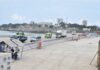
Construction preparations for the new Nithi Bridge in Tharaka Nithi County have advanced significantly, with the contractor’s site established and work underway on facilities including a concrete batching plant and the foundations for the new bridge.
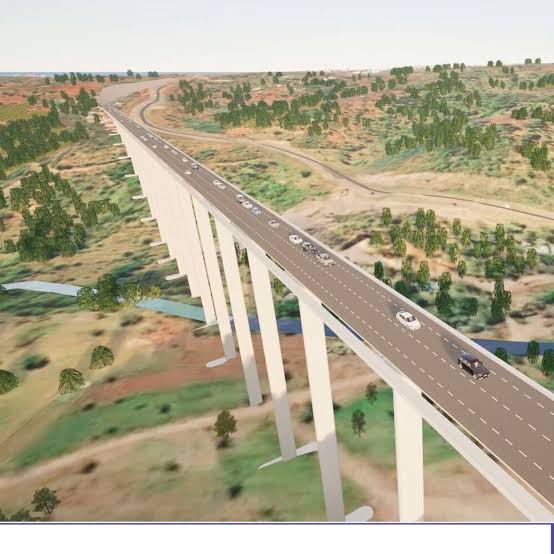
At the centre of the intervention is an approximately 880-metre bridge forming part of a new alignment between the Marima and Mitheru areas. The project, being implemented by the Kenya National Highways Authority (KeNHA), has a contract value of about KSh7.5 billion.
The significance of the project therefore extends well beyond the construction of another bridge. It represents an attempt to use highway and structural engineering to remove the physical characteristics that have contributed to the Nithi section’s long-standing safety problem.
Designing out the blackspot
KeNHA’s tender documentation is unusually clear about the problem the project is intended to solve.
The existing bridge has an overall span of approximately 50 metres and lies on a horizontal curve with a radius of about 90 metres. The curve forms part of an S-curve on the approaches to the bridge. At the same time, the approaches from the river valley have gradients ranging from 10 to 24 per cent.
For a road carrying buses, trucks and other heavy vehicles, that combination is particularly demanding.
A steep downhill section requires drivers to manage increased vehicle speed and braking demand. A sharp curve simultaneously requires steering control and appropriate speed. When the two conditions occur together, the available margin for error becomes smaller.
The situation is further complicated where sight distances are restricted.
This is why the new project is important from a highway-engineering perspective. It does not treat the crashes as solely a driver-behaviour problem. KeNHA’s own documentation identifies both the physical characteristics of the road and driver behaviour as contributing factors.
The solution is consequently to change the physical environment in which drivers operate.
The new alignment will take traffic away from the existing S-curve and across the valley on a substantially longer bridge. In doing so, it is intended to reduce the severe changes in direction and gradient that characterise the existing road.
In other words, the project seeks to engineer the blackspot out of the highway.
From a 50-metre bridge to an 880-metre viaduct
The contrast between the existing and proposed structures illustrates the scale of the intervention. The current bridge is approximately 50 metres long. The proposed crossing will extend for about 880 metres.
The new structure is being developed as a high-level bridge across the Nithi valley rather than as a short crossing that follows the existing road geometry. Current project information describes a prestressed concrete box-girder bridge supported on pile foundations, with 22 spans of approximately 40 metres each. The tallest central piers are expected to rise to around 100 metres above the valley.
This configuration introduces a completely different set of engineering requirements. The bridge must carry highway traffic across a deep valley while transferring substantial vertical and lateral loads through its deck, piers and foundations into the ground.
Its long length also means that structural movement, temperature effects, wind loading, braking forces and the interaction between the superstructure and substructure must be accounted for in the final design.
The use of prestressed concrete is significant in this context. Prestressing allows tensile forces to be deliberately introduced into concrete elements, improving their ability to resist bending and permitting efficient structural forms for longer spans. For a repetitive bridge arrangement of approximately 40-metre spans, prestressed concrete can provide a practical balance between structural capacity, durability and construction efficiency.
But the bridge deck is only one part of the engineering challenge. The foundations may be even more important.
Building foundations in a deep valley
With the tallest piers expected to reach approximately 100 metres, the new Nithi crossing will require substantial substructure works.
KeNHA’s tender required bidders to demonstrate experience with bridge projects involving pile foundations, including cumulative piling experience of at least 1,000 metres for qualifying similar projects.
That requirement provides an indication of the importance of foundation engineering to the project.
Piles transfer structural loads through weaker near-surface materials into deeper, more competent ground. Their design depends on the geological conditions encountered at each foundation location, the loads imposed by the bridge and the interaction between the piles and surrounding soil or rock.
At Nithi, this work must be coordinated with the valley’s steep terrain and the considerable height of the proposed piers.
Geotechnical investigation is therefore not a preliminary formality. It is fundamental to determining how the bridge can safely stand over the valley.
The contractor must establish the ground conditions, determine suitable foundation depths and capacities, and design a system capable of resisting both vertical loads and horizontal forces.
The foundations will also have to accommodate construction-stage loads, which can differ significantly from those experienced by the completed bridge.
The road approaches are just as important
One of the easiest ways to misunderstand the Nithi project is to think of it simply as an 880-metre bridge. It is not.
The bridge forms part of a wider highway realignment. Current project information puts the associated approach-road works at roughly 2.1 to 2.7 kilometres, depending on the project description and measurement of the wider realignment. The tender itself describes the contract as the Realignment of Nithi Bridge and Approach Roads.
A new bridge would provide only a partial solution if vehicles were still required to negotiate the same steep and sharply curved approaches before reaching it. The highway geometry leading onto and away from the structure has to work as an integrated system.
The procurement documents reflect this principle. In evaluating bidders’ design proposals, KeNHA specifically included improvements to overall road geometry, reduction of horizontal and vertical alignment curves, efficient alignment and the ability to execute the solution within the contractual period.
That is perhaps the most important engineering aspect of the project. The bridge is being designed as part of a road rather than as an isolated structure.
A different driving environment
The new alignment is expected to provide a considerably more consistent driving environment.
Earlier project information indicated that the new approach roads would reduce the severe gradients encountered on the existing alignment, with the redesigned sections expected to have a maximum gradient of approximately eight per cent.
Reducing the gradient matters particularly for heavy vehicles.
A truck descending a steep slope has to dissipate a large amount of gravitational potential energy through braking and engine braking systems. Prolonged braking on steep descents can increase brake temperatures and reduce braking effectiveness if the system is pushed beyond its operating limits.
At the same time, climbing steep grades requires greater engine power and can significantly reduce the speed of heavily loaded vehicles.
When these gradients are combined with tight curves, the difference in operating speeds between vehicles can become more pronounced, increasing the potential for conflicts and loss of control.
A more consistent alignment gives drivers and vehicles a greater operating margin.
It does not eliminate crashes. Driver behaviour, vehicle condition, weather and other factors will continue to matter. But engineering the road to provide more forgiving geometry can substantially reduce the consequences of ordinary driving errors.
The bridge deck
The proposed bridge is expected to have a deck approximately 13 metres wide, providing a seven-metre carriageway together with two-metre footpaths on either side. Concrete crash barriers are also included in the design information released for the project.
The carriageway arrangement reflects the bridge’s role as part of the existing A9 highway rather than as a specialised high-speed expressway.
For engineers, however, the more interesting question is how the deck, barriers, bearings, expansion arrangements and structural members will work together over the bridge’s service life.
A bridge in a high valley environment is exposed to a combination of environmental and traffic loads. Wind can be significant at elevated structures, while temperature changes cause expansion and contraction of structural components.
Heavy vehicle traffic also creates repeated loading over many years. Durability consequently becomes as important as initial structural capacity.
Concrete quality, reinforcement detailing, prestressing systems, drainage, waterproofing, bearings, joints and corrosion protection will all contribute to the long-term performance of the completed structure.
Construction logistics at 100 metres above the valley
The scale of the structure creates a major construction-management challenge.
Before the bridge deck can begin to take shape, the contractor must establish access, working platforms, material storage, concrete production and foundation-construction operations.
That process is now visible on the ground.
As of October 5, 2026, site facilities had been established and preparations were underway for the concrete batching plant, while groundwork for the bridge pillars was progressing.
The batching plant will become an important part of the construction operation because the bridge will require large quantities of controlled-quality concrete for foundations, piers and superstructure components.
Concrete production on a project of this scale requires close control of mix proportions, aggregate quality, water-cement ratios, workability, placement and curing.
Transport and placement are equally important. Concrete must reach its point of use within the required time and be placed and compacted correctly.
For prestressed structural elements, quality control becomes even more critical because the performance of the finished member depends on both concrete strength and the correct installation and stressing of the prestressing system.
Land, people and the engineering footprint
The physical engineering solution has also required a substantial land-acquisition process.
Because the new highway alignment moves away from the existing road, the project requires land outside the current road reserve. In May 2026, KeNHA and the National Land Commission began the acquisition and compensation process for affected properties. By August, the process had reached its final inquiry stage, with valuation work completed and compensation calculations underway.
The National Land Commission had identified 96 parcels affected by the new alignment.
The final alignment has to balance structural and highway requirements with land acquisition, environmental considerations, drainage, access to neighbouring properties and the social consequences of construction.
KeNHA subsequently secured early-entry approval to allow construction on the new alignment while the acquisition process was being completed.
A KSh7.5 billion safety intervention
China Wu Yi Company Limited was awarded the contract through competitive procurement. KeNHA records indicate an award value of approximately KSh7.499 billion, with the project funded through the Government of Kenya’s development budget.
The tender was structured as an EPC/Turnkey contract, meaning the contractor’s responsibilities extend across design and construction within the employer’s specified requirements. KeNHA’s tender documentation also provided for a four-month design period and 24 months of construction.
The arrangement places considerable responsibility on the project team to coordinate highway design, structural engineering, geotechnical investigations, materials, construction methodology and programme management.
The challenge will be delivering all of those elements as one functioning road system.
What success will look like
The eventual success of the Nithi project should not be measured by the length of the bridge or the height of its piers. The real test will come when motorists begin using the completed road.
If drivers can travel through the Nithi valley without encountering the combination of steep approaches, sharp curves and restricted sight distances that characterises the existing route, the project will have achieved its principal engineering objective.
That makes Nithi an important case study for Kenya’s wider approach to road safety.
Many road blackspots are addressed through relatively inexpensive interventions such as signs, markings, rumble strips, barriers and speed controls. Those measures remain important, but there are locations where the underlying geometry of the road itself is the dominant problem.
Nithi is one of those locations.
The KSh7.5 billion project therefore represents a fundamentally different response. Instead of asking drivers to negotiate a hazardous road more carefully, engineers are redesigning the road so that the hazard is substantially reduced.
That is the significance of the new Nithi Bridge. It is an attempt to replace an entire piece of problematic highway geometry with a modern alignment built around an approximately 880-metre high-level crossing.
For the communities and motorists who have lived with the Nithi blackspot for decades, the visible construction activity now underway represents the beginning of a long-awaited change.
The ultimate landmark at Nithi be a road where motorists no longer have to approach the crossing wondering whether the next bend will be their last.

-
Product on sale
 AWEBook Volume 2Original price was: KShs 3,500.00.KShs 3,000.00Current price is: KShs 3,000.00.














 highway have approached the Nithi River crossing with unusual caution.)