
Last Updated 1 hour ago by Kenya Engineer
The Swedish Armed Forces has extended its cooperation with Finnish communications technology company Savox Communications through a multi-year lifecycle support agreement for the Savox IMP Intercom System used by the Swedish military.
Signed in Espoo, Finland, on 1 October 2026, the agreement covers spare parts, repair services and development activities intended to maintain the long-term availability, performance and maintainability of the installed communication systems.
The agreement highlights an increasingly important engineering challenge in modern defence programmes: ensuring that mission-critical technologies remain operational long after their initial deployment.
For military organisations, replacing a communication system every time technology advances can be costly and disruptive. Lifecycle support instead seeks to keep existing systems operational while allowing them to evolve through repairs, component replacement, software and hardware upgrades, and adaptation to changing operational requirements.
Designing for a longer service life
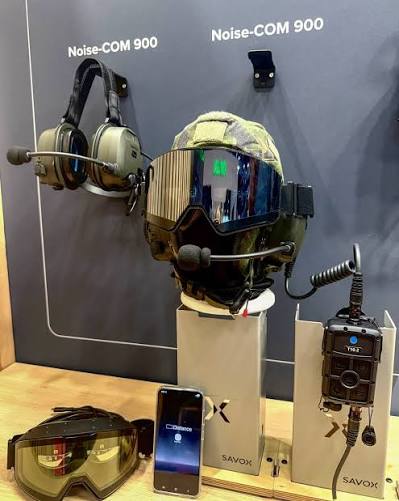
The Savox IMP Intercom System is a modular, fully digital intercom and communications platform designed for defence and public safety applications.
Its architecture allows radios, communications equipment and other mission systems to be integrated into a common communications environment. According to Savox, its open architecture is also intended to allow future upgrades without requiring complete replacement of the underlying system.
That approach reflects a broader shift in engineering towards designing complex systems for maintainability and upgradeability rather than treating them as fixed products with a defined end-of-life date.
Military platforms such as armoured vehicles, ships and aircraft can remain in service for decades. Their electronic and communication systems, however, can become obsolete much faster as processors, communications standards, software and cybersecurity requirements evolve.
The ability to upgrade individual components can therefore become as important as the performance of the original system.
Managing obsolescence
One of the major challenges in maintaining long-lived defence equipment is technological obsolescence.
A component that is readily available when a system is first deployed may no longer be manufactured several years later. This can leave military operators with otherwise functional equipment that becomes difficult or expensive to maintain because a critical electronic component, connector, software platform or communications module is no longer supported.
Lifecycle engineering seeks to address this problem before it becomes an operational constraint.
The modular architecture of the IMP system is intended to provide flexibility as technologies change, allowing individual elements to be upgraded while retaining the wider communications infrastructure.
For defence organisations, this can potentially reduce the cost and disruption associated with wholesale system replacement while preserving the value of existing investments.
The new agreement includes spare-parts management and repair services alongside development activities, creating a support structure intended to keep the installed systems operational while preparing them for future requirements.
Maintaining mission-critical communications
Communications are fundamental to military operations. Personnel operating vehicles, coordinating units or working with other mission systems must be able to exchange information reliably, often in environments where conventional communications infrastructure is unavailable or disrupted.
An intercom system therefore serves a function beyond voice communication. It can form part of the communications architecture linking personnel, radios and other equipment within a platform.
Reliability, maintainability and interoperability consequently become important engineering considerations alongside basic communications performance.
Savox Chief Executive Officer Jerry Kettunen said sustaining operational capability throughout a platform’s lifecycle was a critical requirement for defence organisations.
He said the agreement demonstrated the long-term nature of defence capability development and the importance of lifecycle support in maintaining mission-critical communication systems.
The company will provide technical support, repairs, spare parts, training and future development support under its broader lifecycle services offering.
From replacement to continuous capability development
The Swedish agreement illustrates a wider principle increasingly relevant to complex infrastructure and technology programmes: the engineering process does not end when a system is commissioned.
For systems expected to operate for many years, maintenance, upgrades, cybersecurity, spare-parts availability and technical expertise must be considered from the design stage.
This is particularly important as the proportion of electronics and software within military platforms continues to increase.
A modern platform can contain multiple interconnected digital systems, making compatibility between old and new technologies a continuing engineering challenge.
An open and modular architecture can provide one way of addressing this challenge by allowing new technologies to be incorporated without redesigning the entire platform.
The approach can also reduce the risk of technological lock-in, where an organisation becomes dependent on a specific generation of hardware or proprietary technology that eventually becomes difficult to support.
-
Product on sale
 AWEBook Volume 2Original price was: KShs 3,500.00.KShs 3,000.00Current price is: KShs 3,000.00.