
Last Updated 2 months ago by Kenya Engineer
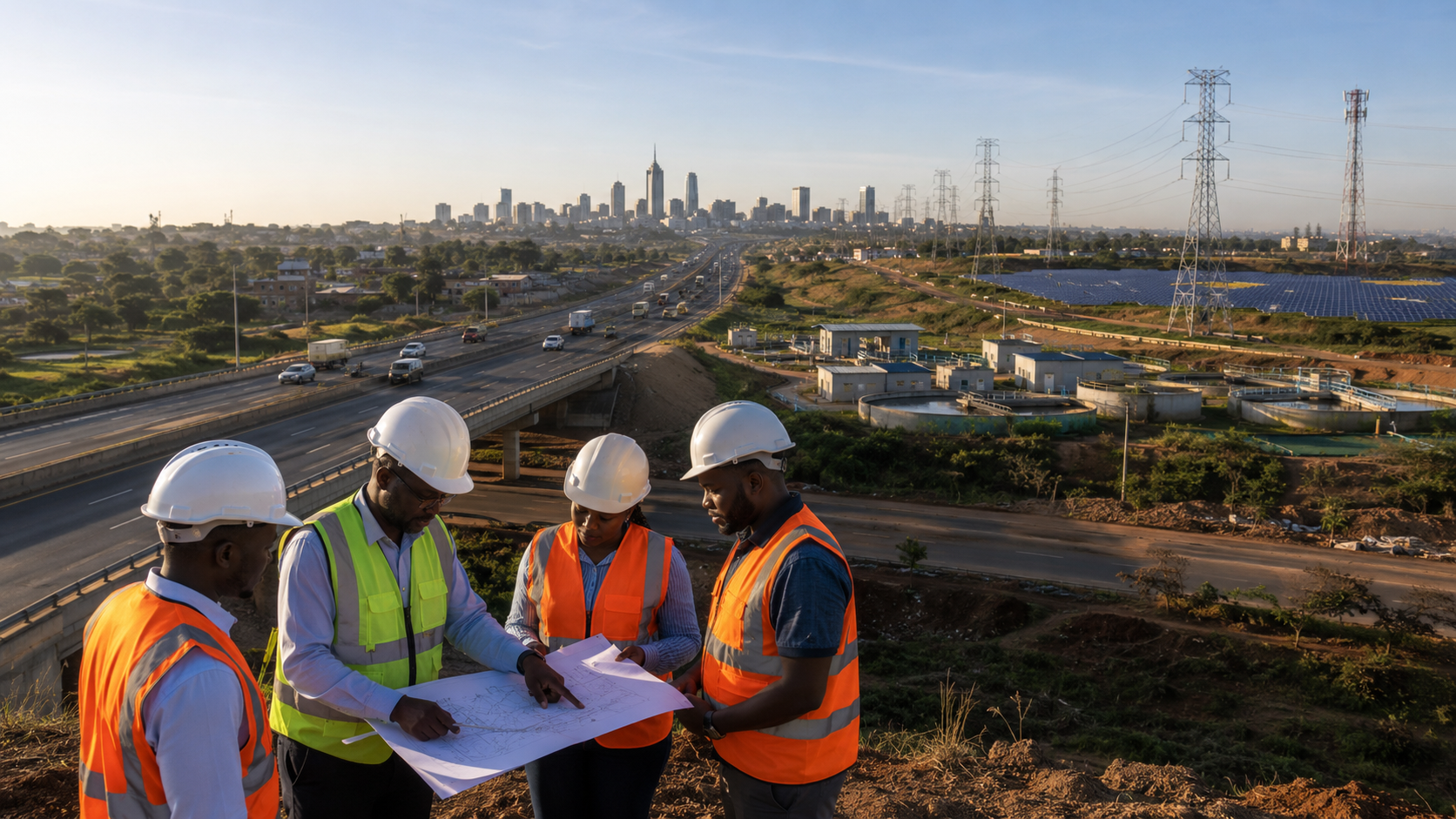
A percentage can sound deceptively simple in a conference hall. On construction sites, however, every additional fraction of GDP must eventually become land acquisition, designs, materials, machinery, skilled labour, supervision and years of maintenance.
That is the practical challenge behind Roads and Transport Cabinet Secretary Davis Chirchir’s proposal that Kenya should increase infrastructure investment from the present estimate of between 4% and 5% of gross domestic product to more than 7%.
Chirchir made the call on August 12 while opening the fifth annual conference of the Association of Consulting Engineers of Kenya in Naivasha. The conference, which runs from August 12 to 14, is examining green growth, smart infrastructure and the resilience of future engineering systems.
According to the Ministry of Roads and Transport, the Cabinet Secretary argued that Kenya’s existing investment rate will not be sufficient to meet rising demand for roads, water, energy and digital connectivity. He pointed to a population projected to reach approximately 85 million by 2050.
The demographic argument is persuasive. More people will require additional housing, transport capacity, electricity connections, water storage, sanitation, communications infrastructure and protection from floods and other climate hazards. Yet the scale of the proposed increase raises questions that cannot be answered by the spending target alone.
Moving from 5% to 7% of GDP would represent an increase of at least 40% relative to the current investment level. If the starting point is 4%, the increase would be at least 75%. Kenya must therefore decide not only where this additional capital will come from, but also which projects deserve priority and how their value will be protected over their full working lives.
The investment case is no longer limited to roads
For much of Kenya’s recent development history, infrastructure investment has been associated most visibly with highways, bypasses, railways and major bridges. The next phase will have to be broader.
A road serving a new industrial zone, for example, has limited economic value if the zone lacks reliable electricity, water, wastewater treatment and high-capacity digital connectivity. A new transmission line cannot deliver its intended benefit if distribution infrastructure remains congested. Urban road expansion will offer only temporary relief if drainage, public transport and land-use planning are handled separately.
In January, Kenya Engineer’s examination of Africa’s infrastructure outlook argued that transport, water, energy and digital infrastructure increasingly need to be planned as interconnected systems. Rapid urbanisation, industrial expansion and climate exposure are making the traditional sector-by-sector approach less effective.
Chirchir’s call for smart, green and climate-resilient infrastructure is therefore significant. He cited technologies such as digital twins, artificial-intelligence-assisted design and Internet of Things sensors as tools that can shorten design cycles, reduce errors and support predictive maintenance.
These technologies can improve delivery, but they are not substitutes for sound engineering fundamentals. A digital model will not correct an unrealistic demand forecast. Sensors will not compensate for an inadequate maintenance budget. Artificial intelligence can optimise designs, but responsibility for safety, professional judgement and compliance must remain clearly assigned.
The fiscal arithmetic cannot be avoided
Kenya’s need for infrastructure is expanding at a time when the government’s capacity to finance it through conventional borrowing is constrained.
The National Treasury’s FY2026/27 budget guide projects a fiscal deficit equivalent to 5.5% of GDP. It allocates KSh220.4 billion to the construction, rehabilitation and maintenance of roads and bridges.
Meanwhile, the World Bank reported in November 2025 that public debt had reached 68.8% of GDP at the end of FY2024/25. It continued to classify Kenya as being at high risk of debt distress, even as economic growth and construction activity showed resilience. The Bank warned that greater reliance on short-term domestic borrowing was increasing refinancing risk. World Bank figures also showed that interest costs and rigid expenditure were narrowing the room available for new development spending.
This does not invalidate the 7% ambition. It changes the conditions under which it can be pursued.
If the increase is financed mainly through new public debt, Kenya risks creating infrastructure whose economic returns are consumed by financing costs. The target must consequently distinguish between government expenditure and total infrastructure investment mobilised across the economy.
Private capital, pension funds, development-finance institutions, climate funds and public-private partnerships will all have a role. Concessional finance will be particularly important for water, climate adaptation and socially necessary projects that cannot generate commercial returns from user charges.
Private finance does not make infrastructure free
Public-private partnerships are frequently presented as the principal answer to limited fiscal space. Properly structured, they can introduce capital, specialist expertise, innovation and long-term maintenance obligations. They can also allocate construction and operational risks to the parties best placed to manage them.
They do not, however, eliminate the cost of a project.
The public eventually pays through taxes, availability payments, tolls, tariffs or guarantees. Poorly prepared PPPs can transfer costs into future budgets while keeping them less visible at the time a contract is signed. Unrealistic traffic forecasts, foreign-exchange exposure and government revenue guarantees can leave taxpayers carrying risks that were initially described as private.
Kenya therefore needs a disciplined pipeline of bankable projects rather than a long catalogue of proposals. Each project should undergo credible feasibility work, independent demand assessment, environmental and social review, affordability testing and transparent value-for-money analysis.
The Finance Act 2026 analysis previously published by Kenya Engineer noted that qualifying PPP infrastructure services can benefit from VAT relief. Such incentives may improve project economics, but they work best when accompanied by clear procurement documentation, realistic cost models and unambiguous risk allocation.
Private finance should supplement public investment where it offers demonstrable value. It should not become a mechanism for keeping liabilities outside the immediate budget.
Maintenance must count as investment
Kenya’s infrastructure debate also has to move beyond the political attraction of new construction.
Routine maintenance rarely attracts the attention given to launching a new road, bridge or water project. Yet delayed maintenance eventually produces more expensive rehabilitation. Failed drainage shortens pavement life; neglected mechanical equipment reduces the reliability of water systems; and overloaded transformers turn otherwise adequate electricity networks into operational bottlenecks.
A credible 7% framework should therefore state how much investment will be reserved for maintaining existing assets. This requires updated asset registers, regular condition assessments and protected maintenance budgets based on engineering evidence.
The public should be able to see whether an agency is extending the working life of infrastructure, not merely how many projects it has started. A kilometre of road kept in serviceable condition can sometimes produce more immediate value than a kilometre of new road whose economic justification remains uncertain.
Project preparation is the first infrastructure gap
Many delays blamed on contractors begin before a contractor reaches the site.
Incomplete designs, unresolved land acquisition, delayed relocation of utilities, weak geotechnical information and unrealistic bills of quantities frequently lead to variations, disputes and cost escalation. Late payments then weaken contractors and consulting firms, slowing work further and increasing the likelihood of claims.
If Kenya is to scale investment sharply, project preparation must be treated as a professional investment in its own right. Designs should reach adequate maturity before procurement. Land and environmental issues should be resolved early, while cost estimates should reflect current taxes, materials prices, climate risks and foreign-exchange exposure.
Consulting engineers also need conditions that protect professional independence. Selecting consultants almost entirely on the lowest fee can reduce the resources available for investigation, design review and site supervision. A modest saving during consultancy procurement can become an expensive variation during construction.
Higher investment should consequently be accompanied by stronger quality-based selection, timely payment for professional services, enforcement of registration requirements and meaningful participation by qualified Kenyan firms.
Measuring what infrastructure actually delivers
The success of the proposed increase should not ultimately be judged by the money committed or the number of groundbreaking ceremonies held.
Road investment should be connected to measurable changes in journey times, freight costs, safety and pavement condition. Water programmes should report additional reliable supply, reductions in non-revenue water and improvements in treatment performance. Energy projects should reduce outage duration, transmission constraints and the cost of connecting productive users.
Digital infrastructure should be assessed through coverage, affordability, redundancy and service reliability. Climate-resilient projects should show how they reduce expected losses from flooding, drought, heat or coastal hazards.
The same discipline applies to regional projects. Chirchir identified the 740-kilometre Horn of Africa Gateway Development corridor, port modernisation and the Dongo Kundu Special Economic Zone among the opportunities available to Kenyan engineers. Their value will depend on whether they generate additional trade, productive investment and employment—not simply whether physical construction is completed.
A useful target, if it changes how Kenya builds
The call to invest more than 7% of GDP can provide a useful national benchmark. Kenya’s growing population, industrial ambitions and climate vulnerability make continued infrastructure expansion unavoidable.
But a higher ratio will not, by itself, produce better infrastructure.
The real transformation will come from selecting fewer weak projects, preparing viable ones properly, protecting maintenance, publishing their financial obligations and measuring the services they deliver. It will also require engineers to be involved early enough to influence policy, financing and procurement—not brought in after key decisions have already been made.
Kenya does need to invest more. The country’s harder and more consequential task is to ensure that every additional shilling buys an asset that is safe, productive, maintainable and still useful decades after the launch ceremony.
-
Product on sale
 AWEBook Volume 2Original price was: KShs 3,500.00.KShs 3,000.00Current price is: KShs 3,000.00.