

Last Updated 1 day ago by Kenya Engineer
At Sawela Lodge in Naivasha, the exhibition stands told one story: electricity transmission, intelligent water metering, sustainable materials, digital monitoring and energy technologies presented as building blocks of a smarter Kenya.
Inside the conference halls, however, a more difficult story was unfolding.
Kenya knows how to imagine infrastructure. Its harder task is finding affordable capital, selecting projects that can survive financial scrutiny, maintaining what has already been built and ensuring that Kenyan engineers retain more than a supporting role in their own country’s development.
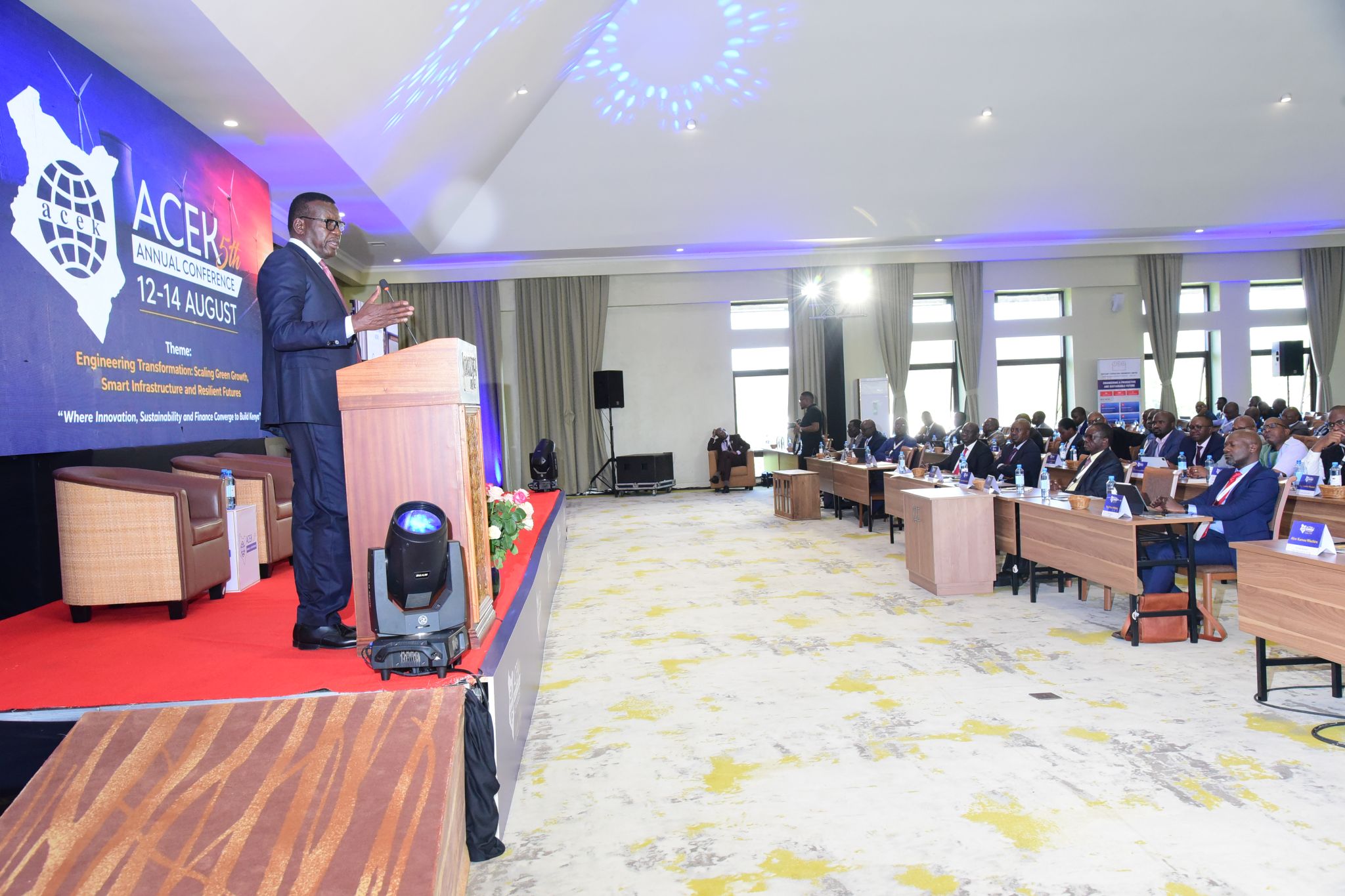
That tension animated the fifth Annual Conference of the Association of Consulting Engineers of Kenya, held from 12 to 14 August 2026 under the theme, Engineering Transformation: Scaling Green Growth, Smart Infrastructure and Resilient Futures. It followed the third ACEK Future Leaders Summit on 11 August.
Across the conference, conversations ranged from infrastructure finance and green industrialisation to artificial intelligence, construction safety, nuclear power, strategic asset management and the changing responsibilities of consulting engineers.
The strongest message was that the profession must move beyond designing technically sound projects. Engineers are increasingly expected to understand whether projects are investable, how they will be operated, what data they will produce, how they will withstand climate stresses and whether they will strengthen Kenya’s domestic engineering capacity.
The engineer as a shaper of investment
Opening the conference, Roads and Transport Cabinet Secretary Davis Chirchir challenged engineers to think beyond technical feasibility and participate more directly in shaping projects capable of attracting commercial and institutional capital.
Among the financing mechanisms he identified were public-private partnerships, the securitisation of revenue streams such as fuel levies, and implementation of the National Tolling Policy. His argument was that Kenya’s changing fiscal environment demands infrastructure that is not merely desirable, but properly structured, risk-assessed and bankable.
The distinction is important. An engineering design can be technically excellent and still fail to secure financing because expected revenues are uncertain, land risks have not been resolved, procurement structures are unsuitable or future maintenance obligations have not been realistically costed.
Kenya Engineer has previously examined this challenge in its analysis, What Kenya Must Fix Before Scaling Infrastructure Investment. The article considers Chirchir’s proposal to raise infrastructure investment from an estimated 4–5 per cent of GDP to more than 7 per cent, but argues that mobilising additional capital must be accompanied by better project preparation, procurement discipline and governance.
That context gave the Naivasha discussion its urgency. Kenya’s infrastructure ambitions are expanding at the same time that public debt and competing expenditure pressures are limiting the government’s room to finance projects conventionally.
The consulting engineer is therefore being pulled upstream—from receiving a completed brief to helping define the problem, model lifecycle costs, allocate risks and structure projects that investors can understand.
This does not mean that every road, water system or public facility must generate a commercial return. It means that engineering decisions must expose the true costs, benefits and risks early enough for government and financiers to choose suitable funding models.
Building Kenya—and Kenyan capacity
ACEK President Eng. Gabriel W. Jabongo pushed the conversation beyond finance to a longstanding concern within the profession: the role assigned to local engineering firms in foreign-financed projects.
He argued that externally led projects should become deliberate platforms for knowledge transfer and domestic capacity development. Kenya should not only host infrastructure; it should strengthen its capacity to design, deliver and eventually lead comparable projects.
This is more than a debate about professional pride. When local firms remain peripheral, the country loses opportunities to build specialist experience, improve company balance sheets, develop intellectual property and assemble multidisciplinary teams capable of competing elsewhere in Africa.
It also weakens institutional memory. Infrastructure requires decades of operation, adaptation and maintenance. A project whose most important technical knowledge leaves the country with the external consultant or contractor can become difficult and expensive to manage.
The harder policy question is how to turn the familiar call for “local participation” into measurable obligations. Requirements could include joint design responsibility, named knowledge-transfer outputs, participation in high-value technical work, documented training and transparent assessment of the responsibilities assigned to Kenyan firms.
Without such measures, local-content promises can be satisfied numerically while the most valuable engineering decisions remain elsewhere.
From emergency repairs to intelligent asset management
One of the conference’s most consequential discussions concerned infrastructure after commissioning.
Eng. Kundu Achoka warned against treating asset management as another name for maintenance. His succinct formulation—“Asset management is not maintenance”—captured the difference between periodically repairing an asset and managing its performance, risks, finances and remaining life as an integrated system.
Roads, bridges, power equipment and water networks are frequently maintained reactively: a defect is reported, a breakdown occurs or public pressure forces an intervention. Strategic asset management starts earlier. It connects inspection data, engineering condition, procurement, operating risk, funding and replacement planning across the asset’s lifecycle.
That idea was paired with Eng. Wanja Kinyua’s presentation of the proposed National Accountability Engine, an AI-enabled framework intended to address Kenya’s infrastructure-data gap.
The approach envisages combining artificial intelligence, Internet of Things devices and remote sensing to map assets, assess their condition and support predictive interventions. Earlier work associated with the proposal reported the potential for substantially faster road-condition surveys and automated identification of defects.
The underlying principle is more important than any single platform: Kenya cannot manage infrastructure intelligently if it does not possess reliable, continuously updated information about what exists and what condition it is in.
Digital twins, mobile mapping, sensors and machine-learning systems could help public agencies move from scattered spreadsheets and emergency inspections towards evidence-based maintenance. Yet the technology raises governance questions that deserve equal attention.
Who owns infrastructure data gathered by a private contractor? Which agency is responsible for maintaining the database? How are automated defect assessments independently validated? Can counties with limited technical capacity use the system? How are cybersecurity risks managed when sensors and operational platforms become connected?
As Kenya Engineer noted in its recent review of Kenya’s AI governance and investment ambitions, predictive systems used in safety-critical environments must be evaluated not only for average accuracy but also for failures that could allow dangerous defects to go undetected.
The conference correctly presented digitalisation as an opportunity. Its success will depend on treating data standards, validation and institutional ownership as engineering requirements rather than administrative afterthoughts.
Green growth moves towards the balance sheet
Green growth at the conference was framed less as a collection of environmental additions and more as a redesign of how infrastructure is conceived, financed, built and operated.
A panel involving Kenya Green Building Society CEO and ESG Lead Nasra Nanda argued that sustainability must be integrated across the built-environment value chain. Resource efficiency, climate resilience, sustainable materials and building performance should influence the project from conception—not be added after the major design and procurement decisions have already been made.
The distinction matters. A building does not become sustainable merely because solar panels, a green roof or a water-recycling installation appears in its final design. Its location, orientation, material quantities, thermal performance, adaptability and operational energy demand may be more consequential over its lifetime.
The conference also explored circular solutions, green buildings, smart energy management and IoT-enabled resource efficiency. These subjects suggest that the profession is beginning to move from discussing sustainability principally as compliance towards treating it as a performance question.
That shift will ultimately require measurable baselines. Claims about “green” infrastructure should be supported by whole-life carbon assessment, energy and water performance data, climate-risk analysis and post-occupancy evidence.
Otherwise, green growth risks becoming a persuasive conference vocabulary without changing what is built.
An energy system becoming larger—and more complex
Energy discussions demonstrated the widening range of choices Kenya’s engineers must evaluate.
Kenya Power Managing Director and CEO Dr (Eng.) Joseph Siror called for deeper collaboration in energy storage, climate-resilient infrastructure, energy efficiency and local innovation. He also highlighted the utility’s expansion to 10.4 million customers and a network extending approximately 344,116 kilometres, alongside investment in automation, digital transformation, e-mobility, e-cooking and renewable-energy integration.
Those figures describe both progress and exposure. A larger grid connects more households and enterprises, but it also increases the volume of equipment that must be inspected, protected, maintained and replaced.
KETRACO used its exhibition presence to highlight the National System Control Centre, STATCOM technology for grid stability and transmission developments including the Kisumu–Kakamega–Musaga 220kV line. These are examples of the less visible infrastructure required to integrate generation and maintain voltage and system stability as the power network evolves.
Conference sessions also considered nuclear power as a possible element of Kenya’s future energy mix. Nuclear energy’s inclusion was significant, even without evidence in the public conference record of a new project decision.
The technology cannot be judged on generation output alone. Its suitability depends on system size, capital cost, financing, construction risk, regulatory independence, waste management, emergency preparedness and the availability of a long-term technical workforce.
The value of placing nuclear energy alongside storage, renewable integration and intelligent energy management is that it forces the profession to compare complete systems—not individual technologies presented in isolation.
The safety question Kenya cannot continue postponing
Engineers Board of Kenya Registrar and CEO Eng. Grace Onyango brought one of the conference’s most uncomfortable questions into view: what does it say about the construction industry when safety may receive less than one per cent of a project budget?
EBK’s account of her intervention stressed the need for stronger skills, professional capacity and a more serious safety culture across construction.
Safety is often described as a priority while being treated commercially as an overhead. Training is compressed, protective equipment is inconsistently enforced, site supervision is stretched and safety provisions become vulnerable when contractors compete primarily on price.
The consequences are borne by workers, their families, the public and ultimately the project itself.
Kenya Engineer has previously reported on the EBK–Lloyd’s Register Foundation construction-safety programme, intended to improve competence and safety culture. The conference intervention showed why such efforts must extend into procurement and project governance.
If safety obligations are not adequately priced, independently monitored and enforced through contracts, training campaigns alone will struggle to change outcomes.
A serious response would require clients to demand project-specific safety plans, consultants to treat safety as a design responsibility, contractors to cost it transparently and regulators to measure performance through leading indicators—not only accident statistics after harm has occurred.
The young engineer as entrepreneur
The Future Leaders Summit added a generational dimension to these debates.
An attendee account by engineer Kariuki David reported that Eng. Gabriel Jabongo placed Kenya’s registered-engineer population at approximately 37,200 and set out an ambition to grow the number of Professional Engineers to 10,000 by 2030.
Eng. Harrison Keter challenged younger participants to view themselves as present actors rather than engineers waiting for their turn: “You’re not the next generation; you’re the generation.”
Other summit contributions explored engineering entrepreneurship, professional visibility, ethics, knowledge transfer and participation in PPPs through consortiums and special-purpose vehicles.
The emphasis on enterprise is timely. Kenya produces technically capable graduates, but many enter a market in which established firms dominate major assignments and smaller consultancies struggle with experience thresholds, financing and professional indemnity requirements.
Encouraging entrepreneurship without addressing these structural barriers would be incomplete. Young firms need access to smaller but meaningful assignments, fair subcontracting arrangements, mentorship tied to actual project responsibility and procurement systems that recognise innovation without compromising competence.
The gap between conversation and execution
Publicly available conference coverage reveals no major formal disagreement among speakers. The more important tensions were embedded in the subjects themselves.
Kenya wants more infrastructure but faces limited public capital. It wants foreign investment but also stronger local engineering firms. It wants rapid project delivery but must improve safety, environmental performance and lifecycle planning. It wants AI-enabled infrastructure management but still has fragmented asset data and uneven institutional capacity.
These are not contradictions that one conference could resolve. They are the working conditions of Kenya’s next development phase.
ACEK’s conference succeeded in bringing the debates into the same room. The test now is whether they become changes in project preparation, procurement documents, design standards, professional training and maintenance budgets.
At the closing conference dinner, supported by Ebara Pumps East Africa, Eng. Jabongo said the outcomes should form a roadmap for the profession beyond Naivasha. That is the right standard by which the gathering should eventually be judged.
The best conference report a year from now would not be another recitation of themes. It would identify projects financed differently, safety budgets protected, Kenyan consultants entrusted with substantive responsibility, infrastructure assets mapped and monitored, and green-performance claims verified in operation.
Engineering transformation will not be measured by the elegance of the language used at Sawela Lodge. It will be visible in the quality, safety, intelligence and longevity of what Kenya builds next.
-
Product on sale
 AWEBook Volume 2Original price was: KShs 3,500.00.KShs 3,000.00Current price is: KShs 3,000.00.