
Last Updated 2 months ago by Kenya Engineer
The commissioning of the 132kV Machakos–Konza–Isinya–Namanga transmission infrastructure has placed renewed attention on the electricity network supporting one of Kenya’s important economic corridors.
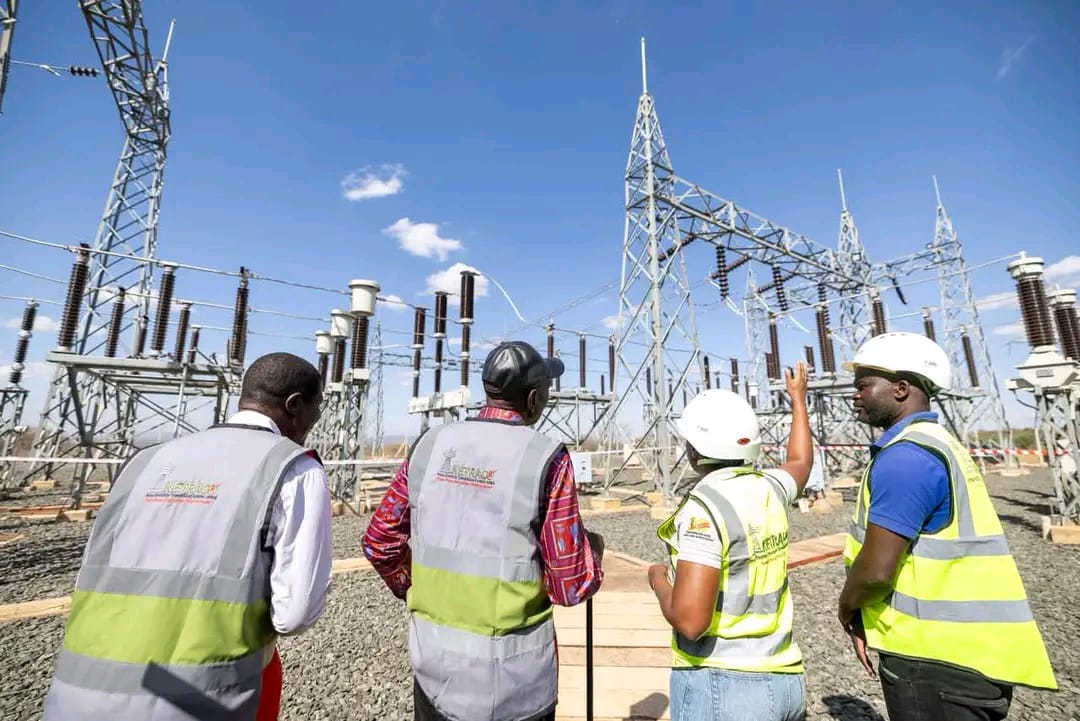
Commissioned by President William Ruto on 3 September 2026, the project connects Machakos, Konza, Kajiado and Namanga through a 109-kilometre high-voltage transmission corridor, supported by 132/33kV substations at Machakos, Konza, Kajiado (Isinya) and Namanga.
Implemented by the Kenya Electricity Transmission Company Limited (KETRACO), the infrastructure is intended to strengthen the electricity backbone serving the corridor’s growing industrial, commercial and residential activity.
But its significance extends beyond the commissioning ceremony. The project illustrates how transmission infrastructure can support economic development by connecting major load centres, improving the capacity of the national grid and creating room for new investment.
A corridor built in stages
The Machakos–Konza–Isinya–Namanga project is not a single newly energised line.
According to KETRACO, the 15-kilometre Machakos–Konza section was energised in October 2016, while the 94-kilometre Isinya–Namanga section was energised in February 2024. The substations are fully operational.
The commissioning therefore marks the formal recognition of an infrastructure development that has progressed in stages.
That distinction matters when assessing the project’s contribution. Transmission investments are often delivered over several years, with individual sections entering service as they are completed. Their full value is realised through integration into the wider network and the ability to serve connected demand.
In this case, the completed corridor strengthens the connection between the Machakos–Konza area, Kajiado and Namanga, creating additional capacity for electricity supply along the route.
Supporting the next phase of industrial growth
The project’s most immediate economic significance lies in the load centres it serves.
KETRACO says the infrastructure supports dedicated and uninterrupted power supply to Konza Technopolis and SGR operations, while integrating Machakos, Konza, Kajiado, Bisil, Kumpa and the Namanga cross-border post into the high-voltage national grid.
It also provides additional capacity for energy-intensive industries along the Kajiado–Namanga corridor, including cement manufacturing, ceramic and tile factories and industrial parks.
For these industries, electricity is not simply another operating expense. It is a basic production input.
Manufacturing processes, pumping systems, refrigeration, automation and other industrial operations depend on a reliable supply of power. Where transmission capacity is constrained, the ability to expand production can be limited even when demand and investment opportunities exist.
The project is therefore part of the infrastructure required to support industrial growth in the corridor.
It is not, by itself, a guarantee that new factories will be established or that existing businesses will expand. Those outcomes will also depend on investment, land, transport, water, labour, markets and the cost of electricity. But stronger transmission infrastructure can remove one of the constraints that businesses face when making those decisions.
Why transmission matters
Electricity generation and electricity transmission perform different functions in the power system.
Generation produces electricity. Transmission moves it over high-voltage networks to substations, where it can be stepped down and distributed to consumers.
A country may have sufficient generation capacity and still experience supply constraints in particular areas if the transmission network is unable to move power where it is needed.
That is why projects such as the Machakos–Konza–Isinya–Namanga corridor matter.
They strengthen the network that connects generation and demand, improve the ability to serve growing load centres and provide additional routes through which electricity can reach businesses and communities.
KETRACO says the project will strengthen electricity quality and reliability for businesses and communities across Southern Kenya up to the Tanzania border.
The wider objective is to develop a transmission system capable of supporting Kenya’s growing electricity needs.
Namanga and the regional dimension
The project also has a regional significance.
Namanga is a major cross-border gateway between Kenya and Tanzania. The transmission corridor extends the high-voltage network to this important economic connection, strengthening the electricity infrastructure serving Southern Kenya.
KETRACO Acting Managing Director Eng. Kipkemoi Kibias said the investment would support businesses, industries and communities across the region while strengthening infrastructure for cross-border economic activity.
The regional dimension is important because electricity infrastructure increasingly forms part of the broader East African economic integration agenda.
Cross-border trade depends on more than roads and customs facilities. It also depends on the reliability of the infrastructure supporting businesses, logistics, manufacturing and commercial activity on both sides of the border.
The Isinya–Namanga corridor does not itself establish a regional electricity market. However, it strengthens the Kenyan transmission network at a point where economic activity and cross-border movement are concentrated.
A project with a long financial history
The project’s financing also reflects the long-term nature of major transmission investments.
KETRACO says the infrastructure was executed in partnership with Shyama Power Limited of India and co-financed by the Government of Kenya and the Export-Import Bank of India (Exim Bank). The release states that the Exim Bank line of credit facility was signed in December 2010 and that the project had a total cost of USD 9.47 million.
The figures and financing arrangements are part of the project’s history, but they also point to a broader issue in infrastructure development: the time between financing commitments, construction, energisation and the eventual realisation of economic benefits.
For transmission infrastructure, the value of an investment is not measured only by the length of the line or the number of substations. It is also measured by the demand it can serve, the reliability it supports and the economic activity it enables.
What comes next?
The commissioning provides an opportunity to assess the corridor’s contribution to Kenya’s wider electricity development plans.
The next question is how effectively the additional transmission capacity will be used.
That will depend on the growth of demand along the corridor, the development of industrial and commercial facilities, the performance of the distribution network and the availability of electricity to be transmitted.
It will also depend on continued investment in the wider grid.
KETRACO’s mandate includes developing high-voltage transmission lines and regional power interconnectors, improving the quality and reliability of electricity supply, evacuating power from planned generation points and facilitating power exchange with neighbouring countries.
The Isinya–Namanga project fits within that broader responsibility.
Its significance is therefore not limited to the infrastructure commissioned on 3 September. It is part of the continuing effort to build a transmission network capable of supporting Kenya’s economic growth and regional integration.
For the Machakos–Konza–Kajiado–Namanga corridor, the immediate task is to translate that infrastructure into reliable electricity supply, productive investment and improved economic opportunity.
The commissioning marks an important step. The longer-term measure of success will be what the strengthened network makes possible.
-
Product on sale
 AWEBook Volume 2Original price was: KShs 3,500.00.KShs 3,000.00Current price is: KShs 3,000.00.