





Last Updated 2 months ago by Kenya Engineer
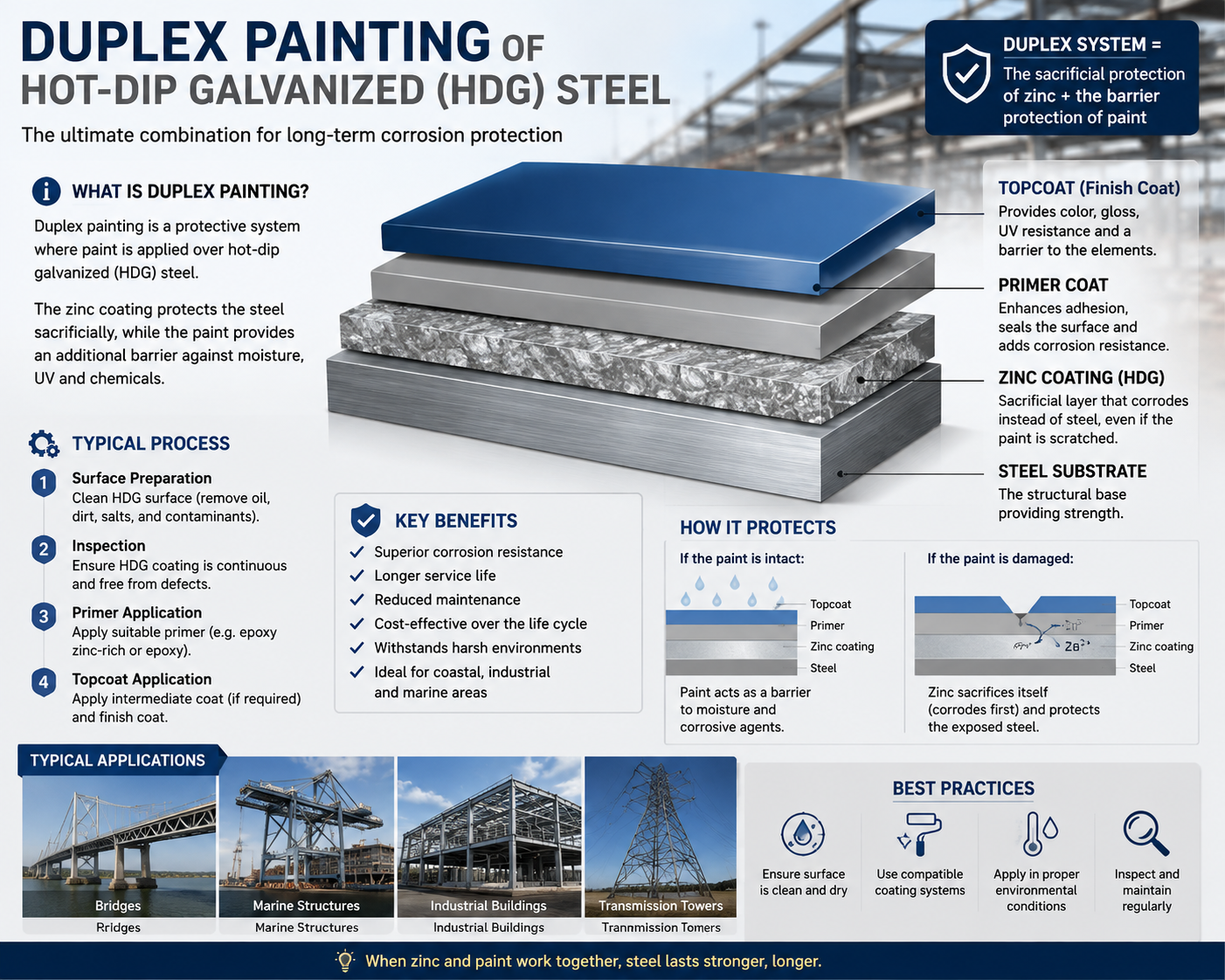
Over recent times I have been asked to revisit the ongoing failures of duplex coatings when applied to galvanized structures. This article examines the relationship between the difficulties and failures associated with duplex painting of hot-dip galvanized (HDG) steel. It discusses a range of issues, some of which are not well understood or widely known, and the effects of not using appropriate procedures during either the galvanizing or painting process.
The purpose is to provide coating specifiers, steel fabricators, galvanizers, inspectors and the painting industry with a better understanding of the problems that can adversely affect painted HDG structures.
Delamination of duplex coatings is a well-documented phenomenon. Experience over many years has highlighted a lack of understanding among the various industries involved about the failures and damage that can occur to HDG.
The debate over responsibility has largely centred on damage caused by the sweep abrasive blasting necessary to provide a mechanical key for adhesion. However, even when recommended practices are followed, damage can be sustained to HDG for reasons that are not commonly known or understood.
The resulting damage can appear as peeling, pinholes or the creation of voids. Steel fabricators are generally faced with this predicament because surface treatment is often part of their work scope. Consequently, the reputation of the painting contractor, galvanizer and others in the chain of events can come into question, while the facility owner may face costly project delays, litigation and future costs if premature coating failure occurs.
Where abrasive sweep blasting causes removal or damage, the specific cause must be identified before responsibility is attributed. This is essential if similar failures are to be prevented on future projects.
Understanding the HDG Process
It is scientifically recognised that metallic zinc, when in contact with iron, provides corrosion protection, with the volume of zinc rather than simply its weight playing an important role in determining service life.
It is common industry practice to describe HDG as a “98% zinc coating”. This description can be misleading because the 98% figure refers to the purity of the zinc used in the galvanizing process. There is also an implied perception that the thickness of the coating represents metallic zinc alone.
The galvanizing process actually creates an integrated metallic alloy comprising varying degrees of zinc, iron and lead. The resulting coating consists of four distinct layers—Gamma, Delta, Zeta and Eta—with an average metal weight mass of approximately 58.5% zinc, 40% iron and 1.5% lead.
For example, an 85-micron coating thickness equates to approximately 610 g/m² and, according to the calculation presented here, comprises approximately 357 grams of zinc, 244 grams of iron and 9 grams of lead.
The lead component is associated with two aspects of the galvanizing process. Galvanizing kettles have historically incorporated a layer of lead beneath the molten zinc for operational reasons, including protection and insulation and assisting with the removal of dross, ash and flux skimmings. In addition, the zinc feedstock referred to in the original technical material contains lead.
The upper Eta layer is relatively soft compared with carbon steel. Zinc is approximately 70 DPN compared with steel at around 159 DPN. For this reason, the air pressure used during sweep blasting of HDG in preparation for painting needs to be controlled, with a maximum of 40 PSI recommended here to reflect the lower hardness and malleability of metallic zinc.
Abrasive Blasting and the Kirkendall Effect
When damage to HDG and duplex paint failures occur, the causes are often not clearly identified. In many cases, responsibility is attributed to the abrasive blasting process, painting practices or defective paint materials.
My experience indicates that, in many cases, duplex paint failures are associated with the galvanizing process and subsequently exacerbated by the abrasive sweep-blasting procedure required to create a surface profile for adhesion.
One area that deserves considerably more attention is what is known as the Kirkendall Effect.
In 1947, Dr Ernest O. Kirkendall of Wayne State University in the United States described the effect that now bears his name. His experiments demonstrated that, at elevated temperatures, inter-diffusion between metals can occur at an atomic level.
In HDG, the metallurgical reaction between zinc and steel continues below the melting temperature of zinc, which is approximately 420°C. Under certain conditions, this can result in the formation of voids at the interface between the Eta and Zeta layers.
These voids can adversely affect the bonding and adhesion between the upper HDG layers. If they are disturbed or exposed during abrasive blasting, they can manifest themselves as pinholes, peeling or detachment.
The concern is particularly associated with the cooling stage following galvanizing. Where HDG is slowly air-cooled or is not adequately quenched immediately after treatment, atomic diffusion can continue. If this occurs, atoms can migrate under elevated temperatures and subsequently leave voids as the material cools.
Where peeling does not occur, these holes or voids may remain unnoticed because they can be extremely difficult to detect with the naked eye.
The subsequent application of paint can compound the problem. Paint applied over such voids can result in solvent entrapment during curing. Localised temperature changes associated with solvent entrapment and evaporation can produce blisters in the still-liquid coating.
This phenomenon is particularly relevant to two-pack materials such as epoxy, polysiloxane and polyurethane. Retained solvent can act as a plasticiser during curing and contribute to blistering and detachment of the coating from the HDG surface.
The exterior coating may remain apparently intact because of its high cohesive film strength while adhesion to the HDG surface has already been compromised. Voids and gaps at the interface can then provide a location for water, oxygen and soluble salts to accumulate, activating the protective properties of the zinc and potentially accelerating the failure mechanism.
This raises an important question. Why is the possible effect of the Kirkendall phenomenon on duplex coating failures not more widely recognised within the galvanizing and painting industries?
When such failures occur, experience has shown that the painting contractor can often be the party left carrying the consequences, even where the origin of the problem lies elsewhere in the chain.
What Happens When the Zinc Surface Is Disturbed?
Following galvanizing, a protective film of zinc corrosion products, including zinc carbonates, develops on the surface as the zinc reacts with oxygen and carbon dioxide. This initially inhibits corrosion.
When this protective surface is removed—whether through natural atmospheric erosion or abrasive sweep blasting—the underlying zinc becomes more reactive.
This is particularly significant in marine, chemical, damp and humid environments. Zinc corrosion products can accumulate at the HDG/paint interface, resulting in adhesion failure between the two materials. This powdery zinc corrosion material is sometimes referred to as efflorescence bleeding.
Abrasive blasting is, of course, necessary in many duplex coating systems because it provides the surface profile required for mechanical adhesion. The difficulty is that the same process also removes the protective surface film and exposes fresh, reactive zinc.
Once exposed to an electrolyte consisting of water, oxygen and soluble salts, the galvanic protection mechanism of the zinc becomes active. If the electrolyte penetrates the paint as vapour or through pinholes, zinc corrosion can occur beneath the coating.
The resulting corrosion material occupies a substantially greater volume than the original zinc surface and is hygroscopic. This can draw additional electrolyte towards the interface, increasing the corrosion cycle and allowing progressively larger quantities of zinc corrosion products to accumulate between the HDG and paint.
This is one reason I believe considerable caution is necessary when specifying duplex coatings.
Why Inorganic Zinc Coatings Behave Differently
There is an important distinction between a galvanized zinc surface that is subsequently painted and an inorganic zinc coating.
In an inorganic zinc coating, metallic zinc exists in particle form distributed throughout the coating film and surrounded by an inorganic binder. Corrosion products generated within the coating are therefore able to accumulate within the coating itself rather than predominantly at the interface.
While a small quantity may gather at the interface, the mechanism is different and, in my experience, this is not normally sufficient to cause the same degree of adhesion failure of the topcoat system.
The commencement of zinc corrosion beneath a paint system depends in part on the ability of water vapour or liquid water to penetrate the coating. This is influenced by paint thickness and the moisture-vapour transmission characteristics of the coating system.
No organic duplex coating can be assumed to be completely impermeable over time. Water vapour can move through coatings in either direction.
A coating is primarily designed to keep the external environment out. However, once moisture has penetrated the coating film and reaches the underside, it can become trapped at the interface between the paint and zinc. Water, oxygen and soluble salts then provide the basic ingredients required for zinc corrosion.
Once corrosion has started, stopping the process can be extremely difficult because the resulting corrosion material is hygroscopic and can continue to draw in moisture unless one of the essential elements is removed. Under an installed coating system, that is often improbable.
Sharp Edges: A Small Detail With Major Consequences
Another area that deserves much greater attention is the treatment of sharp edges and corners.
A significant proportion of coating failures can begin in these areas because most duplex coating materials cannot be applied successfully over a sharp edge. During drying and curing, the coating tends to draw back from the edge, leaving a thinner film no matter how carefully it is applied.
For this reason, galvanizing guidance specifically recommends that sharp edges be removed or smoothed. Where duplex coatings are to be applied, edges should be radiused—3 mm is recommended in the technical guidance referenced in this article—to help ensure continuity of the dry film.
The important point is that this work should be undertaken by the steel fabricator before galvanizing. Where duplex coating is not required, additional zinc growth around sharp edges can actually provide an advantage.
The same principle applies to cracks, rough welds, weld spatter and other discontinuities.
Good painting practice requires rough welds and sharp edges to be ground smooth. Weld spatter should be removed, skip-welded seams should be completed with continuous welds where required, baffles should be welded on both sides and rivets and bolts should be properly secured.
These may appear to be fabrication details, but they can ultimately determine the performance of the corrosion-protection system.
UV Exposure and Organic Duplex Coatings
UV resistance is another consideration.
Organic duplex materials will, over time, experience chalking. As the coating surface degrades, film thickness can be reduced and the opportunity for electrolyte penetration increases.
Depending on the coating material and environmental conditions, chalking can become significant. This needs to be considered when selecting a coating system intended to provide long-term protection as well as an architectural finish.
This is why coating selection cannot be based simply on the initial appearance of the finished steel. The behaviour of the coating throughout its intended service life must be considered.
The Architectural Finish Problem
There is another issue that is frequently overlooked.
The principal HDG standards are concerned primarily with the product and the corrosion-protection process. They do not necessarily address all of the requirements associated with an architectural finish.
Designers are increasingly specifying an architectural appearance for galvanized components. In effect, this creates a requirement beyond conventional corrosion protection and requires additional consideration during procurement, fabrication, galvanizing and painting.
Painting will highlight imperfections that may not be particularly obvious on an unpainted galvanized surface. Lumps, bumps, spikes, weld remnants and other imperfections can become highly visible once a uniform paint coating is applied.
For this reason, the galvanizer should be informed at the tender stage that the galvanized steel will subsequently be painted and that an architectural finish is required.
All imperfections that could affect the finished appearance should be addressed before the galvanized components are dispatched for painting.
An architectural HDG finish therefore comes at an additional cost. The inherent nature of the galvanizing process means that the surface is less uniform than a conventional spray-painted steel surface and can highlight imperfections once a duplex coating is applied.
This is not necessarily a defect in the galvanizing process. It is a consequence of asking the material to satisfy an additional aesthetic requirement.
Steel Chemistry: Silicon and Phosphorus Matter
One of the most important issues begins even earlier—with the chemistry of the steel itself.
It has long been established that steels containing higher levels of silicon or phosphorus can increase the rate of the galvanizing reaction and accelerate the growth of the iron-zinc layers.
These steels are commonly described as reactive steels. They can produce galvanized coatings that are considerably thicker than normal and may have a smooth, dull-grey or rough, sandpaper-like appearance.
Where the reaction becomes extreme, the galvanized coating can detach or flake from the steel substrate. In extreme cases, coating thickness can be several times the normal requirement.
The reactivity of steel can be assessed using the Silicon Equivalent calculation:
Silicon Equivalent = %Si + 2.5 × %P
Welding rods containing elevated levels of these elements can also contribute to excessive zinc thickness.
The important point is that this information should be known before the steel is purchased and before the galvanizing contract is placed.
If high levels of silicon or phosphorus are unavoidable, the galvanizer should be informed in advance. There are measures that can be taken to minimise excessive zinc deposition.
Testing for these elements is relatively inexpensive when compared with the potential cost of increased zinc consumption, rework, disputes or coating failure.
The specification should therefore identify the required steel chemistry, particularly where a high-quality architectural finish is required. Steel and welding consumables should be supported by appropriate chemical-analysis certification.
It should also be recognised that a material certificate represents the composition at the sampled location and does not necessarily guarantee perfect homogeneity throughout every part of a steel item.
Greater zinc thickness is not necessarily a problem. Provided the coating remains properly bonded and does not detach, additional zinc thickness can extend the service life of the galvanized component.
Controlling Excessive Zinc Thickness
Where steel has high silicon or phosphorus levels, there are several measures a galvanizer can consider to minimise the effects.
These include:
- Operating at the lowest practical galvanizing temperature, around 435°C.
- Pre-heating the steel before galvanizing.
- Ensuring rapid entry and exit from the galvanizing bath.
- Using suitable alloying additions such as nickel where appropriate.
The first three measures are relatively straightforward. The use of nickel can be more expensive, but where highly reactive steel is involved, the additional cost can be justified by the potential reduction in excessive zinc deposition and associated problems.
The critical lesson is that the galvanizer should not be expected to discover the steel chemistry only after the steel has emerged from the zinc bath.
The fabricator, specifier and galvanizer should know the chemistry in advance.
Who Is Responsible When a Duplex System Fails?
Corrosion protection is not the responsibility of one contractor.
The process begins with the designer and specifier, continues through steel procurement and fabrication, and then passes through galvanizing, surface preparation, coating application, transportation and erection.
Unless all parties take known measures to mitigate the potential problems, it becomes difficult to justify a claim against one party when something goes wrong.
Structural steel is normally on the critical path of a construction project. A failure can therefore have consequences far beyond the cost of repairing a coating. It can cause delays, disruption, contractual disputes and, in serious cases, substantial financial losses.
The abrasive blasting and coating industry has a responsibility to ensure that HDG accepted for painting has undergone appropriate quality assurance.
Equally, the painting contractor has a responsibility for its own QA activities and must ensure that specified preparation and application procedures are followed.
Damage can also occur during transportation, unloading and final erection.
The lesson is simple: the corrosion-protection system must be managed as a complete system rather than as a series of disconnected contracts.
Design Can Also Affect the Cost
Fabrication design can have a significant effect on the economics of corrosion protection.
For example, boxed or rolled hollow sections need to be appropriately vented or open-ended for safe galvanizing. When both internal and external surfaces are treated, the quantity of zinc and the associated handling and processing requirements increase.
Where the design and application permit exterior-only zinc painting instead, there can be significant savings. The technical material examined here indicates that, for certain high-volume hollow-section applications, the saving can reach approximately 20–25%.
However, this comparison is project-specific. Different structures, quantities and corrosion-protection requirements can produce very different outcomes.
What Should Project Teams Do Differently?
The potential for duplex coating failures can be reduced considerably if the issue is addressed before work begins.
The galvanizer should be informed at the tender stage that the HDG steel is to receive a subsequent paint coating.
The steel and welding consumables should be specified with appropriate silicon and phosphorus limits, and chemical certification should be obtained.
Fabricators should address sharp edges, weld spatter, rough welds and other surface imperfections before galvanizing where these could affect the final finish.
The galvanizing process should be controlled with the subsequent duplex coating requirement in mind.
Following galvanizing, the surface should be properly assessed before sweep blasting, and blasting pressures should be carefully controlled.
The completed coating system should then be subjected to appropriate inspection, including adhesion assessment and testing for pinholes and holidays where required.
These inspection costs are relatively minor compared with the cost of discovering a failure after the structure has been transported, erected and placed into service.
Health and Safety Considerations
There is also a health and safety consideration that should not be overlooked.
Where lead is present within the galvanizing process, abrasive removal of galvanized material can result in contamination of the work environment. Appropriate precautions should therefore be taken during abrasive blasting.
Welding of galvanized steel presents another hazard because of the high temperatures involved and the potential generation of metal fumes. Appropriate respiratory protection and effective ventilation should be mandatory wherever the work creates exposure risks.
Health and safety considerations must form part of the corrosion-protection specification rather than being treated as an afterthought once work has begun.
Is HDG Better Left Uncoated?
Hot-dip galvanizing has an outstanding performance record and remains one of the most effective methods of protecting steel against corrosion.
However, a distinction needs to be made between the performance of HDG as a standalone corrosion-protection system and the performance of a duplex system in which paint is subsequently applied over galvanized steel.
The protective zinc surface plays an important role in delaying corrosion. My concern is that removing this surface during preparation for painting and then placing a relatively impermeable organic coating over reactive zinc can create conditions in which corrosion products accumulate at the interface.
Experience and case histories indicate that HDG is often better left uncoated.
Where painting is nevertheless required—whether for additional corrosion protection, identification or architectural reasons—the specification, surface preparation, coating selection and inspection procedures need to be given serious consideration.
Consider the Alternative
Comparisons between corrosion-protection systems are not always straightforward. Each system has its own strengths, limitations, environmental requirements and application procedures.
Nevertheless, where HDG is being considered specifically for subsequent painting, I believe a proven alternative zinc-paint system deserves consideration.
An inorganic zinc system does not expose a continuous layer of solid metallic zinc at the coating interface in the same manner. Inter-coat adhesion can be more reliable, and the system can avoid some of the additional preparation associated with painting HDG.
It is also less affected by the silicon and phosphorus content of the underlying steel and can provide a more uniform aesthetic appearance.
The cost comparison presented in this study illustrates that, for a particular 300-tonne structural-steel example, the estimated cost of HDG plus the subsequent preparation and top-coating process was approximately US$719,100, compared with approximately US$442,920 for an inorganic solvent-based zinc system and US$457,920 for a water-based inorganic zinc system. These figures are project-specific and should not be treated as universal market prices, but they demonstrate why the complete protection system—not merely the initial galvanizing price—needs to be considered.
The comparison also highlights an important issue: the true cost of a corrosion-protection system includes preparation, transportation, handling, inspection and potential repair—not simply the price of the primary coating.
Conclusion
The problems associated with duplex coatings on galvanized structures cannot simply be attributed to poor painting.
Incorrect blasting practices, excessive blast pressure, removal of the protective zinc surface, possible Kirkendall voids, excessive HDG thickness associated with steel chemistry, sharp edges, surface imperfections, moisture penetration and inadequate quality assurance can all contribute to premature failure.
The problem is therefore a system problem.
The galvanizer needs to know that the steel will subsequently be painted. The fabricator needs to understand the detailing requirements. The steel supplier needs to provide appropriate chemistry information. The painter needs to understand the characteristics of galvanized steel. The inspector needs to verify the preparation and coating system. The designer and specifier need to recognise the limitations and requirements of the selected system.
Most importantly, these requirements need to be established before the first piece of steel enters the galvanizing bath.
HDG remains an outstanding method of protecting structural steel. But where it is to be combined with a paint coating, the decision should not be made simply because “more coating must mean more protection”.
A duplex system is a complete corrosion-protection system. Its success depends on the compatibility and performance of every stage—from steel chemistry and fabrication through galvanizing, surface preparation and painting to transportation, erection and service.
Where these factors are properly understood and controlled, the likelihood of premature failure can be substantially reduced.
Where they are ignored, the industry should not be surprised when the paint fails—and the argument over who is responsible begins.
About the Author
Nick Karakasch is the retired Principal of Total Corrosion Consultants, Melbourne, Australia. His experience spans 55 years in the protective coating, corrosion and fire-protection industries, specialising in galvanizing, inorganic and organic zinc coatings and structural fire protection. He spent many years in management and technical roles with the Dimet Coating organisation and has served as principal consultant to the Galvanizers Association of Australia. During his career in South Africa in the mid-1970s, he also worked as a Site Contracts Manager for R.J. Southey Pty Ltd, one of Africa’s major corrosion-prevention contractors.
-
Product on sale
 AWEBook Volume 2Original price was: KShs 3,500.00.KShs 3,000.00Current price is: KShs 3,000.00.












 steel.)