

Last Updated 1 day ago by Kenya Engineer
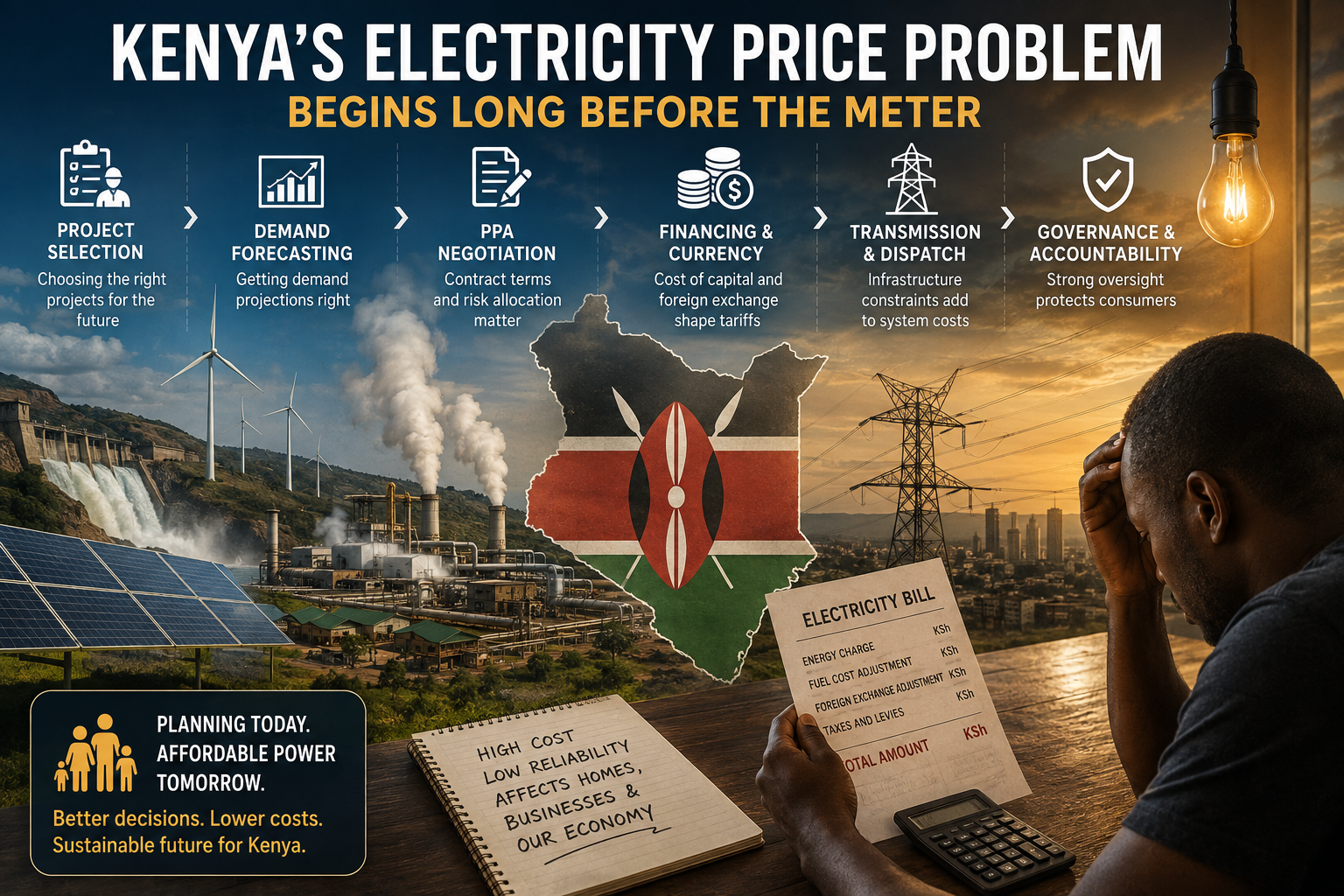
When Kenyan households and businesses complain about the cost of electricity, attention naturally turns to the monthly bill. Consumers see the energy charge, fuel-cost adjustment, foreign-exchange adjustment, taxes and levies, and conclude that the problem begins at the point of billing.
It does not.
The price ultimately paid by the consumer is substantially shaped years before electricity reaches a factory, office, hospital or home. It is influenced when generation projects are selected, when demand is forecast, when a power purchase agreement is negotiated, when financing is denominated in a particular currency, and when responsibilities for transmission, dispatch and grid stability are allocated.
Kenya’s electricity-pricing challenge is therefore not merely a tariff problem. It is a planning, contracting, infrastructure and governance problem.
That distinction is particularly important today. In March 2026, Kenya Power submitted a retail electricity tariff-review application to the Energy and Petroleum Regulatory Authority. The application was subsequently withdrawn, prompting EPRA to cancel the planned public consultations. The episode demonstrated that the structure and future direction of electricity pricing remain active national questions rather than settled matters. The withdrawal provides short-term relief from the proposed tariff changes, but it does not eliminate underlying cost pressures arising from the generation mix, contractual obligations under PPAs, transmission constraints and external factors such as fuel prices and foreign-exchange movements.
PPAs are necessary but their design matters
A power purchase agreement, or PPA, is a long-term contract through which an electricity buyer—usually Kenya Power in the Kenyan market—agrees to purchase power from a generating company.
PPAs are not inherently harmful. Power plants require substantial upfront investment, and lenders will normally finance a project only where there is reasonable certainty that the electricity produced will be purchased and that the project will generate enough revenue to repay its debt.
A properly structured PPA makes generation projects bankable, attracts private capital and allocates risks between the producer, the off-taker and the Government.
The difficulty arises when risk is allocated without sufficient regard for its eventual effect on the consumer.
Many conventional PPAs contain two broad payment components. The first is an energy charge based on the electricity actually delivered. The second is a capacity or availability charge intended to compensate the generator for keeping an agreed quantity of generation capacity available, even when all that electricity is not dispatched. Kenya’s standardised PPA framework for hydro, geothermal and gas-fired generation, for example, anticipates both capacity and energy charges.
Core distinction in Kenyan PPAs
Kenyan PPAs generally differ according to the characteristics of the generating plant and the procurement framework under which the project was developed.
Dispatchable plants such as thermal generation, geothermal and some hydro projects may have capacity or availability charges alongside energy charges. Thermal generation may also have a separate fuel component.
Variable renewable projects such as wind and solar have different contractual characteristics because their output depends on weather conditions. Under Kenya’s 2021 Feed-in Tariff framework, eligible projects are priced on an energy basis, with no capacity component. However, existing projects can have contractual provisions dealing with deemed generation, curtailment or grid unavailability, and individual PPAs should therefore not be assumed to follow one uniform structure.
Capacity payments may be necessary because generators incur financing, staffing, insurance and maintenance expenses regardless of whether their plants operate continuously. However, where capacity is contracted far ahead of actual demand, the utility may be required to pay for electricity that the system cannot economically absorb.
This is where take-or-pay provisions become controversial. They give investors revenue certainty but can transfer demand risk to the off-taker and, ultimately, to electricity consumers and taxpayers. The central question should not be whether all take-or-pay clauses should be eliminated. It should be whether the quantity contracted, the applicable tariff and the allocation of risk are supported by credible demand forecasts and least-cost planning.
Kenya’s demand is growing but planning must remain disciplined
The electricity-demand picture has evolved since the national debate over excess capacity intensified several years ago.
Kenya Power reported a new national peak demand of 2,439.06 MW on 4 December 2025. During the financial year ending June 2025, the company connected 401,848 new customers, while industrial consumers accounted for more than half of the electricity units sold. Total electricity sales reached 11,403 GWh, representing an increase of 8 per cent from the previous year.
This growth is positive. It means that some of the generation capacity once described as excessive may increasingly be required as the economy expands, new consumers are connected, electric mobility develops and more households and institutions adopt electric cooking.
Nevertheless, rising demand should not be interpreted as permission to contract generation indiscriminately.
Power planning must distinguish between installed capacity, dependable capacity, available capacity and electricity that can actually be evacuated and consumed at a particular time. A megawatt installed in a distant location is not automatically a megawatt available to an industrial consumer in Nairobi, Mombasa or western Kenya.
Plant availability, hydrological conditions, transmission constraints, renewable-energy variability, scheduled maintenance and system reserve requirements all influence how much installed capacity can be relied upon.
Kenya therefore requires regularly updated one-year, five-year and longer-term demand projections. Generation procurement must be aligned with those forecasts, the transmission-development programme and realistic commissioning dates.
Poor coordination can result in a power plant being completed before the necessary transmission line, substation or system reinforcement is available. Consumers may then pay for capacity that cannot be fully evacuated, while the country continues experiencing localised shortages and unreliable supply.
Foreign-currency PPAs remain a major source of uncertainty
One of the most important weaknesses in Kenya’s electricity market is the mismatch between the currencies in which many PPAs are denominated and the currency in which Kenya Power earns most of its revenue.
Electricity consumers largely pay their bills in Kenya shillings. However, several generators have contractual payment obligations linked to the US dollar, euro or other foreign currencies because their projects were financed internationally.
When the shilling weakens, Kenya Power requires more shillings to meet the same foreign-currency obligation. The resulting cost may be reflected in the foreign-exchange adjustment charged to consumers.
The reverse is also true. Kenya Power reported that its power-purchase costs decreased by KSh5.94 billion during the 2024/25 financial year, partly because stability in the shilling reduced the cost of obligations under foreign-currency-denominated PPAs. This improvement illustrates how directly currency movements can affect power-purchase costs.
Foreign exchange is not fully controllable by either the generator or the off-taker. Allocating all the risk to one party may therefore create instability.
The Kenya shilling has also experienced a substantial long-term depreciation against the US dollar. The average exchange rate was about KSh51.4 per US dollar in 1995, compared with approximately KSh129 per US dollar in 2025. On those annual-average figures, the number of shillings required to buy one dollar increased by roughly 2.5 times.
The comparison with 2008 is similarly instructive. The shilling averaged about KSh69.2 per US dollar in 2008, while the exchange rate was around KSh129.4–129.5 per dollar in 2026. Using those reference points, one US dollar costs roughly 1.9 times as many shillings today as it did on average in 2008. Because the figures represent different reference periods, the comparison should be understood as an indication of the long-term movement of the currency rather than a like-for-like annual comparison.
Future PPAs should consider a more balanced combination of local-currency financing, currency hedging, partial indexation, clearly defined adjustment bands and caps on the foreign-exchange exposure transferred to the consumer. Government-supported projects should also demonstrate that every reasonable opportunity to raise domestic capital has been considered.
Kenya has growing pension, insurance, banking and capital-market resources. Increasing the local-currency component of infrastructure financing would not eliminate foreign-exchange risk, but it could reduce the degree to which electricity prices fluctuate with international currency movements.
Cheap generation is not enough without an efficient grid
Kenya has invested heavily in geothermal, hydro, wind and solar generation. According to the National Energy Policy 2025–2034, the country’s total installed electricity capacity—including grid-connected, captive and off-grid installations—stood at 3,811.6 MW in December 2024. Geothermal and hydropower accounted for substantial portions of this capacity.
However, the cost of generating electricity is only part of the final price.
Transmission congestion can prevent the system operator from dispatching the lowest-cost available generator. Under such circumstances, a more expensive thermal or peaking plant may be dispatched because it is located closer to the affected load centre or because it can provide system support that another generator cannot immediately supply.
The consumer then pays not only for electricity but also for the consequences of delayed transmission investment.
Investment decisions must therefore assess the cost of delivered electricity rather than concentrating solely on the tariff quoted at the power station. A generation project that appears cheap at the point of production may prove expensive after transmission reinforcement, curtailment, balancing and reserve requirements are included.
The national energy framework now envisages major transmission expansion, battery-energy storage and stronger regional interconnections. The Kenya National Energy Compact targets 8,000 kilometres of additional transmission infrastructure, 400 MW of battery-energy storage and an increase in cross-border electricity trading by 2030.
These investments will be essential as more variable renewable generation is introduced.
Wind and solar should not be rejected simply because their output changes with weather conditions. Instead, new projects should be evaluated together with the cost of forecasting, storage, flexible generation, system reserves and grid reinforcement required to integrate them reliably.
System losses remain an electricity-pricing issue
Kenya Power reduced total system losses from 23.16 per cent to 21.21 per cent during the year ending June 2025. The improvement was attributed to smart-meter deployment, replacement of faulty meters, feeder upgrades and improved energy accounting.
This progress is welcome, but losses above 20 per cent still represent a substantial economic burden.
Losses include the electricity physically dissipated through conductors, transformers and other infrastructure, as well as commercial losses caused by illegal connections, defective meters, billing errors and unaccounted consumption.
Every unit generated but not successfully billed must still be paid for somewhere within the electricity value chain. High losses consequently increase the revenue that must be recovered from the electricity that is successfully sold.
Reducing losses is therefore comparable to developing a new source of generation, except that the recovered energy does not require a new power plant. Investments in adequately sized conductors, modern transformers, reactive-power compensation, network automation, smart metering and anti-theft enforcement can reduce the need for more expensive generation while improving the quality of supply.
Accountability must also extend across institutions. Where an electricity purchaser suffers contractual penalties because power cannot be evacuated following transmission failure, the responsibility should not automatically remain with the purchaser if the failed infrastructure is owned or operated by another entity.
Risk should follow responsibility.
Transparency is essential to restoring public confidence
PPAs often contain commercially sensitive information. That does not mean every material provision should remain hidden from the public.
Consumers are expected to meet costs arising from these agreements for periods that may extend for 20 years or longer. They therefore have a legitimate interest in understanding the obligations being undertaken on their behalf.
At a minimum, public disclosure should cover:
- the identity and ownership structure of the generating company;
- plant location, technology and installed capacity;
- the applicable energy and capacity charges;
- foreign-currency and inflation indexation;
- deemed-generation and curtailment provisions;
- government guarantees and contingent liabilities;
- termination obligations;
- environmental and social impacts; and
- the process through which the project was selected.
Disclosure would allow Parliament, engineers, economists, investors and consumers to evaluate whether projects are consistent with the country’s least-cost development plan.
It would also reduce speculation. Not every high-priced PPA is necessarily evidence of wrongdoing. Older projects may have been developed when technology, financing and perceived country risks were considerably more expensive. Transparency would allow legitimate costs to be distinguished from poor procurement, weak negotiation or unjustified expenditure.
Competitive procurement must replace negotiated capacity
Kenya’s earlier feed-in tariff framework helped attract renewable-energy investment when the market was less mature. However, the cost of solar, wind, storage and associated technologies has changed considerably.
Where sufficient investor interest exists, competitive auctions can reveal the actual market price more effectively than administratively determined tariffs or unsolicited proposals.
Kenya’s current policy direction is to operationalise renewable-energy auctions, open-access arrangements, bulk-supply regulations and standardised PPAs. The Renewable Energy Auctions Policy applies competitive procurement principles to solar, wind and other qualifying renewable-energy projects, while the 2021 Feed-in Tariff Policy was narrowed substantially towards smaller renewable projects.
The success of an auction, however, should not be judged by the lowest headline bid alone.
Bidders must demonstrate access to land, financing, grid connection, environmental approvals and the technical capacity to deliver. Unrealistically low bids can result in delayed or abandoned projects, forcing the system to procure emergency power later at a higher cost.
The objective should be the lowest credible lifetime cost of reliably delivered electricity.
Kenya must also create demand for the power it produces
Electricity affordability is partly influenced by how effectively existing infrastructure is used.
Power plants, transmission lines, substations and distribution networks are capital-intensive assets. When electricity demand is concentrated within a few hours of the day, the system must maintain capacity for the peak while leaving part of that infrastructure underutilised during off-peak periods.
Time-of-use tariffs can encourage industries, water-pumping installations, cold-storage facilities, electric-vehicle charging stations and other flexible users to shift some consumption to periods of lower demand.
Kenya should also deliberately grow productive electricity use through electric cooking, industrial heating, irrigation, agro-processing, refrigeration, Energy 4 Health, data centres and public transport.
Growing demand does not mean encouraging waste. It means replacing imported fossil fuels and inefficient traditional energy sources with productive use of locally generated electricity. Where electricity from Kenya’s predominantly renewable generation mix displaces fossil fuels or carbon-intensive traditional fuels, this can also contribute to greenhouse-gas emissions reductions and support the country’s climate and environmental objectives.
The National Energy Compact recognises productive use of energy as a driver of both economic development and utility revenue. It also notes the opportunity to use night-time electricity demand from electric mobility to improve utilisation of the power system.
The next generation of PPAs must protect both investment and consumers
Kenya still needs private investment in power generation. Public resources alone will not finance the generation, transmission, storage and distribution infrastructure required for industrialisation and universal access.
Investors must therefore be able to earn a reasonable, predictable return.
At the same time, bankability cannot mean transferring every commercial risk to the Government, Kenya Power and electricity consumers. Investors should retain the risks they are best able to manage, including construction performance, operational efficiency and compliance with declared plant availability.
The off-taker should be accountable for prudent demand forecasting, efficient dispatch and timely payment. Transmission companies should be accountable for evacuating contracted power. Regulators should ensure that procurement is competitive, costs are reasonable and contract variations are justified. Government guarantees should be transparent and limited to clearly defined risks that the private sector cannot reasonably absorb.
Kenya’s electricity price problem cannot be solved by targeting one institution or one category of producer. Neither Kenya Power nor independent power producers can be considered in isolation from the policy, financing, transmission and governance system within which they operate.
A well-designed PPA is not simply the agreement offering the lowest initial tariff. It is an agreement that produces affordable, reliable electricity throughout its lifetime, distributes risks fairly, supports grid stability and remains financially sustainable under changing economic conditions.
That is the standard against which Kenya’s existing and future power contracts should be judged.
About the author
Geoffrey Nagillah Makanga, P.Tech. Eng., CEM, is a professional civil engineering practitioner, certified energy manager and Nema Lead environmental and social safeguards consultant. He holds a BSc in Water and Environmental Engineering from Egerton University and an MBA in Strategic Management from United States International University-Africa. His experience covers renewable-energy resource assessment, hydropower design, energy auditing, environmental and social impact assessment, power-project transaction advisory and infrastructure development across East Africa. He has participated in the development and assessment of small hydropower, solar, floating solar, waste-to-energy and multipurpose water-infrastructure projects. Currently managing the civil infrastructure O&M of six operational SHPs for KTDA.
-
Product on sale
 AWEBook Volume 2Original price was: KShs 3,500.00.KShs 3,000.00Current price is: KShs 3,000.00.