
Last Updated 2 months ago by Kenya Engineer
For years, African governments have spoken about moving freight from congested roads back to rail. Traxtion is now placing private money behind that ambition.
The South African rail services company is investing R3.4 billion, approximately $210 million, in 46 locomotives and 920 wagons. Its chief executive, James Holley, told Reuters on 14 August that the company sees an opportunity in the combination of rising mineral production and policy reforms that are opening state-owned rail networks to private train operators.
The investment was first announced in December 2025, so the latest development is not a new order. What is new is the clearer regional strategy around it and the capital Traxtion has assembled to execute the plan. In June 2026, the company announced an $86 million equity raise involving STANLIB Infrastructure Investments, Standard Bank and existing investor Harith. Traxtion said the transaction completed the equity requirement for the rolling-stock programme.
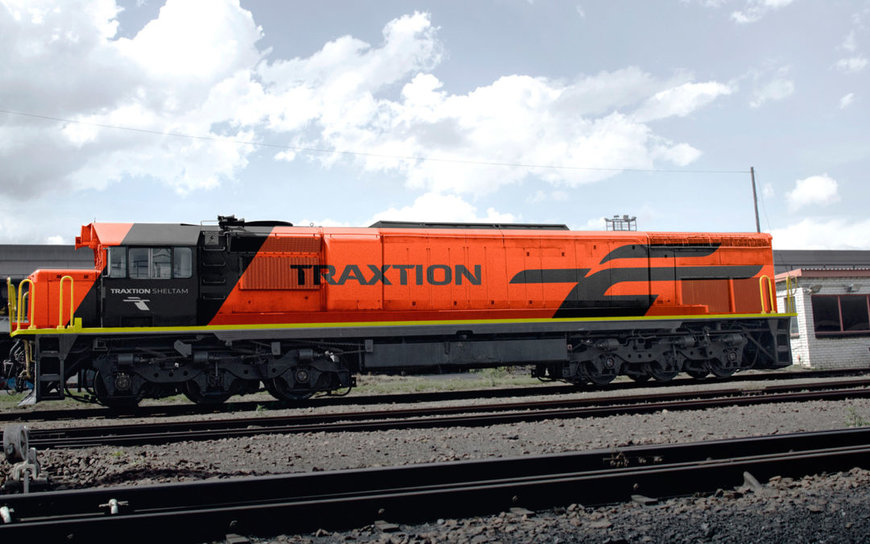
The fleet plan is technically and industrially significant. It includes 42 former KiwiRail U26C diesel-electric locomotives that are to be modernised to C30MEI specification and four C30-8MMI locomotives. Traxtion says the work will include new fuel-efficient engines, upgraded control systems, major servicing and repainting at its Rosslyn Rail Services Hub in South Africa. It has set a minimum local-content target of 60 per cent and projects 662 direct jobs during construction and deployment.
The delivery timetable is worth watching. In December, the company said the first upgraded units would roll out in the third quarter of 2026. Its June financing update said the first locomotives were expected to enter service in March 2027. Large fleet programmes often evolve, but the change illustrates why investment announcements should be followed through manufacturing, certification, network access and commercial operation.
Open access changes the railway business
Traxtion’s bet rests heavily on South Africa’s decision to separate infrastructure access from train operation. The rail network remains publicly owned, but qualified private operators can apply for paths, pay access charges and run their own trains under an agreed timetable and safety regime.
South Africa has moved beyond policy statements. In May 2026, the Transnet Rail Infrastructure Manager announced that 11 private train operating companies had been allocated slots across five strategic corridors. The allocations were expected to introduce 24 million tonnes of additional annual freight capacity, with potential to reach 52 million tonnes over five years. The national objective is to lift rail volumes from about 180 million tonnes to 250 million tonnes by 2030.
The model is attractive because it brings locomotives, wagons, operating expertise and private capital into a system whose infrastructure remains a strategic public asset. More traffic can also increase access revenue available for track maintenance and modernisation.
But open access is not privatisation by another name, and it does not remove the public operator. It creates a railway with multiple users competing for limited paths on the same infrastructure. That makes the quality of the network statement, tariff methodology and capacity-allocation system as important as the locomotives themselves.
Transnet released a draft fourth version of its Network Statement for consultation in July 2026, accompanied by documents on access agreements, the network register, capacity, ancillary services and performance indicators. The continuing revisions show that open access is a regulatory and engineering process, not a single policy switch.
Rolling stock cannot repair a corridor
A locomotive investment can address one constraint and expose the next. If the track has speed restrictions, signalling is unreliable, passing loops are too short, border procedures are slow or port terminals cannot receive trains, additional locomotives may spend more time waiting than hauling.
Private operators also need confidence that access charges will be predictable over the life of their equipment. A modernised locomotive is a long-lived asset; its financing case depends on secure traffic, usable train paths and a maintenance ecosystem that can supply components and skilled labour for years.
Safety regulation becomes more demanding as operator numbers increase. The infrastructure manager must coordinate timetables, possession windows and incident response across companies with different fleets and commercial priorities. Common rules are required for braking performance, communications, train integrity, axle loads and the reporting of defects. The commercial marketplace only works if the railway remains one technically coherent system.
These questions become harder across borders. Traxtion operates or sees opportunity in Angola, the Democratic Republic of Congo, Zambia, Mozambique and Zimbabwe. The wider investment landscape includes the 30-year Lobito Corridor concession, the planned $1.4 billion rehabilitation of the Tanzania-Zambia Railway and Zimbabwe’s $533 million rail modernisation programme.
Those projects are often described as mineral-export corridors, especially for copper and lithium. Yet a railway that only evacuates raw minerals can leave limited value along its route. The stronger development case is a two-way logistics system that also carries fuel, fertiliser, machinery, agricultural products and manufactured goods at reliable cost.
That requires border agencies, ports, dry ports and industrial zones to be planned as parts of the corridor rather than as separate projects.
What Kenya should take from the Southern African experiment
Kenya’s railway structure is different, but the underlying lesson is relevant. The 2026 Economic Survey reported that Standard Gauge Railway freight rose to about 7.33 million tonnes in 2025, generating KSh16.6 billion. Kenya Engineer has also tracked plans to extend the SGR from Naivasha through Kisumu to Malaba and connect with Uganda’s network.
The country’s immediate challenge is therefore not a simple shortage of train operators. It is to make the entire Mombasa-to-hinterland logistics chain perform as one system: port evacuation, SGR capacity, inland container depots, last-mile connections, interchange with the metre-gauge network and eventual cross-border continuity.
South Africa’s experience nevertheless poses useful questions. Is network capacity published transparently? Are access and haulage charges linked to service performance? Can large industrial users obtain predictable rail paths without disadvantaging smaller shippers? Are maintenance responsibilities and investment obligations clear? Could carefully designed third-party participation mobilise rolling stock and terminal investment without fragmenting operational control?
Open access should not be adopted simply because it is fashionable. A weakly regulated multi-operator railway can reproduce existing delays while adding disputes over capacity and responsibility. Conversely, a transparent access regime can draw private capital into locomotives, wagons, terminals and maintenance while keeping the infrastructure in public hands.
Traxtion’s R3.4 billion commitment will provide an unusually visible test. The first measure of success will not be the number of locomotives rebuilt in Rosslyn. It will be how many additional tonnes move reliably, at what cost, over infrastructure that is safer and better maintained as a result.
If that happens, the programme could help move African rail reform from conference language to an operating model. If it does not, the continent will have another reminder that rolling stock is only as productive as the system beneath and around it.
-
Product on sale
 AWEBook Volume 2Original price was: KShs 3,500.00.KShs 3,000.00Current price is: KShs 3,000.00.