
Last Updated 2 months ago by Kenya Engineer
For years, South Africa’s electricity story was defined by scarcity. In 2026, Eskom is trying to sell a different proposition: surplus power for one of the world’s fastest-growing industrial loads.
The Financial Times reported on 11 August that Eskom was courting large technology companies and data-centre operators as potential customers. The approach follows a sharp improvement in generation performance. In its official winter outlook published on 22 April, Eskom forecast no load-shedding from 1 April to 31 August and reported about 6GW of surplus peak capacity.
The utility attributed the margin mainly to a 5.2GW reduction in unplanned losses and 1.1GW from demand-side management. By mid-July it was reporting more than 400 consecutive days without rotational load-shedding. These are company figures, and the longer-term durability of the turnaround will still be tested by plant age, maintenance and demand growth. Nevertheless, the operating platform is materially stronger than it was.
From surplus electricity to exportable computation
A data centre converts electricity, cooling capacity, fibre connectivity and specialised equipment into computing services that can be sold across borders. That makes it attractive to a utility with spare generation: unlike many households, a large facility can provide a high, relatively steady load and a long-term revenue stream.
But the word ‘surplus’ can mislead. A seasonal reserve margin is not the same as firm capacity available every hour over a 15-year investment horizon. Data-centre developers will examine grid-connection times, the number of independent supply paths, voltage quality, outage history, restoration procedures and the carbon intensity attached to each megawatt-hour. They will also ask whether the network can support rapid load growth without constraining other users.
South Africa begins with scale. The FT said the country hosts the majority of Africa’s existing data-centre capacity and that Eskom has been engaging global cloud companies. The reported engagement should not be confused with signed supply deals. It is a competitive pitch whose success will depend on tariffs, connection certainty, fibre routes, permitting, land, skills and credible power guarantees.
The Kenya comparison
Kenya is developing its own proposition. Kenya Engineer reported in December 2025 that Airtel Africa’s Nxtra was building a 44MW data centre at Tatu City, planned to enter service in the first quarter of 2027. The facility is designed for cloud, artificial-intelligence and other data-intensive workloads. Konza Technopolis and Nairobi’s existing carrier ecosystem add to the country’s regional ambitions.
Kenya’s strongest energy card is geothermal. A high share of firm, low-carbon generation can be valuable to operators under pressure to account for the emissions associated with computing. New transmission assets, including the Isinya–Konza line, improve the physical platform for digital and industrial development.
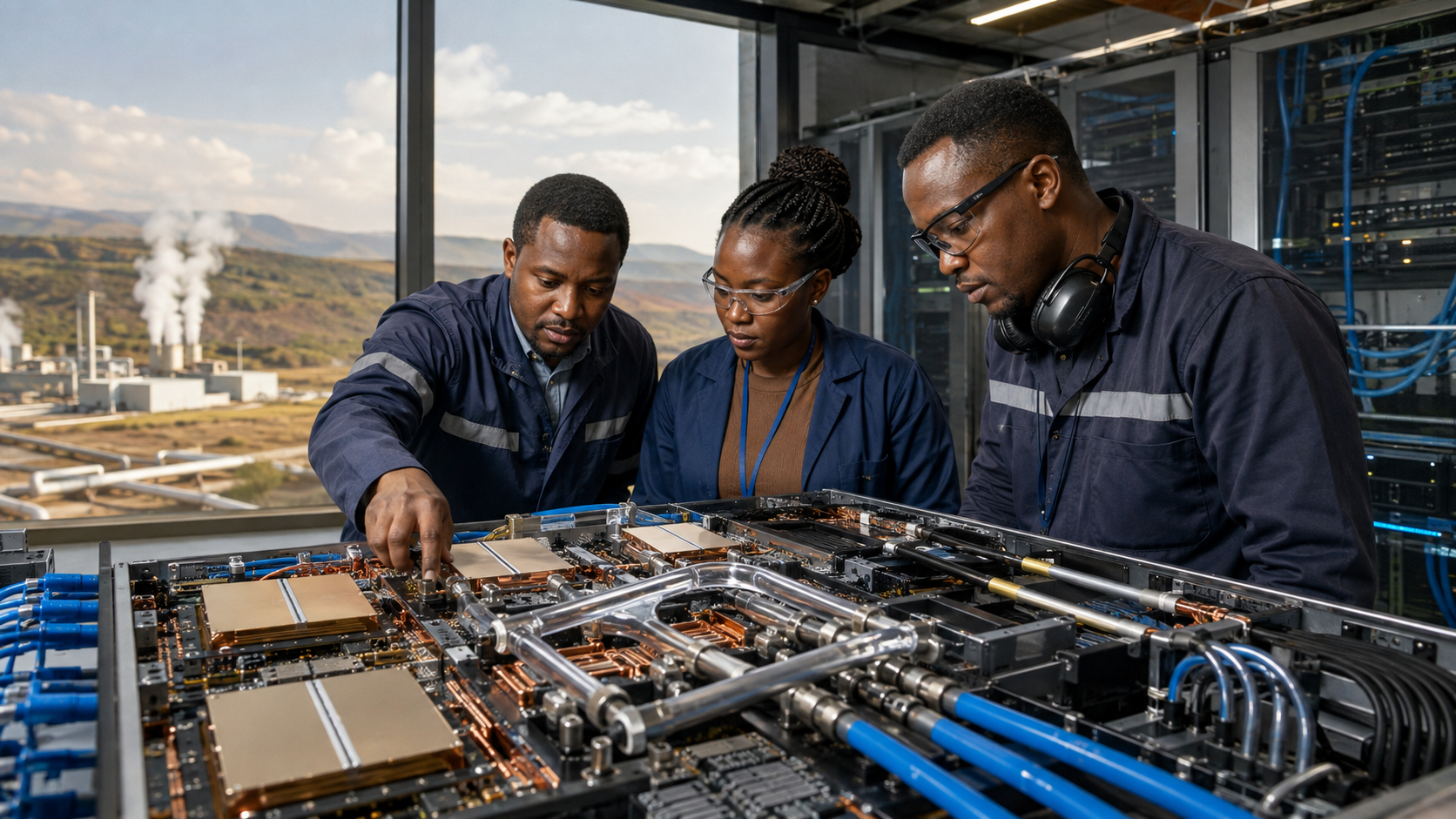
Yet there is no automatic geothermal dividend. A data centre needs redundant utility paths, onsite or contracted backup, high-performance cooling, secure fibre, water planning where evaporative systems are used, and a workforce able to operate electrical and thermal systems around the clock. Kenya Engineer’s recent coverage of battery storage, liquid cooling and predictive maintenance reflects how tightly these disciplines are now connected.
An industrial policy, not a prestige project
Governments are tempted to count data-centre megawatts as an end in themselves. The better measure is the productive ecosystem around them: local construction and commissioning, electrical and mechanical services, network engineering, cybersecurity, equipment maintenance, research access, cloud adoption by domestic firms and the availability of affordable computing for local innovators.
Power pricing must also be handled carefully. A special tariff that merely shifts network costs to other consumers would be difficult to defend. A well-designed anchor-load agreement, by contrast, could improve asset utilisation, support new transmission investment and provide predictable revenue—provided the contract is transparent about capacity, reliability obligations and cost allocation.
Water and land constraints should be resolved at planning stage, not after construction. Cooling technology, climate and workload determine water use, while backup generation and battery systems bring safety and environmental requirements of their own. These facilities are industrial plants, even if their product is digital.
Eskom’s pitch marks an important turn in Africa’s energy narrative: reliable electricity is becoming an input to the compute economy, not simply a service to be rationed. For Kenya, the response should not be a race for announcements. It should be a coherent power-to-compute strategy that turns geothermal strength, fibre connectivity and engineering capability into durable regional advantage.

-
Product on sale
 AWEBook Volume 2Original price was: KShs 3,500.00.KShs 3,000.00Current price is: KShs 3,000.00.