
Last Updated 2 months ago by Kenya Engineer
Solar power’s waste problem is easy to postpone because its equipment is designed to last. A module installed today may remain on a roof or in a utility field for 25 to 30 years, and sometimes longer. That time horizon is precisely why the rules and collection systems need to be designed now.
A Reuters industry briefing published on 11 August 2026 placed global solar photovoltaic capacity at 2.4 terawatts at the end of 2025—enough generation to serve more than one billion homes. The International Energy Agency expects solar to account for most of the renewable capacity added between 2025 and 2030. What looks like a distant waste stream is therefore being manufactured and installed at enormous scale today.
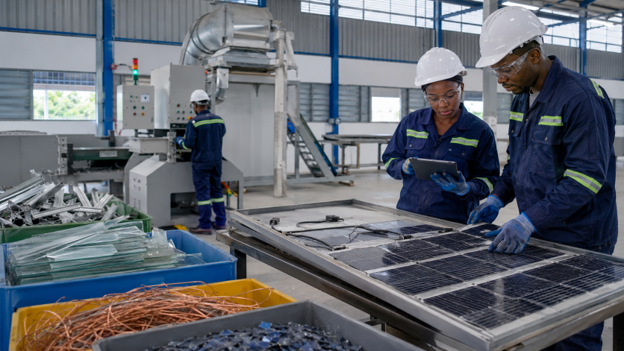
A solar module is mostly glass by mass, with an aluminium frame and smaller quantities of copper, silicon, silver and polymers. Some technologies also contain hazardous substances such as lead or cadmium. The frame and glass can be recovered relatively easily at basic facilities; separating high-purity silicon and silver from laminated cells is far harder.
Durability creates the recycling challenge
The engineering feature that protects a panel from moisture, heat and weather also makes it difficult to take apart. Cells are bonded inside a durable encapsulant. Shredding can recover bulk glass and metals, but it may downgrade valuable materials and lose the small, high-value fractions that could otherwise return to manufacturing.
IRENA forecasts a steep increase in end-of-life volumes as the installed base ages. Reuters cited a projection rising from 0.2 million tonnes in 2021 to 4 million tonnes in 2030, nearly 50 million tonnes in 2040 and more than 200 million tonnes by 2050. Forecasts this far out are uncertain: panels may last longer than assumed, while utility owners may also replace working modules early when newer equipment produces more power from the same land.
That uncertainty is difficult for recyclers. Current volumes are dispersed and often too small to justify dedicated plants, but investors need confidence that future material will be collected rather than dumped, exported informally or lost in general e-waste. Collection logistics can cost more than the recovered material when panels are scattered across thousands of roofs.
Kenya already has a legal starting point
Kenya’s Sustainable Waste Management (Extended Producer Responsibility) Regulations, 2024 provide an important foundation. NEMA says manufacturers and importers must take responsibility for the full life cycle of products they place on the market, register with a producer-responsibility scheme and meet EPR obligations. The regulations operationalise the polluter-pays principle.
The next question is how explicitly photovoltaic modules, inverters and related power electronics are handled in implementation. Solar equipment has long service lives, high upfront value and a mix of materials unlike ordinary consumer packaging. An effective scheme will need product registration, durable ownership records, take-back points, trained handlers and rules for testing modules that still have useful life.
Reuse should not become a loophole. A second-hand panel that can safely generate for another decade has value, particularly for lower-power applications. But imported or repurposed modules need electrical-safety testing, traceable performance data and a clear party responsible when they finally become waste. Otherwise Kenya risks becoming the last stop for equipment whose disposal costs were avoided elsewhere.
Design the market before building the plant
The first investment should be information. Kenya needs an inventory of installed modules by technology, approximate commissioning date, location and responsible owner. That data can support realistic waste forecasts and help determine whether one national facility, several collection hubs or a regional East African plant makes commercial sense.
Producer fees should reflect actual end-of-life cost and remain available when the panel is retired decades later. Pre-cycling provisions in procurement and power-purchase contracts could reserve funds upfront. Large solar farms can be required to submit decommissioning and material-recovery plans, while importers and manufacturers should finance collection for distributed systems.
There is also an industrial opportunity. Recovering aluminium, copper, glass and high-purity semiconductor material can reduce exposure to imported inputs and create specialised work in testing, logistics, materials science and process engineering. For any future Kenyan solar-manufacturing strategy, design for disassembly and access to secondary materials should be treated as competitiveness issues—not only environmental compliance.
The policy should remain proportionate. Solar waste is not a reason to slow deployment, and its material footprint should be compared honestly with the continuous waste and emissions associated with fossil energy. The sensible response is to preserve solar’s climate and access benefits while engineering out a future disposal liability.
Kenya has a rare advantage: the rules can be strengthened before the largest retirement wave arrives. Waiting until old panels are stacked in informal yards would turn a manageable materials stream into a public clean-up bill.

-
Product on sale
 AWEBook Volume 2Original price was: KShs 3,500.00.KShs 3,000.00Current price is: KShs 3,000.00.