
Last Updated 2 months ago by Kenya Engineer
A useful homeowner’s toolkit is not the largest box in the shop. It is a small, deliberate collection that solves frequent problems safely, accepts readily available consumables and remains dependable after years in storage. The best tool is usually the one that fits the fastener, material and risk – not the one that can be forced to do the job.
Kenya Engineer published a concise list of essential homeowner tools in 2024. This expanded guide keeps that practical foundation but adds what buyers most often need later: how to choose between similar tools, what not to do with them, how to maintain them and where the boundary lies between sensible home maintenance and work that requires a qualified trade professional.
Build the kit in three sensible stages
| Priority | Buy first | Why |
| Emergency basics | Torch/headlamp, plunger, adjustable wrench, screwdrivers, pliers, utility knife, tape measure and safety glasses. | Handles leaks, outages, loose fittings, packages and basic inspection without waiting for a full workshop. |
| Routine repairs | Hammer, spirit level, spanner set, drill-driver, bits, gloves, dust mask and step ladder. | Supports furniture, shelves, fixtures, wall mounting and planned maintenance. |
| Capability additions | Multimeter, voltage detector, hand saw, hacksaw, precision drivers, sockets and job-specific accessories. | Useful once the owner understands the task, limits and safe method. |
If the budget is limited, buy fewer sound tools rather than a 100-piece set padded with fragile duplicates and obscure sizes. A medium hammer, six good screwdrivers and three useful pliers will outwork a case full of soft metal. Before buying, hold the tool, operate its adjustment and ask whether replacement blades, bits, batteries or parts are available locally.
1. A claw hammer
A medium claw hammer covers driving and removing nails, light assembly and many everyday repairs.
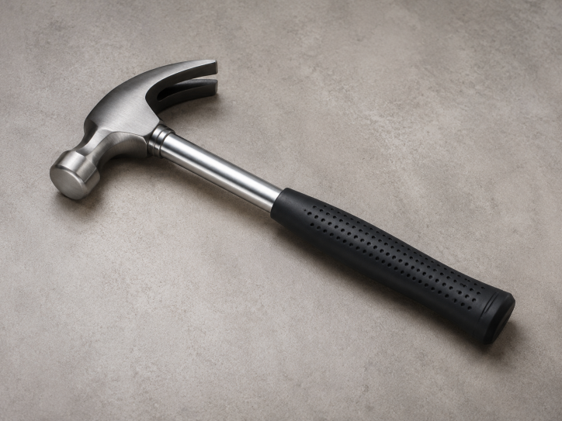
 A medium claw hammer is the first striking tool most homes should own. It drives nails, removes them with the claw, taps joints into place and helps with light demolition. For general household work, a head in the region of 450-570 g is usually controllable without being too light to work effectively.
Look for a smooth, slightly crowned striking face; a claw that is neither excessively thick nor needle-thin; and a handle that feels secure when your hand is dry or sweaty. Steel, fibreglass and hardwood handles can all serve well when properly made. Balance matters more than decorative features: hold the hammer near the end of the handle and check that the head does not feel as though it is pulling the tool sideways.
Use the flat face only on fasteners and suitable workpieces. A hammer is not a substitute for a spanner, and the side of the head is not designed for striking. Check periodically that the head is tight and the handle is not split. Wear eye protection when striking masonry, hardened metal or any brittle material, and never hit one hardened hammer face with another.
2. A proper screwdriver set
A useful set includes several flat and cross-head sizes; the right fit protects both the screw and the user.
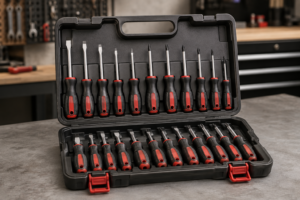 One damaged screw can turn a five-minute repair into an afternoon. The usual cause is not a weak screw but the wrong screwdriver. A useful starter set should include small, medium and large flat-blade drivers and common cross-head sizes. Add a precision set for spectacles, toys and electronics, and insulated screwdrivers only for electrical work within their certified rating.
The tip should fill the screw recess with minimal play. If the driver rocks, cams out or needs to be held at an angle, stop and choose another size. Long shafts improve access; short stubby drivers help in cramped cabinets. A magnetic tip is convenient but should not be treated as a holding device above people or delicate equipment.
Do not use a screwdriver as a chisel, pry bar, punch or mains-voltage tester. Wipe the shaft after use, replace rounded tips, and keep the correct bits with furniture and appliances whose fasteners are unusual. For electrical work, isolation and verification remain essential; an insulated handle alone does not make live work safe.
3. Pliers and cutters: three shapes, three jobs
Combination pliers, long-nose pliers and diagonal cutters perform different gripping and cutting tasks.
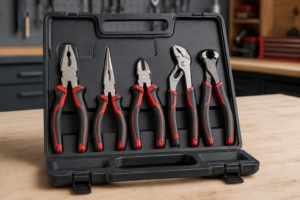 Combination pliers grip, twist and bend; long-nose pliers reach into tight spaces and hold small parts; diagonal cutters cut wire, cable ties and other appropriate soft materials. Buying these as a small trio is more useful than expecting one pair to perform every task badly.
Check that the jaws meet evenly, the hinge moves without excessive play and the cutting edges close cleanly. Handles should resist slipping. Handles that merely look insulated must not be assumed suitable for electrical work; genuine electrical tools carry a recognised voltage rating and still require safe isolation procedures.
Never use pliers on a nut that should be turned with a spanner: the serrated jaws will round the fastener. Do not cut hardened steel, live conductors or material beyond the cutter’s rating. A tiny drop of light oil at the joint and dry storage will keep the action smooth.
4. Spanners and adjustable wrenches
A small metric combination-spanner set plus a well-made adjustable wrench handles most accessible nuts and bolts.
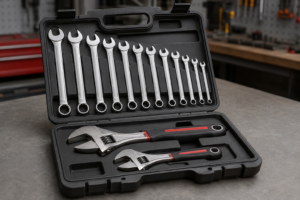 An adjustable wrench is convenient when the exact fastener size is unknown. A compact metric combination-spanner set is better when the size is known because it grips more securely and is less likely to round the corners. Homes with imported furniture, bicycles, motorcycles or appliances may also benefit from hex keys and selected sockets.
On an adjustable wrench, place the fixed jaw on the side that takes the greater force and keep the movable jaw snug against the fastener. Pull rather than push when possible so that a sudden release does not throw you forward. Do not extend the handle with a pipe unless the manufacturer designed the tool for it.
A fastener that will not move may be corroded, cross-threaded or carrying a load. Penetrating oil and patience are safer than uncontrolled force. Stop when pipes begin to twist, fittings deform or the work may release pressurised water or gas.
5. A tape measure and spirit level
Measure before buying, drilling or cutting; level before fixing permanently.
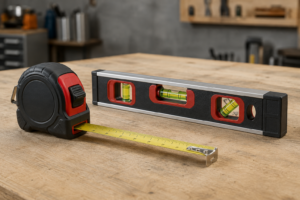 A 5 m metric tape measure is adequate for most rooms, furniture and repair work. A 400-600 mm spirit level helps install shelves, curtain rods, appliances and frames accurately. Together they prevent the most common DIY error: making a permanent hole before confirming the position.
Check the tape’s end hook; a small amount of movement is intentional because it compensates for inside and outside measurements. A bent hook, kinked blade or unreadable scale destroys accuracy. Retract the tape under control rather than letting the blade whip into the case.
Test a spirit level by taking a reading, rotating it end-for-end on the same surface and checking that the bubble returns to the same position. Do this occasionally, especially after a drop. Mark both the proposed fixing point and the hidden service risk: walls may contain electrical cables and water pipes even when the visible surface is clear.
6. A retractable utility knife
A retractable knife is safer and more useful than an exposed loose blade when used with discipline.
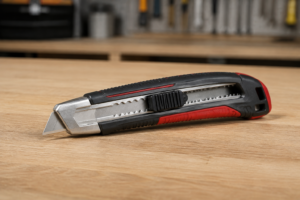 For opening cartons, trimming sheet material, cutting rope and scoring finishes, a retractable utility knife is cleaner and safer than improvising with a kitchen knife. Choose a rigid body, a positive blade lock and replacement blades that are readily available.
Extend only the amount of blade required, cut away from your body and keep the free hand out of the cutting path. Several light passes are safer and more accurate than one forceful pass. Use a stable sacrificial cutting surface; never cut toward electrical cables, pressurised pipes or a finished tabletop.
Retract the blade immediately after use and store the knife where children cannot reach it. Dispose of used blades in a rigid marked container, not loose in household waste. A sharp blade used correctly is safer than a dull one that demands excessive force.
7. A cordless drill-driver
A compact cordless drill-driver with the correct bits is the most versatile household power tool.
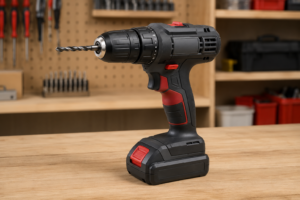 A cordless drill-driver speeds up furniture assembly, drilling and screw driving. For occasional home use, a compact 12-18 V platform with a keyless chuck, variable speed, reversible drive and adjustable torque clutch is usually more useful than a heavy high-powered machine.
Buy the bits for the materials you will actually encounter: high-speed-steel bits for suitable metals and plastics, brad-point or general wood bits, and masonry bits for brick or concrete when the drill has the required hammer function. Driver bits must match the screw recess. The accessory is often more important than the tool’s advertised torque.
Before drilling, check both sides of the work where possible and consider concealed cables, pipes and reinforcement. Clamp small workpieces; remove the battery before changing accessories; tie back hair and loose clothing; and wear eye protection. A drill-driver is not a substitute for a rotary hammer on hard structural concrete, and drilling structural members without understanding them can weaken the building.
For battery longevity, avoid storing a depleted pack for months or leaving it in extreme heat. If you expect to add tools later, a common battery platform can be economical – provided the brand has genuine local batteries and after-sales support.
8. A non-contact voltage detector and a digital multimeter
Electrical test instruments support diagnosis, but they do not turn an untrained user into an electrician.
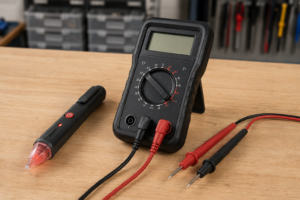 A non-contact detector is useful for an initial indication that alternating voltage may be present. A digital multimeter can measure voltage, resistance and continuity when it is correctly selected and connected. These tools help a competent user check batteries, fuses and simple isolated circuits, and they help describe a fault accurately to a technician.
They also create false confidence. A non-contact detector may respond to induced voltage or fail because of shielding, orientation, a flat internal battery or an incorrect sensitivity range. A multimeter placed in the current socket and then applied across the mains can create a short circuit. Meter category rating, fused inputs, lead condition and correct range selection matter.
For household mains work, switch off at the correct isolator, prevent accidental reconnection and prove your tester on a known source before and after checking the circuit. If you do not understand those steps, use the instrument only on low-voltage items and call a licensed electrician. Never open a distribution board merely because you own a multimeter.
9. A hand saw and a hacksaw
A wood saw and a tensioned hacksaw cover many light cutting jobs without the risk and cost of a power saw.
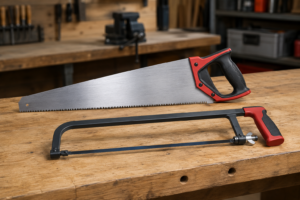 A medium general-purpose hand saw handles timber and board; a hacksaw cuts suitable metal and plastic. The tooth pattern, not the shape of the handle, determines the material and finish. Fine teeth give a cleaner but slower cut; coarse teeth clear soft material quickly.
Support the work on both sides of the cut without trapping the blade. Mark a clear line, begin with light strokes and keep hands away from the path. Hacksaw teeth usually face the direction of the cutting stroke specified by the frame design, and the blade should be tensioned firmly without being forced beyond its limit.
Replace kinked, cracked or badly dulled blades. Protect the teeth in storage and remove resin or metal filings after use. Powered saws deserve separate training, guards, hearing protection and dust control; they are not simply faster versions of hand tools.
10. A plunger and a pipe wrench
A plunger clears many simple blockages; a pipe wrench is for appropriate threaded metal pipe, not every plumbing fitting.
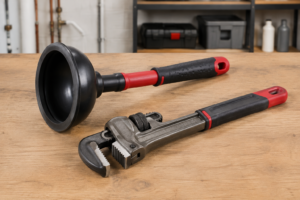 A cup plunger belongs in the home before a blockage occurs. Used with enough water to seal the cup and steady controlled strokes, it can clear many sink and floor-drain obstructions without chemicals. A toilet often needs a flange-style plunger shaped to seal the outlet more effectively.
A pipe wrench grips round threaded metal pipe through serrated jaws. Those jaws can destroy chrome taps, plastic fittings, compression nuts and decorative surfaces. For modern household plumbing, an adjustable wrench, water-pump pliers and the exact valve or fitting tool may be more appropriate.
Know the main water shut-off valve and test that it operates before an emergency. Stop work if a pipe disappears into a wall and begins twisting, if a valve will not isolate, if sewage is backing up broadly, or if the work involves gas, a water heater safety device or a pressurised storage vessel.
11. A torch and headlamp
A headlamp keeps both hands available; a torch is quicker for inspection and emergencies.
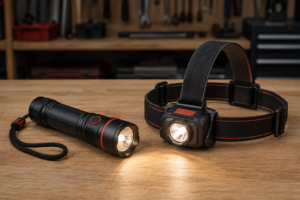 Good lighting is a safety tool, not a convenience. A handheld LED torch is ideal for inspection and outages; a headlamp keeps both hands free under sinks, inside ceiling spaces and around a vehicle. Choose common batteries or a rechargeable format with clear remaining-charge indication.
Store the light where it can be found in darkness, not at the bottom of the toolbox. Test it monthly and keep a second source available when working where a failure would leave you trapped or exposed. Do not depend on a phone whose battery may already be low during a blackout.
In dusty or wet locations, select an appropriate ingress-protection rating. Around fuel vapour or other potentially explosive atmospheres, ordinary consumer lights may be unsuitable; intrinsically safe equipment is a specialist requirement.
12. A stable step ladder
A stable, fully opened step ladder is safer than chairs, stacked boxes or improvised supports.
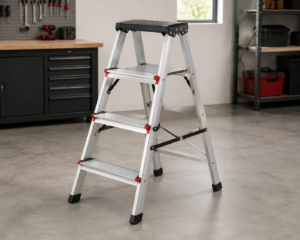 Many household injuries begin with the sentence, ‘It will only take a minute.’ A compact step ladder with broad treads, sound hinges, locking spreaders and non-slip feet is safer than climbing on a chair, bed or stack of blocks.
Inspect the feet, rivets and locks before use. Open it fully on a level, firm surface; face the steps; keep your belt buckle between the rails; and maintain secure contact. Do not stand on a top cap that is not designed as a step, lean sideways to extend reach or place a metal ladder near exposed electrical conductors.
Roof access, exterior work at significant height and work above a stairwell require more than a taller household ladder. They may require fall protection, correct ladder angle, an assistant and professional competence. The ability to reach a fault does not make the repair safe.
13. Personal protective equipment
Eye, hand, respiratory and hearing protection should match the hazard and the tool being used.
 Safety glasses, work gloves, suitable dust protection and hearing protection should be bought with the tools, not after an incident. Clear impact-rated glasses are the everyday minimum for drilling, cutting and striking. Goggles seal better against fine dust or splashes. Gloves improve grip and protect from abrasion, but they can be dangerous near rotating machinery that may catch loose material.
A simple nuisance-dust mask is not protection against asbestos, toxic chemicals, solvent vapour or all construction dust. Respiratory protection must match the contaminant and fit the wearer. Similarly, household gloves are not automatically electrically insulating or chemically resistant.
PPE is the last line of defence. It does not make an unsafe method acceptable. Control the energy, isolate the supply, secure the workpiece, ventilate or capture dust, and use the right tool before relying on what you wear.
Small additions that make the main tools more useful
A toolkit becomes far more capable with a small, organised stock of consumables. Keep common screws, nails, washers and wall plugs in labelled compartments; include PTFE thread-seal tape for suitable threaded plumbing connections, cable ties, a pencil or permanent marker, masking tape, sandpaper, a small brush, light machine oil and clean rags. Keep drill bits and blades in their holders so the cutting edges do not damage one another.
Adhesive tape is not a permanent repair for damaged mains wiring, leaking pressurised pipe or a cracked structural part. Likewise, a wall plug must match the screw, the drill diameter and the wall material. Consumables are part of the engineering of a repair; they are not decorations added after the hole is made.
The toolbox is also a safety system
• Store sharp tools with blades retracted or covered and keep them inaccessible to children.
• Return each tool to a fixed location so an emergency does not become a search exercise.
• Keep steel tools dry; remove dust and corrosive residue before storage; lightly protect vulnerable joints and surfaces.
• Separate measuring and electrical-test instruments from heavy tools that may damage them.
• Remove leaking disposable batteries and do not leave lithium power-tool packs in extreme heat.
• Inspect extension leads, chargers and test leads rather than coiling damaged insulation out of sight.
• Maintain a simple inventory and replace consumed blades, fuses, batteries and PPE immediately after the job.
Common buying and DIY mistakes
• Buying by piece count instead of steel quality, fit, balance and replacement support.
• Using an adjustable wrench where the correct spanner or socket would grip better.
• Using a screwdriver as a chisel, a knife as a screwdriver, or pliers as a spanner.
• Drilling before checking alignment, wall material, concealed services and fixing type.
• Working on live electrical equipment because the repair appears small.
• Climbing on furniture because fetching the ladder feels slower.
• Continuing after a fitting, fastener or pipe begins to deform – a sign that the method or tool is wrong.
• Treating PPE as permission to proceed rather than asking whether the hazard can be eliminated.
• Attempting structural, gas, high-voltage, refrigerant, roof or major plumbing work without the necessary competence and approvals.
Know the line: repair, isolate or call
A homeowner should be able to isolate water and electricity, make a scene safe, document symptoms and carry out low-risk maintenance. That is valuable competence. The moment a task involves uncertain live conductors, a distribution board, gas, a load-bearing element, a pressurised vessel, refrigerant, sewage exposure, significant work at height or a repair whose failure could injure another person, the responsible tool is the telephone.
Calling a professional is not surrendering self-reliance. It is using judgment – the most important tool in the house.

-
Product on sale
 AWEBook Volume 2Original price was: KShs 3,500.00.KShs 3,000.00Current price is: KShs 3,000.00.