
Last Updated 2 months ago by Kenya Engineer
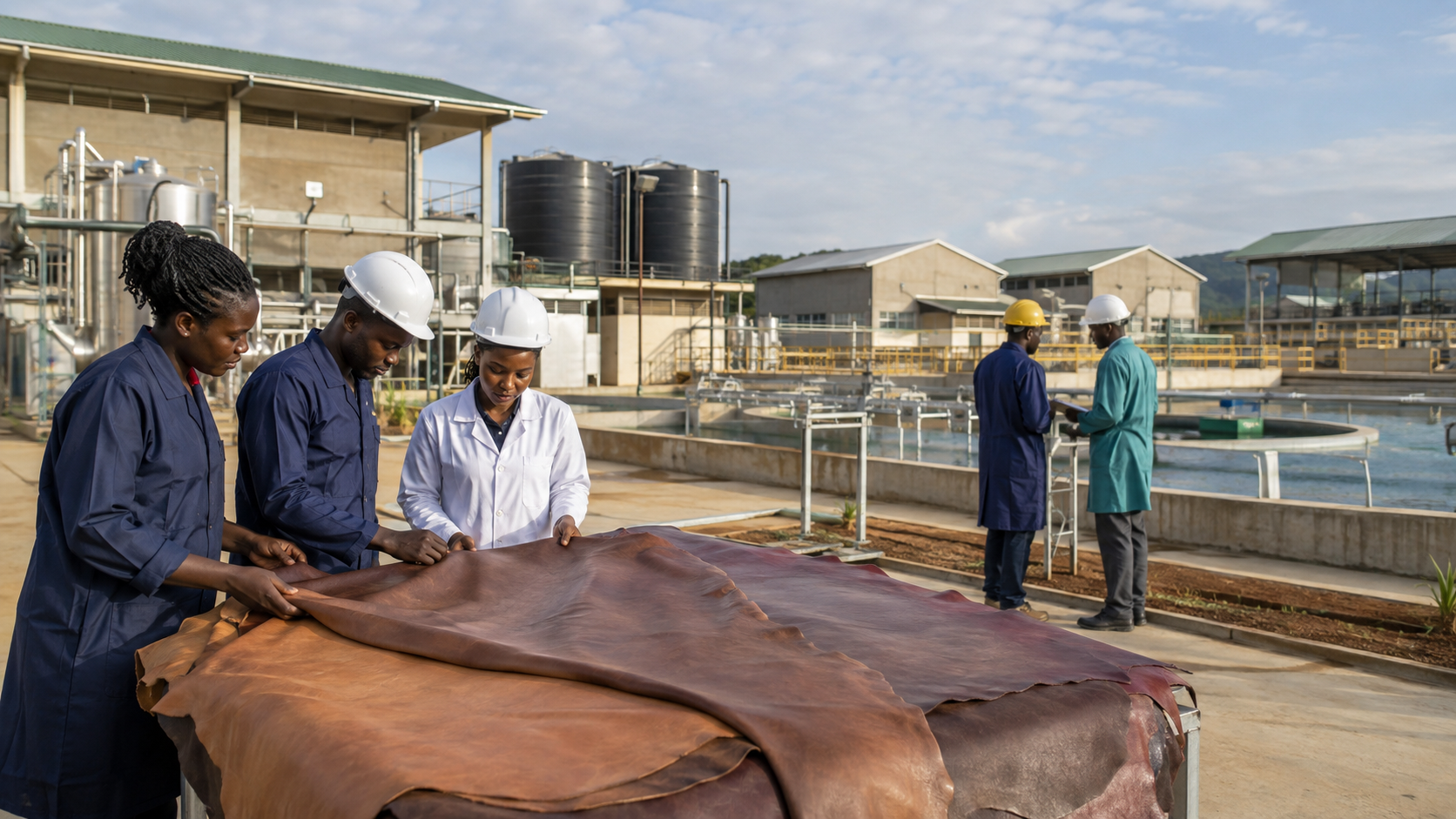
At an industrial park built around tanning, water is not a supporting utility. It is part of the production process.
That is what makes the commissioning of a Sh375 million water supply system at the Kinanie Leather Industrial Park in Machakos consequential. The project gives Kenya’s long-delayed leather manufacturing cluster a more credible path towards operation. It does not, on its own, guarantee that the park will become the industrial success imagined by its promoters.
According to the government, the project comprises two boreholes, a 25-kilometre transmission pipeline connected to the Mavoko water system and internal distribution infrastructure. It is currently delivering approximately 1.3 million litres a day and is intended to support as many as 36 leather manufacturers. Roads and electricity had already been provided, leaving water as one of the most pressing unresolved constraints at the park. (Government Advertising Agency, 7 August 2026)
The engineering achievement is substantial. Supplying a large industrial site consistently requires more than drilling boreholes: it involves source assessment, pumping, storage, pressure management, distribution, metering and provision for future demand. Reliability will matter as much as headline capacity because tanning plants cannot operate efficiently around unpredictable supply interruptions.
Yet Kinanie’s history offers a reason for measured optimism.
In August 2025, the Export Processing Zones Authority and Kenya Leather Development Council signed a lease agreement intended to end what the Ministry of Industry described as a ten-year institutional stand-off. At the time, the ministry said 36 investors were waiting to occupy tannery and warehouse space. A subsequent ministry update placed the number of interested investors at 40. (State Department for Industry, 5 August 2025)
Those numbers reflect interest, rather than factories in production. The distinction is important.
The government has also attached ambitious economic projections to the park. Official statements have suggested that Kenya’s leather industry could grow from about Sh15 billion to Sh120 billion annually and create more than 100,000 jobs. A separate announcement projected 200,000 jobs and a Sh130 billion contribution to gross domestic product by 2030.
These figures are institutional forecasts, not measured outcomes. Their variation between official announcements is another reason the park should eventually be judged through a published operating scorecard: occupied factories, hides processed, finished goods produced, jobs verified, exports earned and environmental standards achieved.
Water supply and wastewater are one system
The most important engineering question now is not merely whether Kinanie has water. It is what happens to that water after it passes through a tannery.
Leather processing can generate wastewater containing sulphides, salts, organic matter, ammonia and chromium, depending on the tanning method. A leather cluster without dependable effluent collection and treatment risks moving pollution from scattered facilities into one concentrated location.
The State Department for Industry reported in July 2025 that Kinanie’s common effluent treatment plant had been completed, while describing the wider development as 70 per cent complete. The next step should be independent confirmation of the plant’s operational capacity, commissioning tests, discharge compliance and ability to handle the waste load generated as tenants enter production. (State Department for Industry, 24 July 2025)
Treatment should also not become an excuse for inefficient production. UNIDO’s technical guidance shows that cleaner tanning methods can substantially reduce pollution before wastewater reaches a treatment plant. Depending on the process adopted, better chemical management can reduce chromium loads by about 90 per cent and make major reductions in sulphides, ammonia, chlorides and organic pollution. (UNIDO tannery-effluent guidance)
That makes cleaner production, chemical recovery, water reuse and process monitoring as important as the common treatment works.
From livestock wealth to industrial products
Kenya produces millions of hides and skins, but the value captured from them is limited when raw material is damaged, underused or exported before substantial processing. Kinanie’s promise is to connect livestock production, preservation, tanning, footwear, leather goods, design, machinery maintenance and export logistics within one industrial system.
That system will require more than physical sheds. Manufacturers need consistent-quality hides, trained leather technologists, footwear designers, laboratories, production engineers, access to finance and markets able to absorb the final products.
This is consistent with a long-running argument in the Kenya Engineer archive: industrial clusters work when infrastructure, skills, technology, finance and institutional coordination develop together. Buildings and utilities are necessary, but they do not constitute industrialisation by themselves. (Kenya Engineer: “Challenges to Industrialization and Manufacturing in Kenya”)
Kinanie has now crossed an important threshold. The water system removes a credible obstacle that investors could previously point to. The harder test begins when production lines start running.
Success will be visible when the park converts Kenyan hides into competitive shoes, bags, garments and industrial leather products while meeting water-quality and environmental obligations. Until then, Kinanie should be described accurately: no longer merely a stalled project, but not yet a proven industrial cluster.
-
Product on sale
 AWEBook Volume 2Original price was: KShs 3,500.00.KShs 3,000.00Current price is: KShs 3,000.00.