
Last Updated 2 months ago by Kenya Engineer
A robot completing a backflip makes excellent video. It does not necessarily make a useful factory worker. That gap between demonstration and dependable operation is the most important context for Unitree Robotics’ planned debut on the Shanghai Stock Exchange.
The Hangzhou-based company has priced its initial public offering at 150.8 yuan per share and is seeking to raise approximately 6.1 billion yuan, or $904 million. The offer values Unitree at roughly 61 billion yuan—about $9 billion—and is expected to make it China’s first mainland-listed humanoid-robot manufacturer.
Subscriptions opened on 10 August 2026. Unitree intends to use the proceeds for hardware and software development, new products and additional manufacturing capacity. Chinese artificial-intelligence company DeepSeek is among the strategic investors. Reuters reported the offer details and subscription timetable.
Founded by engineer Wang Xingxing in 2016, Unitree first built its reputation on relatively affordable quadruped robots. Its H1, G1 and R1 humanoid platforms later attracted global attention through demonstrations of running, dancing and martial-arts movements.
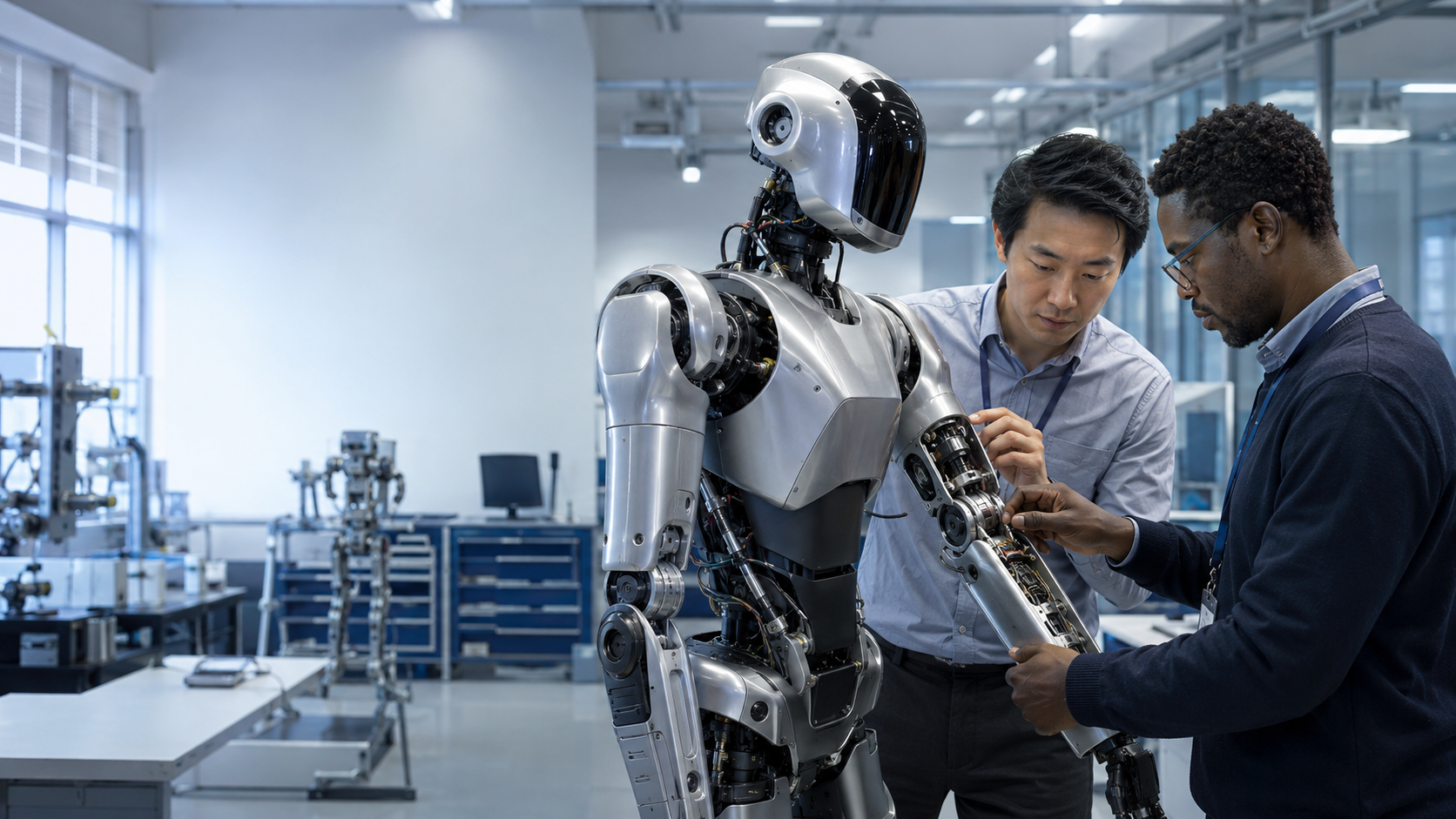
The spectacle can obscure the engineering. Dynamic locomotion requires precise coordination between joint actuators, inertial sensors, perception systems and control software. The machine has to estimate its posture, calculate the forces required to remain stable and correct its movement fast enough to avoid falling.
Unitree’s G1, for example, is about 1.32 metres tall and weighs roughly 35 kg. Depending on configuration, it has between 23 and 43 degrees of freedom. The smaller R1 weighs about 29 kg and starts at $5,900 before tax and shipping, according to the company’s published specifications. Unitree provides specifications for the G1 and R1 on its product pages.
China’s manufacturing advantage
Unitree’s significance lies partly in price. China has extensive domestic supply chains for electric motors, reducers, bearings, batteries, sensors, controllers and precision-machined components. A robotics manufacturer can source and iterate on many of these systems without importing every critical subsystem.
That advantage is beginning to appear in the company’s financial results. Unitree’s revenue rose more than fourfold to nearly 1.7 billion yuan in 2025. Humanoid robots generated about 867.8 million yuan and overtook quadrupeds as its largest business.
Unlike many humanoid start-ups, Unitree was profitable, recording adjusted net income of about 600 million yuan. More than 40 per cent of revenue came from overseas markets during the reporting periods disclosed in its prospectus.
There are signs of pressure beneath the growth. First-quarter 2026 revenue increased by 68.5 per cent, but profit excluding one-off items fell by more than half as spending on research and marketing increased. The IPO valuation is therefore a large bet on future demand as much as a reflection of present earnings. The Shanghai exchange reported 2025 revenue of 1.699 billion yuan and adjusted profit of 590 million yuan during its review of the application.
Movement is not yet general-purpose work
Humanoid robots remain unreliable at many tasks that people perform without thinking: handling unfamiliar objects, recovering from small errors, working safely around people and changing from one assignment to another without extensive retraining.
A machine may execute a rehearsed movement brilliantly while struggling to pick differently shaped components from an untidy container for an entire shift. Dexterity, endurance and consistent autonomous decision-making are still major constraints.
Current demand consequently comes largely from universities, research institutions, educational programmes and government-backed demonstration projects. Factory and household adoption is much less mature than promotional videos sometimes suggest.
For Africa, the immediate opportunity is unlikely to be wholesale replacement of workers. More realistic applications include robotics research, engineering education, inspection of hazardous or inaccessible environments and carefully controlled automation in manufacturing and logistics.
Universities could use lower-cost platforms to teach motion planning, sensing, control engineering and embodied artificial intelligence. Industrial companies may find value in quadruped or wheeled machines for repeatable inspection work before general-purpose humanoids become dependable.
Unitree’s IPO will give the company capital to close the distance between demonstration and deployment. Whether investors receive the returns implied by its valuation will depend on something less dramatic than a backflip: how often its robots can perform useful work, safely and without human rescue.
-
Product on sale
 AWEBook Volume 2Original price was: KShs 3,500.00.KShs 3,000.00Current price is: KShs 3,000.00.