
Last Updated 2 months ago by Kenya Engineer
For years, South Africa’s renewable-energy debate was dominated by procurement rounds and generation targets. The next phase is more physical: transformers, substations, connection corridors and the ability to move electricity from remote renewable resources to industrial consumers.
Industry projections suggest that utility-scale and commercial projects totalling slightly more than 5 GW could reach financial close during 2026. Based on prevailing project-development costs, that pipeline has been estimated at between R90 billion and R110 billion.
The figures were presented by Danie Möller, chief EPC officer at renewable-energy developer Mulilo. They are industry projections, not an audited government total, and some projects may close later than expected. Even so, the activity illustrates how quickly South Africa’s private electricity market is changing. Möller’s assessment was published by Engineering News on 6 August 2026.
Corporate power-purchase agreements and wheeling arrangements are allowing mines, manufacturers and other large users to buy electricity from privately developed plants. That has created a market alongside the government’s Renewable Energy Independent Power Producer Procurement Programme.
The change is producing work not only for developers, but for civil, electrical, structural and grid-integration engineers.
From modules to megavolt-amperes
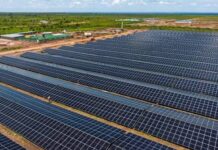
Mulilo’s Du Plessis Dam Solar PV2 project near De Aar in the Northern Cape offers a useful view of the construction scale involved.
The 105 MWdc facility has required the installation of nearly 170,000 photovoltaic modules. It is expected to supply industrial customers and generate roughly 248 GWh annually. Mulilo says the module installation was completed on programme and within budget, following a supply chain stretching from manufacturing facilities in Asia to the project site.
The more strategically important asset may be nearby. Mulilo has energised the Kestrel Main Transmission Substation, a new 400/132 kV installation developed under a self-build model. The substation is intended to serve four renewable projects with combined capacity exceeding 500 MW before being transferred to the National Transmission Company South Africa.
Developers undertaking transmission works is significant. It can shorten connection schedules, but it also demands compliance with the utility’s protection, control, telecommunications, quality and commissioning requirements.
Mulilo says it purchased a 500 MVA transformer months before it was needed on site. That decision tied up capital early, but reduced exposure to one of the industry’s most persistent risks: long manufacturing and delivery periods for major transformers.
Its account also demonstrates why solar projects should not be reduced to the price of modules. Roads, foundations, drainage, trackers, cabling, inverters, control systems, substations and transmission connections all have to arrive in the right sequence.
Generation can move only as fast as transmission
South Africa has some of its strongest solar and wind resources in areas far from the country’s traditional coal-based generation centres. Much of the transmission network was designed to carry power away from coal stations in the northeast, not to collect large quantities of renewable electricity from the Cape provinces.
The National Transmission Company has acknowledged that connection capacity in parts of the Eastern and Western Cape has been fully allocated. Its response includes controlled curtailment, through which generators can connect on the understanding that some output may be reduced when the network is congested.
The regulator has approved a four per cent curtailment framework that could increase hosting capacity in the two provinces from 5,625 MW to 7,205 MW by 2028. That would unlock an additional 1,580 MW, according to the transmission company’s grid-capacity update.
Curtailment is a useful operating tool, but it cannot replace physical expansion indefinitely. New lines and substations remain necessary if South Africa is to sustain private investment without accumulating generation that cannot be dispatched.
For Kenya, the lesson is direct. Competitive generation can attract capital quickly, but grid planning, land acquisition, transformer procurement and transmission construction move on longer timelines. Procurement for generation and planning for evacuation infrastructure must therefore proceed as one engineering programme.
South Africa’s private pipeline will ultimately be judged not by the capacity announced or financed, but by how much dependable electricity reaches customers.
-
Product on sale
 AWEBook Volume 2Original price was: KShs 3,500.00.KShs 3,000.00Current price is: KShs 3,000.00.